Can I Interest You in a Self-Riding Skateboard?
A quick test for whether AI is coming for something you love: picture the version that does it for you, and watch whether you feel relief or theft. A skateboard riding itself and a backyard beehive explain the rest.
Friends — how much of your skate session do you waste actually skateboarding?
Picture the infomercial. Same founder as last year, same good lighting, same plain t-shirt, but something behind the eyes has changed, a hint of desperation. Last year he stood on this stage and unveiled the GhostRider™, the bicycle that rides itself — no seat, no pedals, no handlebar, nobody aboard — and it took a smooth riderless lap to a standing ovation. Then the market asked the one question a launch never does: who pays four thousand dollars to skip a bike ride? The GhostRider did not sell.
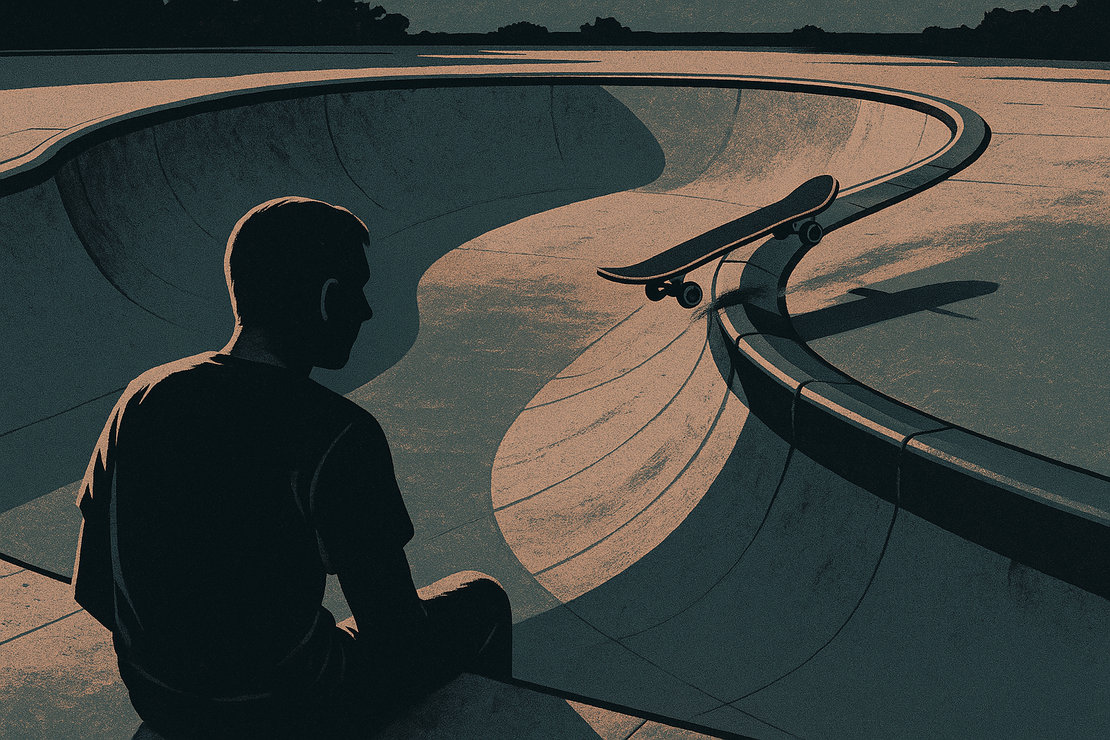
A lesser founder pivots. This one doubles down. He steps to the mic: “So tonight the cloth comes off the GhostRipper™: the world’s first fully autonomous skateboard. Set it down at the skatepark, step back, and let it go. Watch it drop in and slash a carve in the deep end of the bowl. Then it rolls out, pops a clean tre flip, and locks a 50-50 the length of the rail, switch stance, naturally. It rolls away from the trick you’ve been throwing yourself at for three years — first try, every try. No slams. No worn-out Vans. No nine months in a sling. You dreamed of landing it; now you don’t have to. Call in the next ten minutes and we’ll send a second board free, so a friend can not-skate beside you!”
I’d watch it to the end out of admiration for the nerve. The man looked straight at why the first one failed and built the same mistake a size smaller. Somewhere in the writing of the pitch the product ate its own reason to exist, and the room kept clapping anyway.
I told a version of this joke once already, about that self-riding bicycle. The bike at least started with a cover story. Bicycles really are transport as often as they’re recreation, so “we made riding effortless” sounds almost like a real pitch, right until you notice the way they made it effortless was to take the rider off, and an empty bike gets nobody anywhere. The alibi lasts about a second. A skateboard doesn’t get the second. People do commute on them, across campuses and downtowns, and good for them, but that’s not the board in the ad. The board in the ad is the one you drove to the skatepark to ride, whose whole existence is the bowl and the ledge and the rail. Nobody ever dropped into a bowl to commute to the other side of it.
The instrument
That is what makes the GhostRipper useful. The reason it reads as a joke instead of a product is diagnostic, and once you notice that, you can point it at anything you do. Take the thing, picture the automated version, and watch which way your gut goes. If the automatic version sounds like a gift, you were doing the thing to be done with it. For me that’s lawnmowing. But if you find relaxation in mowing, as many people do, and the robot mower feels like a small theft, then the doing was a big part of the point. Relief or loss: where the needle lands tells you what the activity actually was to you. The bicycle and the skateboard are the opposite of mowing for me, all joy in the doing, so I’ll keep doing the riding myself.
I gave the two cases names in the bicycle piece: a means is something you do to get an outcome; hand you the outcome and skip the doing, and you’ve lost nothing. You’ve likely gained time to spend on something else. An end is something where the doing is the entire point; skip it and there’s nothing left to hand you. The dishwasher is a mercy because clean dishes were always the point and the suds never were. The GhostRipper is a punchline because, at the skatepark, the suds were the entire point.
Here is why this is more than me taking shots at hokey founders with a launch-day gag. Whatever else artificial intelligence turns out to be, it is a machine for skipping the doing. It hands you the essay without the drafting, the image without the drawing, the working code without the afternoon of thinking and noodling. It is, precisely, a means-eater. It cannot touch an end, because an end has no separable outcome to deliver. There’s nothing to hand back.
So the question everyone keeps asking — is the machine coming for this? — has another one hiding inside it, one you can answer yourself without a forecast. Was this ever a means to me, or was it an end? The machine takes the first kind and leaves the second alone, not out of mercy but because there is nothing there for it to take.
Two proofs, one in the backyard
The skatepark is the easy proof, because the automatic version is absurd on its face. The harder, better proof was in my backyard.
You can buy honey for five dollars at the store. That jar is the self-riding skateboard of beekeeping: the outcome, handed over, the doing skipped, and it’s been sitting on the shelf the whole time. I kept bees anyway, for years, and bought the store jar too. Here’s the tell: I left almost all of what the hives made to the bees. I never ran the place as a honey factory, that was never my motivation. I ran it as a small science-and-ecology project I got to stand inside, in the back corner of a yard, and more often than not it was a losing fight, which is its own essay. The output was never the point. If it had been, I’d have run the numbers at the start, listened to the math, and either never started or quit the first winter a hive didn’t make it. I kept at it for years instead, cheerfully underwater the whole time.
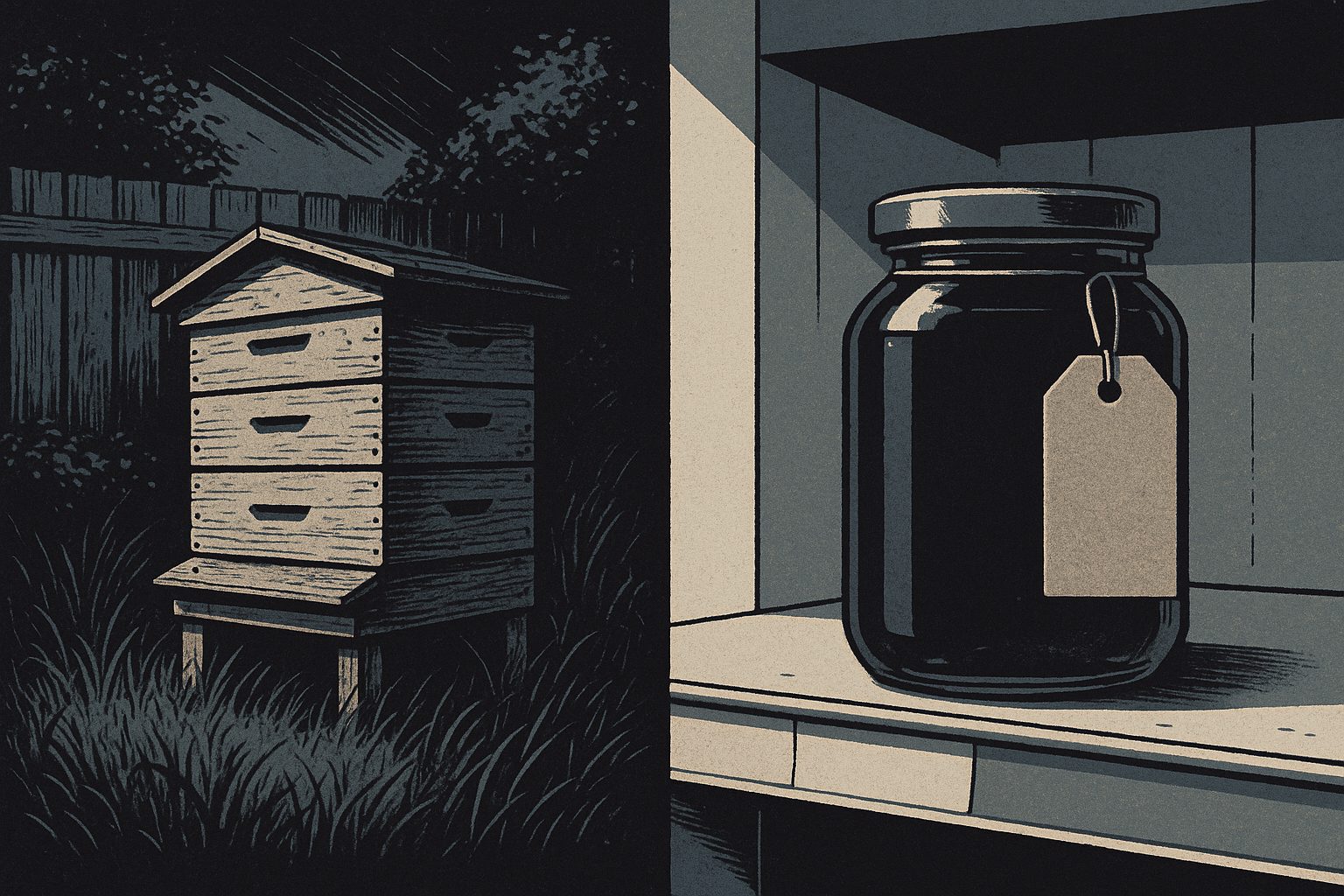 The same honey. One took years; the other took five dollars.
The bees present the cleaner ends/means case because beekeeping comes with a pre-automated alternative, and it’s called Publix. The convenient version already exists, costs almost nothing, and the hobbyist looks right at that jar of honey on the shelf and still keeps the bees. Nobody had to invent the means-eater for honey. The grocery store is the means-eater for honey, and millions of people decline it every weekend, on purpose, for the doing.
The part where it looks like I’m caught
Now point the instrument back at me, because it’s about to look like I’ve been had.
I wrote a whole manifesto about choosing the harder path. Then I spend my working days handing a language model my drafts, my boilerplate, the busywork. Pick the hard way, says the one guy; let the machine do it, says the same guy, in the next breath. That looks like hypocrisy you could drive a honey-loaded grocery truck through.
It isn’t, and the instrument is exactly why. The hard path I defend and the work I hand off sit on opposite sides of that line, and I sorted them there long before I had words for it. Take prose. I won’t pretend writing a sentence is drudgery, a dish to be washed and forgotten. I care how one lands, and I always have. But when I’m honest about what I’m there for, it’s the thought underneath: the argument, the thing I’m trying to say. The sentence is how I carry it, and building one clean on command is a craft I have the taste for and never fully owned, which is its own essay. So a model that drafts in a register I can hear is right doesn’t take the part I came for. It clears the labor between the thought and the page and hands the attention back, to spend on the thinking, and on shoving the prose around until it’s mine. The bike ride, the bowl, the bees are a different category: ends, entirely. A model that learned how to somehow ride my skateboard wouldn’t clear me of any labor I wanted to relinquish. It would take the only thing I’m there for.
Two distinctions are doing the work there, and they’re worth separating before they blur. The first is means against ends: is the doing the point, or only the outcome? The second is taste against craft: the judgment that knows what’s right, and the hands that can make it on demand. They aren’t the same thing, and they don’t stay aligned. Grinding a corner in a skateboard bowl is an end built entirely of craft — no voice in it, nothing for a machine to take — and it’s the thing I wouldn’t hand over even if I could, because there the doing was everything. Prose sits somewhere toward the other end of the spectrum: a craft I’m happy to have help with, kept honest by a taste I keep as my own.
We Already Voted With Our Lives made this same argument inside a single cockpit: the autopilot flies the plane, the pilot keeps the judgment, and we all board without a second thought. Run the test wider and it sorts out into piles of do’s and don’ts, not just the parts of one task but the whole inventory of things you do with your hours. Some of them you’d hand a machine in a heartbeat and feel lighter for it. Some you’d sooner break the machine than let it touch. The line between those two piles is the most honest map of your values you’re likely to get, and the machine, by being so good at one pile and so useless at the other, is the thing that finally drew it for you. (The same instrument has a third application: what it does to the things you only ever watch other people do. That’s The Unwatchable Race.)
The line moves
It isn’t a fixed line, and it isn’t the same for everyone. Cooking is a means to me on a Tuesday and an end on the night I’m cooking for someone I love, and it’s a daily end for people who would never let a meal-bot near the stove. The same activity sits in different piles for different people, and shifts piles by the day. So the skill isn’t memorizing which things are ends. It’s the smaller, harder act of telling, for you, right now, which side a given thing is on — and not letting the answer get decided for you.
Because it will try to get decided for you. Much of modern life is optimized toward convenience, which only ever flows in one direction: toward means. Every product built to skip the doing is, underneath, an argument that the doing was a chore. Most of the time it’s right, and you should thank it. But it makes that argument about everything at once, the bowl and the bees and a dinner included, and if you take it at face value you will automate your way clean out of the parts of your life that mattered most to you.
So I keep the GhostRipper around as a thought, a cautionary tale of what happens if I don’t carefully guard my ends. The machine can have everything I was only ever doing to be done with. What’s left in my hands once it takes all of that — the things I’d smash it before surrendering — turns out to be a short, specific, faintly embarrassing list. It reads like a description of what I love. I didn’t sit down and write the list. I just watched what I refused to put down.