Courageous Cat
November 20, 2026
· by Michael Morrison
· 6 min read
Article 5 of 5 so far in


The walk under LL Cool J's I'm Bad is a cartoon theme from 1960, built in the shadow of Peter Gunn, replayed by the L.A. Posse in 1987. The record's secret is how short the notes are.
Ice-T took a shot at LL Cool J on “I’m Your Pusher,” and I led this whole project with that song, so it seems only fair to give LL some love with this bad little bass line. It’s a walk. Eight notes, up and back, under one of the loudest records of 1987. And it comes from a cartoon.
It’s also the line that taught me something I should have known going in: you can have every note right and still be wrong, if you hold them too long.
Bigger and Deffer
LL Cool J was nineteen when Bigger and Deffer came out in the summer of 1987, his second album for Def Jam and the one that made him the biggest solo rapper in the country. “I Need Love” was the hit everyone argued about, a rap ballad that got him called soft by people who’d been waiting for an excuse. “I’m Bad” came first, in June, and it was the opposite of soft. It was LL’s first single on the Hot 100 and a top-five R&B record, and it was built by the L.A. Posse, three producers from Los Angeles (Dwayne Simon, Bobby “Bobcat” Ervin and Darryl Pierce), working with LL himself.
Listen to what it’s built from and a theme shows up. The hook is the “Theme from S.W.A.T.,” the cop-show music Rhythm Heritage took to number one in 1976. There’s a siren, a real one, a Federal Signal Q2B, the kind on a fire truck. There’s a bit of LL’s own “Rock the Bells” and a riff from 7th Wonder’s “Daisy Lady,” and under all of it a bass walk that the Posse replayed rather than sampled. The record is a nineteen-year-old telling you how bad he is over the sound of the police arriving. And that walk, the oldest thing on the record by a long way, is police music too.
A cat in a cape
Courageous Cat and Minute Mouse was a syndicated cartoon from 1960, created by Bob Kane as a parody of his own Batman: a cat and a mouse in capes, a cat-signal, a gun that did whatever the plot needed. The episodes were five minutes long and there were a lot of them. The theme, by Johnny Holiday, was a slinky walking line, the kind of thing every TV detective show used after Henry Mancini’s “Peter Gunn” made it the sound of danger in 1958, a job it was still doing in 1983 under the arcade game Spy Hunter. A crime-show walk, under a cat.
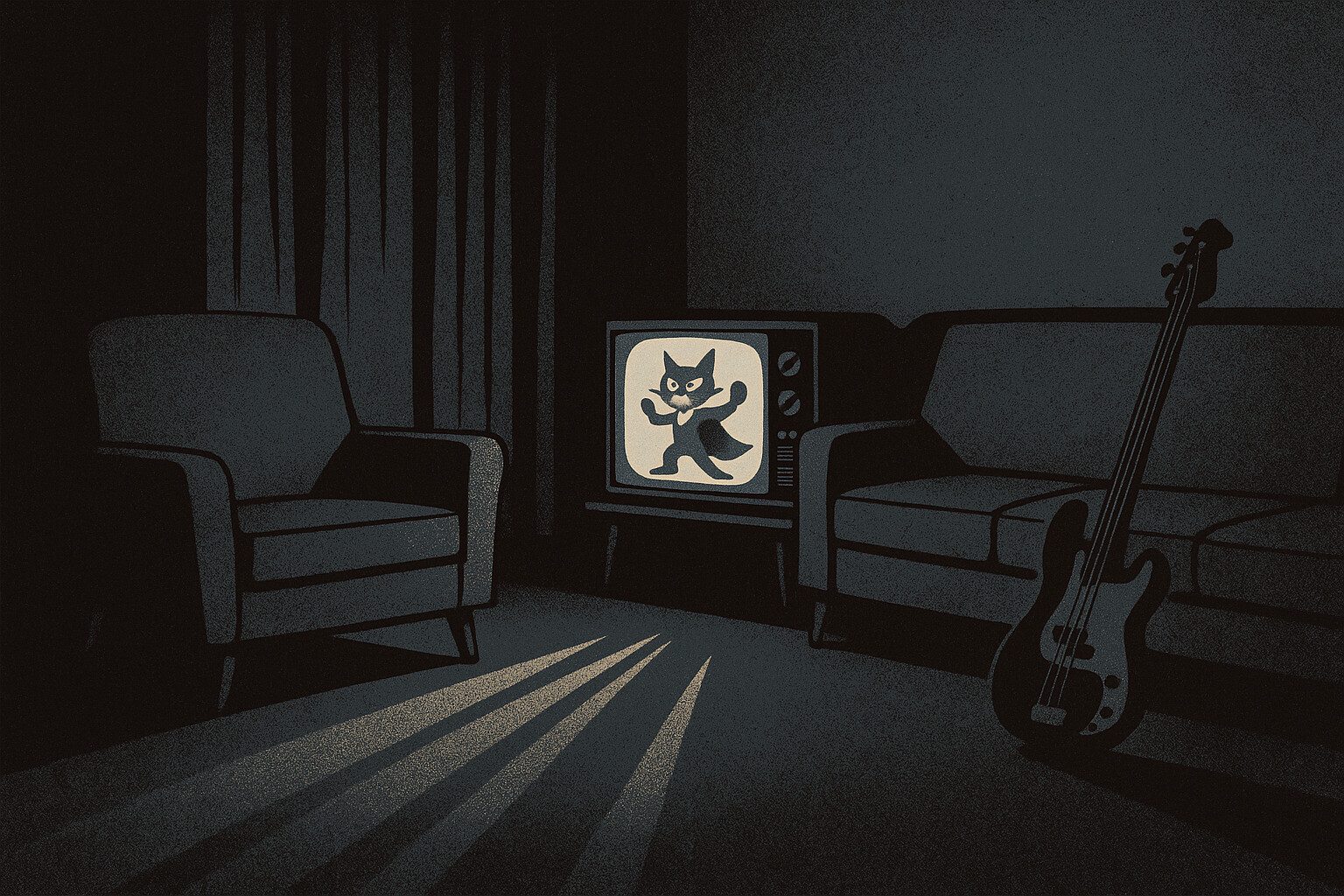 The walk is a cartoon theme from 1960, in the shadow of Peter Gunn.
Put the two next to each other and even I can hear the family resemblance. “Peter Gunn” creeps up and down a step or two at a time. The Courageous Cat theme takes a different route: up and straight back down, with one sour note squeezed in on the way. Twenty-seven years later the L.A. Posse took that route, slowed it to a hip hop tempo and dropped it lower, and LL rapped over a cartoon cat’s theme song about how bad he was. He wasn’t the first musician to find it funny. The New York Dolls opened their shows with the theme in 1973, and their studio take sat in a vault until 1994, which tells you it was already a musicians’ in-joke when LL was five.
The Syndicate
I told part of this story in Six Notes Down. Ice-T mocked this song’s hook on “The Syndicate,” on the same album as “I’m Your Pusher,” LL answered in 1990, Afrika Bambaataa settled it, and both of them spent decades playing cops on television, LL for fourteen seasons as a federal agent on NCIS: Los Angeles. The kid who rapped over a siren and a cop-show theme grew up to be the guy the siren was for. The line I’m playing here is the one Ice-T made fun of, which is as good a reason as any to learn it.
The line
The notes were right and the line was wrong
I had the notes for a week before I had the line. It’s a short walk up and back down, and the tab I started from wrote it as eight even notes to the bar. I played it exactly as written, and it sounded like someone describing the record rather than playing it. Thick. Smeared. The record with a blanket over it.
The fix was length. Every note on the record is clipped, there and then gone, and the moment I eased each one off before the next landed, it snapped into place. Same eight spots. Half the sound. That’s the lesson I keep relearning on this project: a tab tells you where the notes start, and the line is also where they stop.
The uke bass
I play it an octave up from the record, which trades some low end for a hand that never has to move, and on a short neck that’s a trade worth making. The plucking hand gets no such break: eight notes a bar, every bar, each one the same length and cut off clean. The play-along at Tiny Bass Lines will slow the record down until they are.
The siren and the S.W.A.T. hook pin the record to 1987. The walk is eight years older than LL and still the same route: eight notes, up and back, each one stopped before it has a chance to hang around. Ice-T got the first post. LL gets the walk.

This is one of the Tiny Bass Lines: favorite bass lines, a few notes each, learned by a beginner on a ukulele bass and played on the coping of a mini ramp. Each essay is the story behind one line.
The notes, where your fingers go, how to read the notation, a drum loop to play along with and a printable sheet for “I'm Bad” are at tinybasslines.com/im-bad.