Everybody Can Dunk Now
In basketball, height stands in for skill often enough that nobody bothers questioning it. AI is height anyone can rent, and the tape measure is coming for every sport at once.
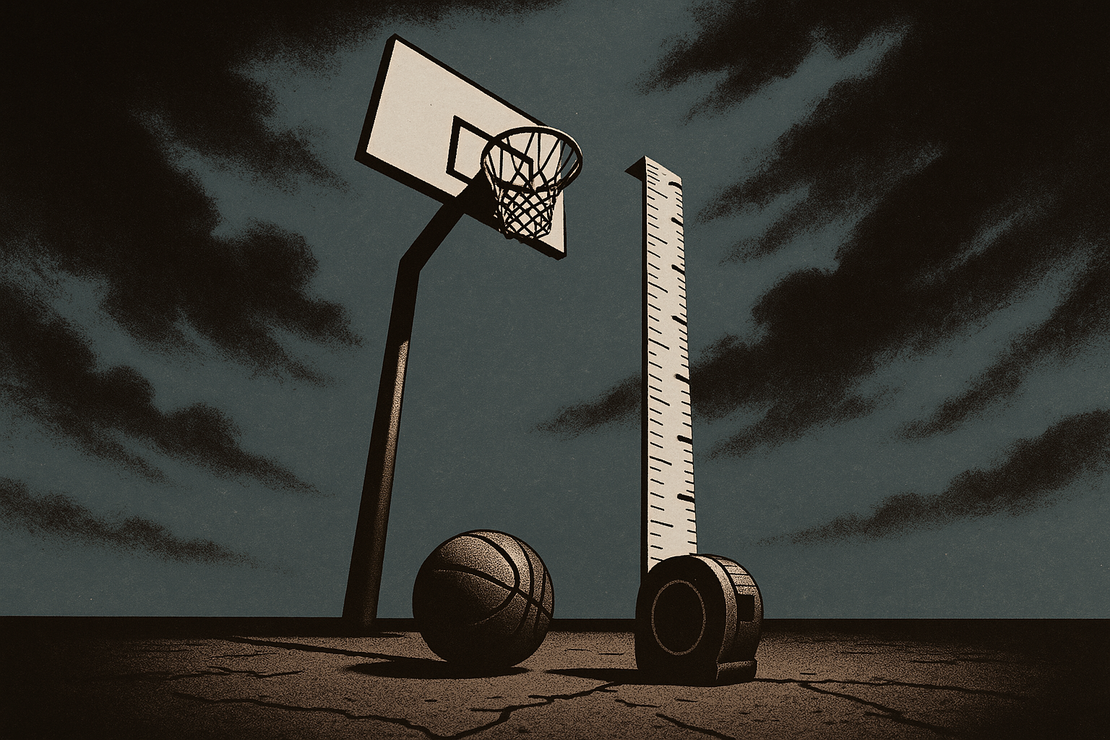
Basketball tryouts run on a piece of equipment nobody talks about, and it isn’t the ball. It’s the tape measure.
I was five foot two through junior high and all of high school. I was also, and I say this with the easy confidence of a man decades past having to prove it, a good young athlete. I loved to practice, and worshipped hustle. That was the part people who grew up tall never quite believed — practice was the good part of the day. Driveway, gym, playground, whatever was open. I wore out several front storm doors practicing catching baseball ground balls thrown at the stairs to catch them on the return at odd angles, and occasionally one would catch the stair corner and smash into the door. Wham! My parents tolerated it I guess because they recognized the work ethic. Years of that, the ten thousand hours Malcolm Gladwell would later teach everybody to count, and I was happy to spend them.
A friend of mine was a foot taller. He had never played basketball. Not in a rec league, not in a driveway, not at all. He tried out, and he made the team I got cut from. I still remember him excitedly telling me he made the team I couldn’t, and having to feign excitement. I was happy for my friend but it was brutal. And I still went home and shot baskets. None of this was a scandal. At six foot two, what the roster needed from him was basic coordination and the ability to follow instructions. The sport-specific skill I’d spent years building — the thing I believed was the whole game — was, for him, optional equipment. It could be taught later, to the degree it was even needed given his natural advantage, at the team’s convenience.
The curve
Basketball was and still is very much a meritocracy. Sports are the most honest meritocracy we run, if you’re good enough. What height does is quieter than rigging: it stands in for skill. The taller you are, the less of the actual craft you need to clear the same bar. At six-two, coordination will do. At five-two the bar doesn’t rise a little; it goes nearly vertical. Muggsy Bogues cracked the NBA at five foot three, the shortest man ever to do it, and the ticket cost him being one of the best ball-handlers alive. The advantage doesn’t abolish the merit curve. It lets some people board it near the top.
And the sport has a built-in instrument for taking the measurement: the dunk. A dunk isn’t just a crowd-pleaser. It’s a threshold trick, the way a 540 is in vert skateboarding — the move that files you into a different tier the moment you land it (still working on that one FYI). My brother was enough taller than me to have a real shot at a dunk, and I remember him trying, over and over, a whole stubborn stretch of trying. The closest he got was a half-deflated ball he could just barely squeeze over the rim. Below a certain line, and my brother stood almost exactly on it, the dunk isn’t harder. It’s impossible. No amount of practice buys it. Which is exactly what makes it a good measuring device: it measures the trait, and only pretends to measure the work.
You should object here, and the objection has a name. Spud Webb won the 1986 dunk contest at five foot seven, beating his own six-foot-eight teammate, the defending champion. So the line moves. But look at how he moved it: a forty-two-inch vertical leap, better than double what steady training buys an ordinary athlete. He didn’t practice his way through the gate. He substituted one unearnable trait for another.
Muggsy is the control on that experiment. Bogues jumped forty-four inches, two better than Webb, and never dunked in an NBA game — four inches shorter, hands too small to hold the ball in traffic. Nearly identical hops, and the shorter man still couldn’t buy the trick.
I should be straight about where this strains, because it does. A leap isn’t height. Height is zero percent trainable, and a vertical genuinely can be improved with work: a real plyometric block buys something like five to nine percent, an inch or two on an ordinary vertical, and years of serious training add more. What gets issued at birth is the ceiling — muscle fiber type mostly decides how high your effort gets to stack. So the honest shape of this is a gradient. How much of a given gate can effort actually buy? For height, nothing. For a leap, something, and never enough on its own to put five-seven over six-eight. For craft, nearly all of it. That gradient is the whole reason a kid can leave one game and go find another.
Other games
So I changed sports. BMX racing first, then BMX freestyle, then skateboarding, which took the rest of my life and still has it.
That move from traditional ball sports to individual “action sports” is interesting to me in retrospect because it paid even fewer outward dividends. By any honest measure the new sports were harder, and at least in that era orders of magnitude less culturally accepted. Skateboarding is a brutal apprenticeship that runs in decades and pays out in fractions; it cost me more hours than basketball ever asked for, and it punished failure with a working knowledge of which local surgeon was best in each orthopaedic specialty. Basketball’s downside was losing. Ours came with stitches and casts. And where basketball arrived wrapped in institutional approval — coaches, seasons, varsity letters, gyms built and heated at public expense, scholarships waiting at the far end — BMX and skating came with none of it. No coach, no team, no season. Adults mostly filed it under delinquency, and the price of a practice space was getting run off from every parking lot in town, learning how to become an amateur carpenter at age 13, and allegedly “borrowing” lumber from construction sites.
So the trade, plainly: a supported game I could never fully enter, for an unsupported one that would take everything I had. The difference was the door policy. Nobody at a skatepark has ever turned me away for biology. There is no tape-measure trick in skating — there’s just the trick, and either you’ve paid what it costs or you haven’t. I left a game gated by something I could never earn for a game gated by exactly one thing, and it was a thing I could. And I have.
That was a doozy of a sports setup for something far more sweeping: the tape measure just came for everybody.
Height for rent
That’s what AI is, in the creative trades: height you can rent. Hand the model a prompt and it returns the finished move — the competent essay, the clean illustration, the working code. The surface skill a working writer or illustrator or programmer spent years, often decades, of daily practice building is now the factory setting. I called it a flood in The Gate Was the Product, cheap competent work rising against every gate in the culture. From inside, it’s stranger than a flood. It’s every kid in the neighborhood walking out one morning and knocking down threes better than you ever hit. The shot you built alone, in the driveway, over years.
Two different injuries hide in that, and they land together. The first is leveling: everyone gets the skill, so having it stops distinguishing anyone. The second is flooding: the leveled-up everybody can also produce at close to zero cost, so the market drowns in competence at the exact moment competence quits paying. Either alone might be survivable. Together they erase one specific tier of people. The top survives; the genuinely elite are still above the machine’s reach, for now. The bottom is having the best morning of its life; the person who could never draw at all just got handed a killer fade-away jump shot. The erasure lands on the earned middle — the working pros who spent a decade becoming reliably, professionally good, and woke up to find reliably-professionally-good on tap.
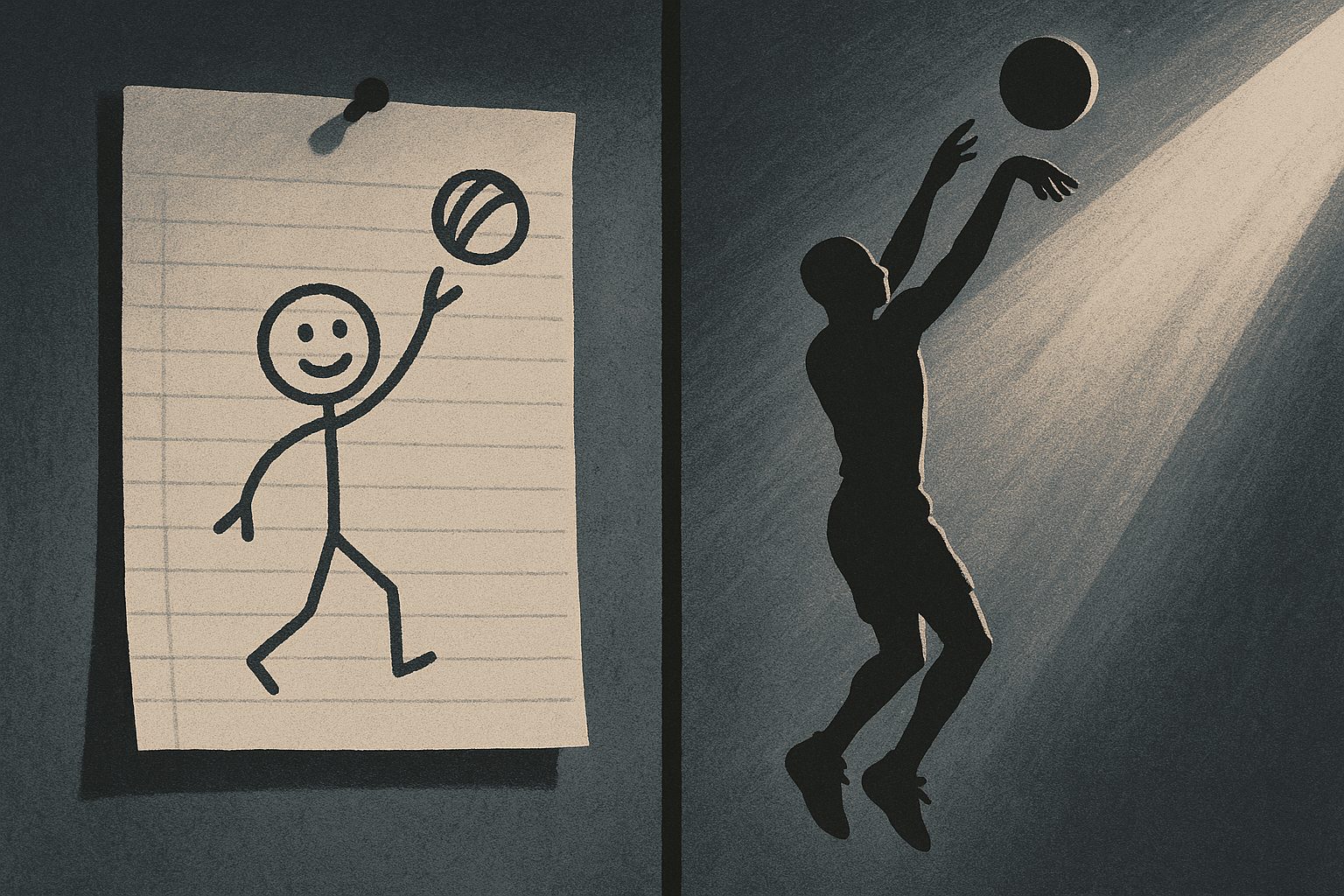 The drawing you could make, and the move you got handed.
And the prizes did not multiply to meet them. If you skim everything else, don’t skim this. The roster still has the same number of spots. When everyone is suddenly tall, the slots don’t go to everyone; they go to whatever is still scarce, and what’s still scarce splits two ways. Upward, into skill the machine can’t rent out. And sideways, into things that were never skill at all: the audience you already had, the brand, the capital, the timing. My tall friend didn’t cheat anybody. But he boarded the merit curve at six foot two, and plenty of what wins in a flood boarded the same way. The striver’s particular cruelty is losing the differentiator and the slot in the same season, and watching the slot go to someone who never put in the hours it took to build either. I lived that cruelty on the basketball court; I’m still processing what it means at the keyboard.
The dunk was never the game
Now, “everybody can dunk” needs its asterisk, and the asterisk is the way through.
What the machine rents out is the dunk — the artifact, the execution, the surface of the move. It does not rent out the game. I made that case in Unlocked, Not Cheated: AI lifts the maker who has taste and lacks execution, and does nothing for the maker with neither, because knowing what’s worth making, for whom, and whether the thing in your hands is actually any good doesn’t come with the rental. Muggsy Bogues didn’t last fourteen NBA seasons by dunking. He could dunk — he has said so plainly, and did it in high school — but never once in an NBA game. He lasted on elite-of-elite level skill and court vision, the parts of basketball no growth spurt has ever conferred on anyone. The dunk was never the game. It was only ever the measurement, and a measurement dies the day everybody can do it.
Two cautions before the ending. First: the rented height keeps growing. The machine’s floor is a treadmill, not a wall, and whether the elite tier stays above it is a question I can’t answer from here. I’m suspicious of anyone who can. My six-foot-two friend may find next week that everybody is now six foot four. Maybe. Second: the top is finite by definition. “Get better” is real advice and it cannot be everyone’s answer, because the arithmetic forbids it. Some of the erased middle were genuinely good, and being good has never stopped anybody from getting cut. Both of those things can be true at the same time.
The other move
Which leaves the move I learned at five foot two. When a gate measures something you can’t earn, go find the game that’s gated by what you can.
That is not permission to go find something easier. There isn’t anything easier; that’s rather the point. The open games come with less shelter, then and now. Nobody heats the gym on the open road. Skateboarding out-cost basketball in every way that counts, and it was still the better trade, because it was honest — every hour came back as skill, and every skill showed. And I still get up every day at fifty-five years old and think about what trick I wanna try to land next, and still pay full price for every one I get. The maker’s version of that move runs the same direction: out of the tiers the machine now hands out at the door, and into the games still scored on judgment, taste, presence, the accumulated specificity of one person’s eye. The games where the hours still buy what they promise.
I eventually got a little taller. The rim never got lower. What changed is that the tape measure is now sweeping through everyone’s sport at once, and a whole generation of strivers is about to learn in one season what the short kids always knew. The measurement was never the game. There are other games.
Mine had wheels.
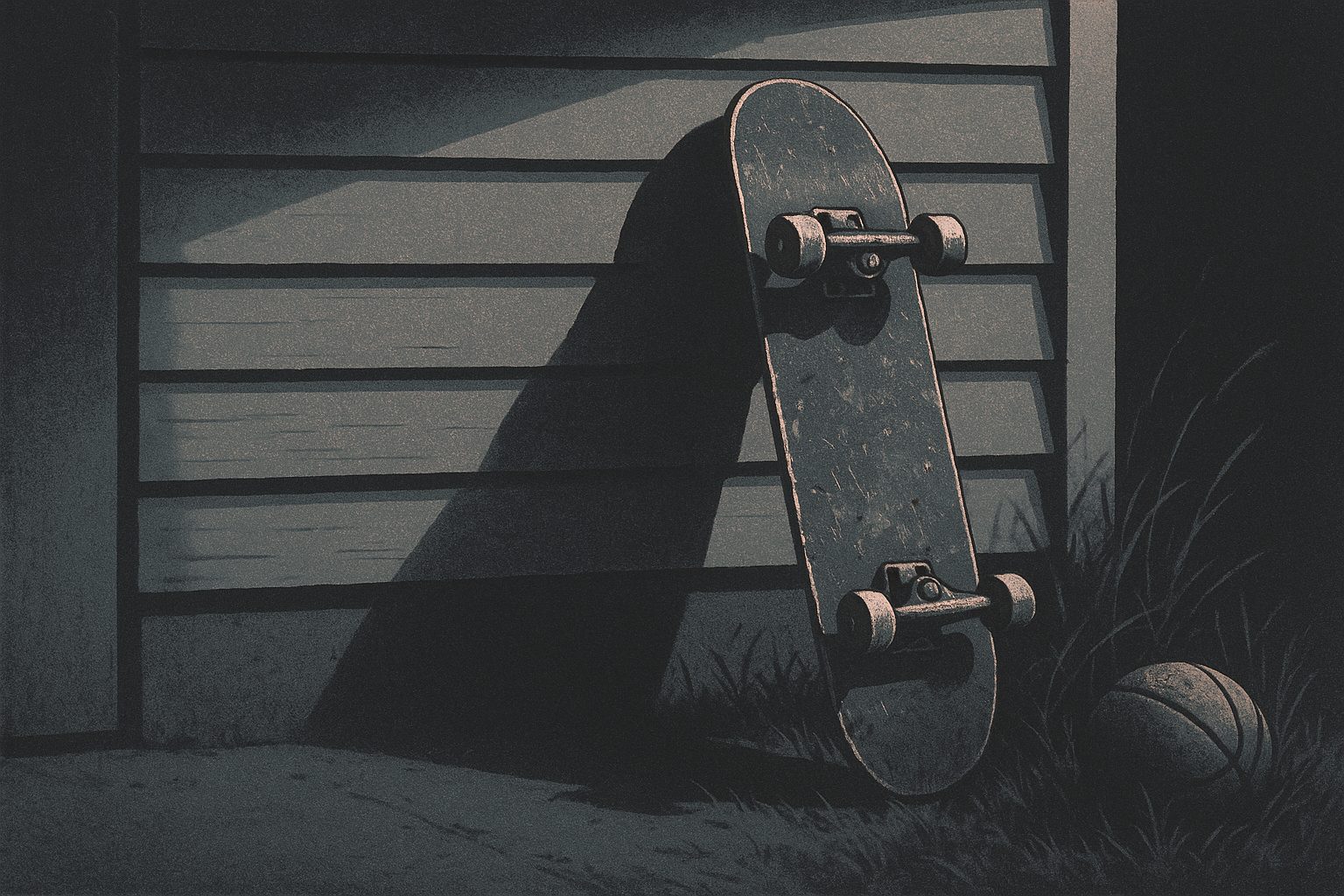 The game that was chosen, and the one left behind.