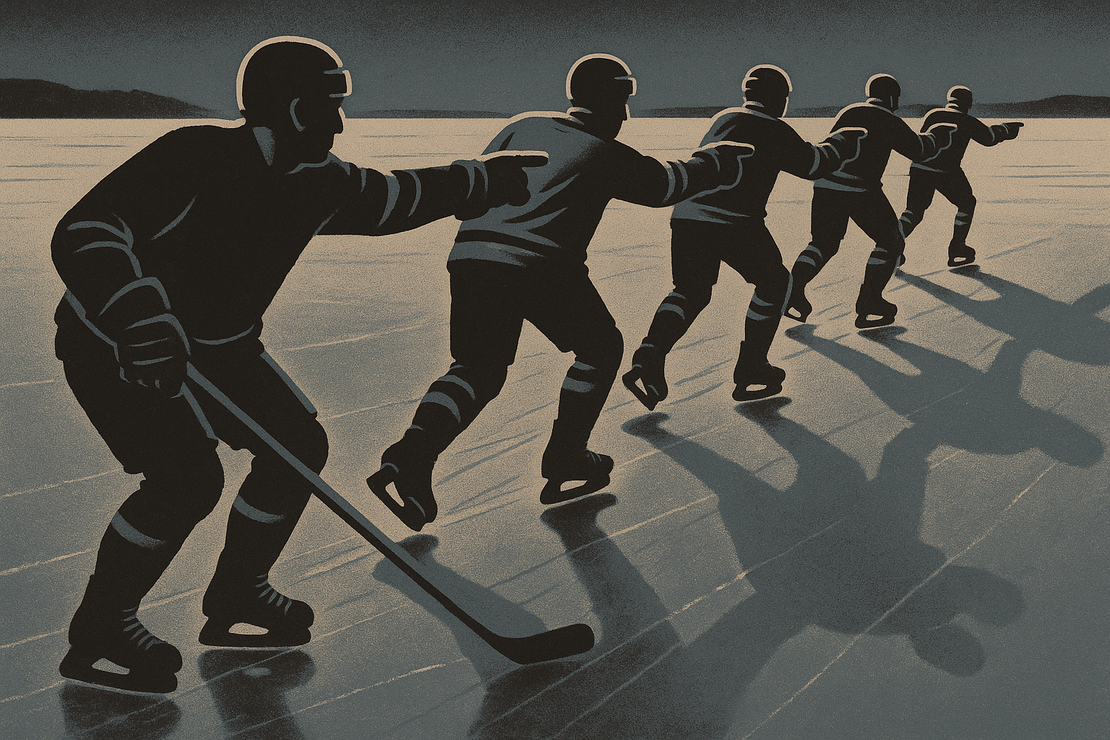
Everyone's a Ringer to Somebody
Every player better than you in your beer league is a ringer; every tool past the one you learned on is cheating. The cheating line always indexes to the self — except writing turns out to have one kind of friction the panic keeps getting right by accident.
I played beer-league hockey for fifteen straight years, the kind with a checking ban and a roster that runs from former juniors to guys who learned to skate at thirty (me!), and I’ve noticed a tic in how everyone in it thinks, myself included. Whoever is better than you is a ringer. Not “better.” A ringer. A guy who doesn’t belong down here with us honest players, who’s slumming, who ought to be playing up a division and is padding his stats against us gentlemen of the game. The actual skill of the league has nothing to do with the judgment. You run the same math in the top tier and the bottom: draw the line at your own ability and call everyone above it a cheat. I suspect you probably don’t escape this issue until you truly graduate to the professional ranks, where incentives flip and you actually want to move up leagues.
The part everyone misses about themselves and clocks instantly in others is that you are some slower guy’s ringer. The guy you’re sure is slumming is, at that very moment, calling someone better a ringer himself. Everybody’s somebody’s ringer. Nobody thinks he’s anybody’s. I drag this locker-room tic into a discussion about AI because it’s the same reflex, and the AI version is getting outsized attention.
A writer defending his words as fully manmade in the AI era will say, often with a healthy dose of sanctimony, that he typed every letter himself. And he’s telling the truth. But I can’t help noticing the machine he typed them on: backspace, spellcheck, autocorrect, infinite undo, a cursor and a pointer that lets him block-select and tear the third paragraph out and drop it after the seventh. The same guy fifty years earlier at a manual typewriter, retyping a full page to fix one line with a bottle of white-out drying beside him, would look at the modern rig and see a cheater, a 21st century guy letting a computer fix his spelling and rearrange his thinking after the fact. But typewriter guy doesn’t escape the ringer accusation…a 12th century monk who gave a year to one illuminated handwritten gospel with quill and ink would look at the typewriter and see something worse than cheating: abject sorcery. Each of these people put the cheating line exactly where he himself was standing, called everything behind it quaint and everything ahead of it fraud, and each was the next man’s ringer, the same accusation accumulating across centuries.
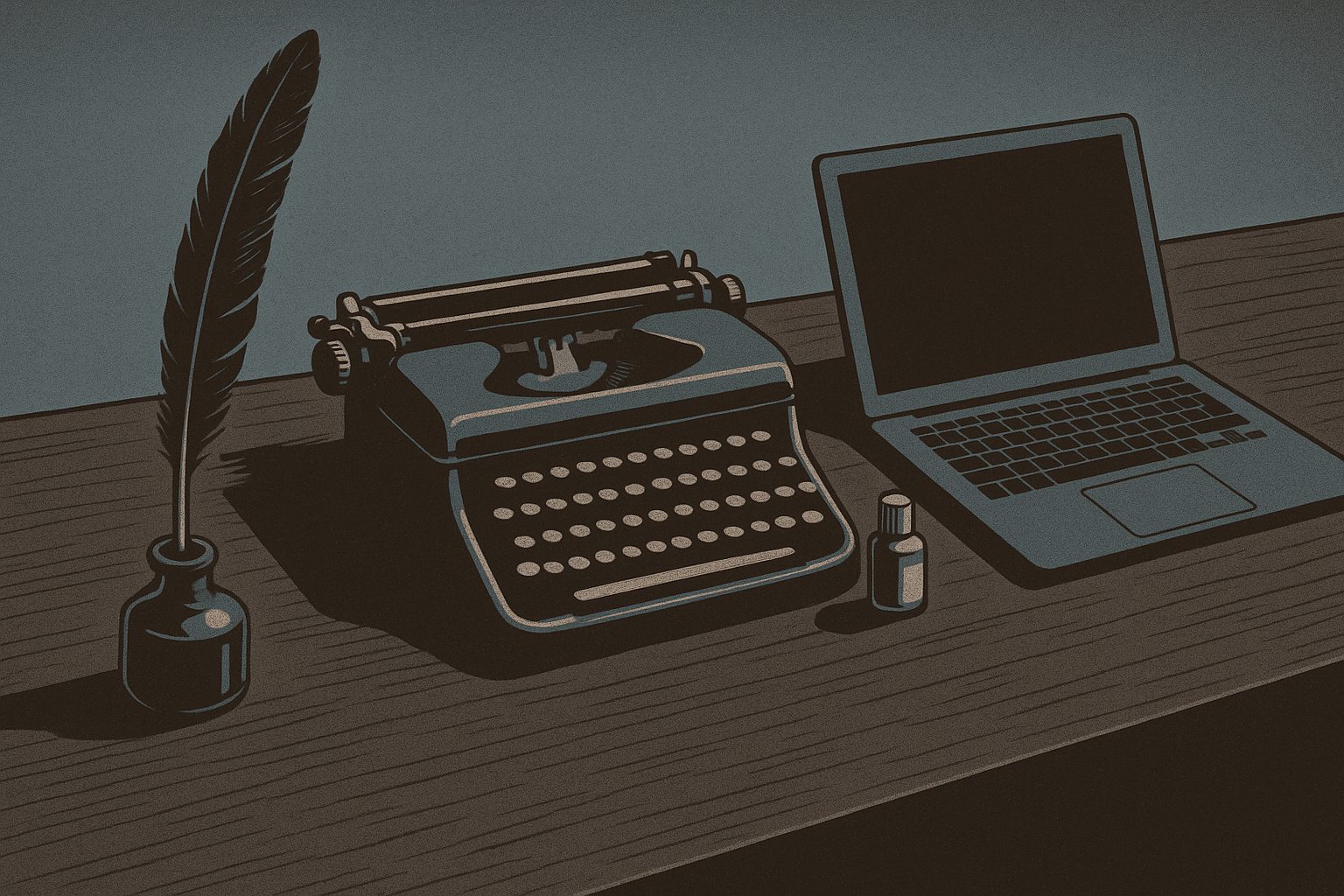 Every tool on this desk was fraud to the man behind it.
It would be easy to stop there, on a tidy lesson: every tool was once the scary one wrongly accused, so relax, AI is just the next typewriter. I don’t believe that, and why I don’t is the part worth digging into.
Not all friction is the same friction
Start with handwriting, since I just mocked the monk for clinging to the pen. He was right. Psychologists Mueller and Oppenheimer ran the study that named it — The Pen Is Mightier Than the Keyboard, 2014 — and found that students who took notes by hand understood the lecture better than the ones who typed. The cause is counterintuitive: typing’s problem is that it’s fast. Fast enough to take down a lecture word for word, which lets you skip the thinking entirely. The longhand crowd couldn’t keep up, so they had to listen, compress, and translate into their own words on the fly. That struggle was the learning. The monk nods.
The finding has taken hits since — a 2021 replication out of Heather Urry’s lab at Tufts came up empty — but the harder evidence came from testing done inside the skull. Wire students into EEG caps, as a Norwegian lab under the neuroscientist van der Meer did, and handwriting lights up broad networks tied to memory that typing leaves dark. The pen isn’t nostalgia. It does something to the mind the keyboard just skips.
The handwriting purist, it turns out, is half right. Some of the friction he clings to is absolutely valid. That’s the ringer call landing on something real for once: right verdict, wrong reasoning. He drew the line at his own feet like everyone else does; it just happened to fall where the work lives.
Which gives us the insight to actually sort this out, the one the keystroke argument never makes. Two kinds of friction live in any craft. There’s the kind that’s pure cost: retyping a clean page, hunting a typo, waiting for white-out to dry. It produces nothing but delay, and you should kill it with fire when a tool lets you. And there’s the kind that is the work: the compression that turns a lecture into understanding, the ugly drafting where you find out what you actually think by failing to say it five times. Call it formative friction. Remove the first kind and you’ve lost nothing. Remove formative friction and you’ve removed the thing it was quietly building, and you won’t feel the loss for years, because the thing it was really building was you.
Notice where the keyboard’s real damage landed, though: on intake. The studies are about notes — someone else’s thinking on its way into your head, where the pen’s slowness forces the compression and the keyboard’s speed skips it. Composition runs the other direction, your own thinking on its way out, and there the fight with the draft survived every tool that ever touched it.
Here’s why the word processor was a false alarm and this isn’t. The word processor only ever ate the first kind of friction. Spellcheck, backspace, cut-and-paste: every one of them stripped out cost without removing anything from the thinking itself. You still had to write the sentence; the machine just spared you the retyping. That’s why “it’s only the next typewriter” held up for fifty years. Fifty years of ringer calls, every one of them wrong. The tools kept removing friction that provided nothing of value on the thinking front. AI is the first writing tool that can reach the second kind of friction. Hand a model the drafting and it doesn’t only spare you the typing; it can spare you the fight with the draft where you’d have learned what you meant. I’ve argued before that the practice of a craft is the forge that builds your taste, and that the kid who has a machine do his homework isn’t cheated out of an essay so much as out of the reps that would have built his judgment. This is that same claim pointed at a tool instead of a kid. A machine doing your chores was never the danger. A machine that takes the labor that was secretly working on you — that’s the new thing we’re dealing with, and it went out to everyone at once.
The tic with a server farm behind it
And the ringer tic has one last cost, the ugliest, now that we’ve poured it into software. An AI detector is a machine that rules on whether you cheated, and it rules by measuring you against a baseline of what “human” writing looks like — meaning, whatever writing it was trained to read as normal. A Stanford team ran seven of the popular AI detectors and found they cleared native-born American eighth-graders almost perfectly while flagging more than half of the essays written by non-native English speakers as machine-made. Those writers hadn’t used a machine. They’d written with a smaller vocabulary and a plainer structure, and the detector had quietly crowned the educated native speaker as the human default and filed everyone else under suspect. That’s the same beer-league reflex, now with a server farm behind it and a stranger on the wrong end. And notice the accusation changed direction. The beer leaguer flags the player with the heavy slapper above him; the detector flags the plainer writer below its register. The tic was never really “better than me is cheating.” It’s “I am the standard”: everything above the line plays like a ringer, everything below it writes like a machine. We drew the line at our own register, named our side of it “human,” and shipped a system that accuses the immigrant of being a robot for the crime of having learned the language second.
Where did the line fall on this piece, then? A machine read every draft of this essay and graded it for the patterns machines write in; the tally runs about one flag per hundred words, and I left most of them standing because they’re mine. A machine drew the hockey players up top. And late in the editing, with a sentence calling the flagged TOEFL writers sloppy, I knew the word was wrong, sat there unable to produce a better one, and asked for help. The machine said “plainer.” Perfect. I could’ve fumbled with a thesaurus for a few minutes and probably gotten there, but I chose the better tool instead. Sorting that one is easy: knowing that “sloppy” poisoned the paragraph was the work, and I’d done it; fetching a word I could already feel the shape of was cost. But the paragraph about intake and composition, the one that patched a hole a careful reader had every right to fall through? I found the hole. The machine offered the right patch. I’ve reread it since and I still can’t tell you which of us learned something. That one sits on the line, and I wrote this essay, and I still can’t call it.
So when someone waves the keystroke flag — I typed every letter, I’m clean — I’ve stopped hearing a defense of craft in it. I hear a guy defending his instrument, which is the one part of this that was never the point. The keyboard isn’t the craft. The formation is: the friction that was building you while you cursed it. The real question is never whether a machine touched the work. It’s whether the part you handed off was only cost, or was secretly the work itself, and that line, unlike the ringer’s, isn’t drawn at your own skates. Like the line between a means and an end, it moves by the person, by the task, by the day. Telling where it falls for you, on this piece, right now, is a judgment no detector and no purist can make on your behalf. The monk was wrong about the typewriter and right about the pen, at the very same time.