Fifty Percent of What?
Everyone arguing over whether AI-assisted work is 'more than 50% human' is measuring with a unit that never existed. The older questions are the ones I'd rather answer.
When critics noticed that a Fortune journalist named Nick Lichtenberg was publishing more articles in six months than his colleagues managed in a year, and that an AI model was doing a lot of the producing, the magazine’s leadership offered a defense that has stuck with me: “More than 50% is Nick.” It was meant to reassure. It did the opposite, and not for the reason everyone assumed.
Everyone heard “only half a person” and recoiled. Almost nobody asked the question that actually decides the thing: fifty percent of what? Words? Sentences? Hours? Decisions? Judgment? The number was offered as a measurement, and no one could say a measurement of what, because there is no unit. We have spent two years arguing about the authorship of AI-assisted work in a currency that doesn’t exist.
I want to make the case that the percentage frame is incoherent — there is no quantity there to count — and that once it falls, the questions that replace it are old, answerable, and much harder to wriggle out of. I should say where I’m standing, because it’s unusual. I wrote forty-seven books over two decades; I know what authorship feels like from the inside. Those books are in the training data, and I’m a claimant in the settlement over it, so I’m one of the writers the “they took our work” argument is actually about. I also build tooling whose entire job is to catch the fingerprints of careless AI prose, so I’m not here to defend slop. And I’ve had a career ended by technology before: my software books were made obsolete by the open web and Stack Overflow, and I’m now a working developer watching AI come for the second one. I can grant the critics nearly everything they believe and still tell you the percentage question is the wrong question. That’s the argument.
Authorship was always a fraction
Start with the thing the number assumes: that there is, somewhere, a book that is 100% one human’s. There isn’t, and there never was.
A novel passes through an editor who restructures it, a copyeditor who rewrites at the sentence level, an agent whose notes reshaped it before it sold. “As told to” is a whole genre. Ghostwriters produce books that carry someone else’s name and nobody calls it fraud, because the person on the cover supplied the thing the book is of — the life, the voice, the authority — and hired out the sentences. Television you love was written by a room, and no single human wrote “the” script. We have never once computed the human percentage of a normally made book, because the question was always meaningless. We are demanding that number now, for the first time in the history of publishing, and only for the machine.
There is no original at the bottom
It runs deeper than collaborators touching a manuscript. The celebrated originals are built on borrowed skeletons too.
Sex and the City is a modernized Golden Girls: four women, sharply differentiated, with the man-eater and the innocent ported over almost intact — Samantha is Blanche, Charlotte is Rose. It’s a structure critics call “recombinant” television because it recurs from Mary Tyler Moore through Designing Women and Living Single and out the other side. The tell is the reflex it provokes: the creator of Golden Girls — a show that grew out of Mary Tyler Moore as surely as Sex and the City grew out of Golden Girls — reportedly resents the comparison. That instinct, mine came from nowhere, is the Romantic-author myth caught in the act.
Or take the most famous origin story in all of games, which happens to be a lie. Charles Darrow sold Parker Brothers on the tale that he dreamed up Monopoly alone in his basement during the Depression, and the company turned him into the folk hero of American game design. He didn’t invent it. The board, the properties, the railroads, the GO TO JAIL square, all of it came from The Landlord’s Game, patented in 1904 by Elizabeth Magie as a teaching tool about the evils of letting a few people own all the land. Parker Brothers bought Magie’s patent for five hundred dollars, no royalties, and ran the Darrow story for decades. The borrowing was never the scandal; Magie was building on Henry George’s economics, and nobody owns the idea of a board you move around. The scandal was the concealment, and the quiet erasure of the woman underneath it. When an economics professor named Ralph Anspach was later sued for making a game called Anti-Monopoly, his winning move was to prove in court that “Monopoly” had become a generic name for the game, not a trademark Parker Brothers could own. Congress handed the trademark back soon after, but by then the point was made: the original everyone was fighting over turned out not to be one.
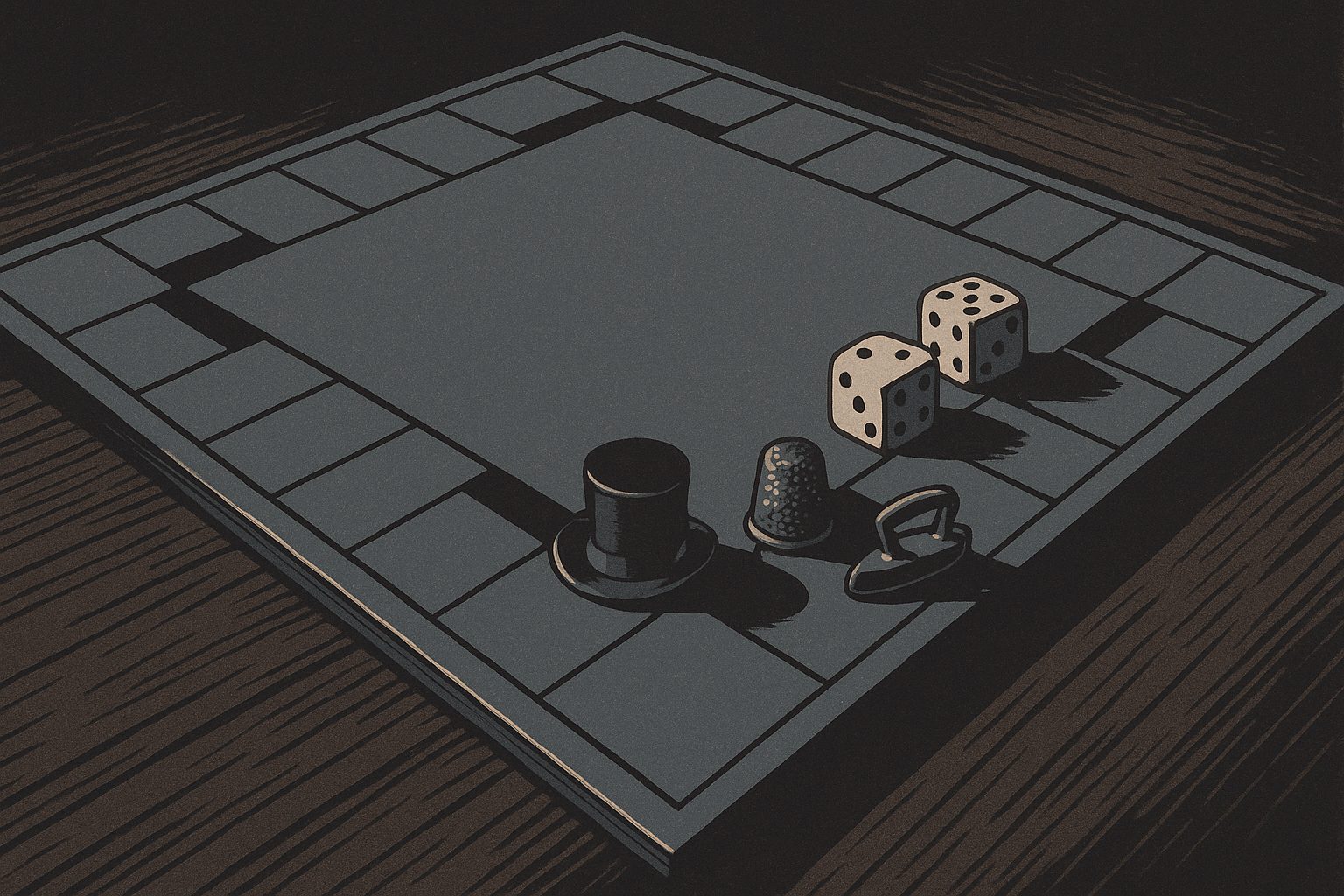 The board everyone fought over: patented by Elizabeth Magie in 1904, sold for five hundred dollars, credited to someone else.
And where the comparison is interpretive, the acknowledged cases are everywhere: West Side Story is Romeo and Juliet, Clueless is Austen’s Emma, Bridget Jones is Pride and Prejudice down to naming the love interest Mark Darcy.
Set two musicians against each other and you can see the whole argument in miniature. When a fan named Billy pointed out that Olivia Rodrigo’s “Brutal” lifted the riff from his “Pump It Up,” Elvis Costello didn’t reach for a lawyer. He replied: “This is fine by me, Billy. It’s how rock and roll works. You take the broken pieces of another thrill and make a brand new toy. That’s what I did.” And he tagged his own debt going back two generations: “Pump It Up” out of Dylan’s “Subterranean Homesick Blues,” out of Chuck Berry’s “Too Much Monkey Business.” Chuck Berry to Dylan to Costello to Rodrigo, narrated proudly by the man in the middle. There is no original at the bottom of that chain. The honest creator’s instinct is Costello’s receipts, not the denial.
I learned this from the inside. Years ago I designed Inc. The Game of Business, a tabletop strategy game openly inspired by Monopoly and then built, at nearly every turn, to be something else, because there is no reason on earth to make a lazy clone of the best-selling board game in history. The borrowed skeleton got us to the starting line and no further. Every deliberate departure from it, the economics we modeled, the decisions we forced on players, the feeling we were chasing, was the authorship. Nobody who played it would mistake it for Monopoly, and nobody who made it would pretend Monopoly wasn’t the seed. Borrowing the frame and being honest about it is not the exception. It is how the work gets made.
Here’s the part that should unsettle the purist. A human absorbing Golden Girls and then writing Sex and the City and a model trained on ten thousand novels differ in speed and in self-awareness. They do not differ in kind. She absorbed slowly, over a life, and called it inspiration. The model absorbs fast, in a training run, and we call it theft. Naming the borrowing, the way a model’s training does, is arguably the more honest version of a thing every artist has always done while looking the other way. The speed gap between the two is real, and I take up its consequences in You Can’t Police a Groove — they fall on who gets paid, not on whose authorship this is.
So where does authorship live?
If not in the word count, then where? In the decisions that carry meaning. The premise. The structure. The characters and what’s true about them. The selection: which of the seventeen drafts lives, and which die. The judgment about what rings true and what’s three degrees off. The final read, where a human takes responsibility for the whole.
A film is the cleanest proof. A director doesn’t operate the camera, write the score, build the sets, or speak the lines. We do not say the movie therefore isn’t theirs. We say they authored it, because authorship was never the manual labor. It was the answerability for ten thousand choices made and held. Spielberg doesn’t pull his own focus or run his own boom mic, and no one has proposed revoking his filmography. The hand that types the sentence is the boom operator of prose. It matters. Authorship lived somewhere else.
That’s the move the whole essay turns on. Authorship is responsibility for the meaning-bearing choices, not the manufacture of the words. Which is why the percentage was always a category error: it counts keystrokes and calls the total a soul.
The two questions that replace the number
Drop “what percent was human?” and two better questions step into the gap, and they’re the ones we actually care about.
First: were the decisions that matter made by a human? That’s a quality question, and it has a real answer in any given case. Second: was the reader told the truth about how it was made? That’s an honesty question, and it also has a real answer. The percentage maps onto neither of the things people are actually afraid of — bad work, and being deceived — which is exactly why it satisfies no one. These two questions map onto both.
The experiment performance already ran
If you want to know whether the line is human-versus-machine or honest-versus-deceptive, look at music, which ran the experiment forty years ago and published the result.
Milli Vanilli concealed the machine and were destroyed. Rob Pilatus and Fab Morvan never sang a note; session singers did, and when the producer confessed in 1990 the duo lost the first and only Grammy ever rescinded. Notice precisely what ended them. Not the session singers, since hired voices are how countless records get made, but passing the voices off as their own. They were the music industry’s slop scandal decades before anyone said “AI.”
Alan Jackson exposed the machine and was celebrated. At the 1994 ACM Awards, when told to perform over a pre-recorded track he considered a lie to the audience, he sent his drummer out with no sticks, miming over the canned audio so anyone watching closely would see it wasn’t live. Producers noticed; the cameras refused to show the drummer. People still admire him for it.
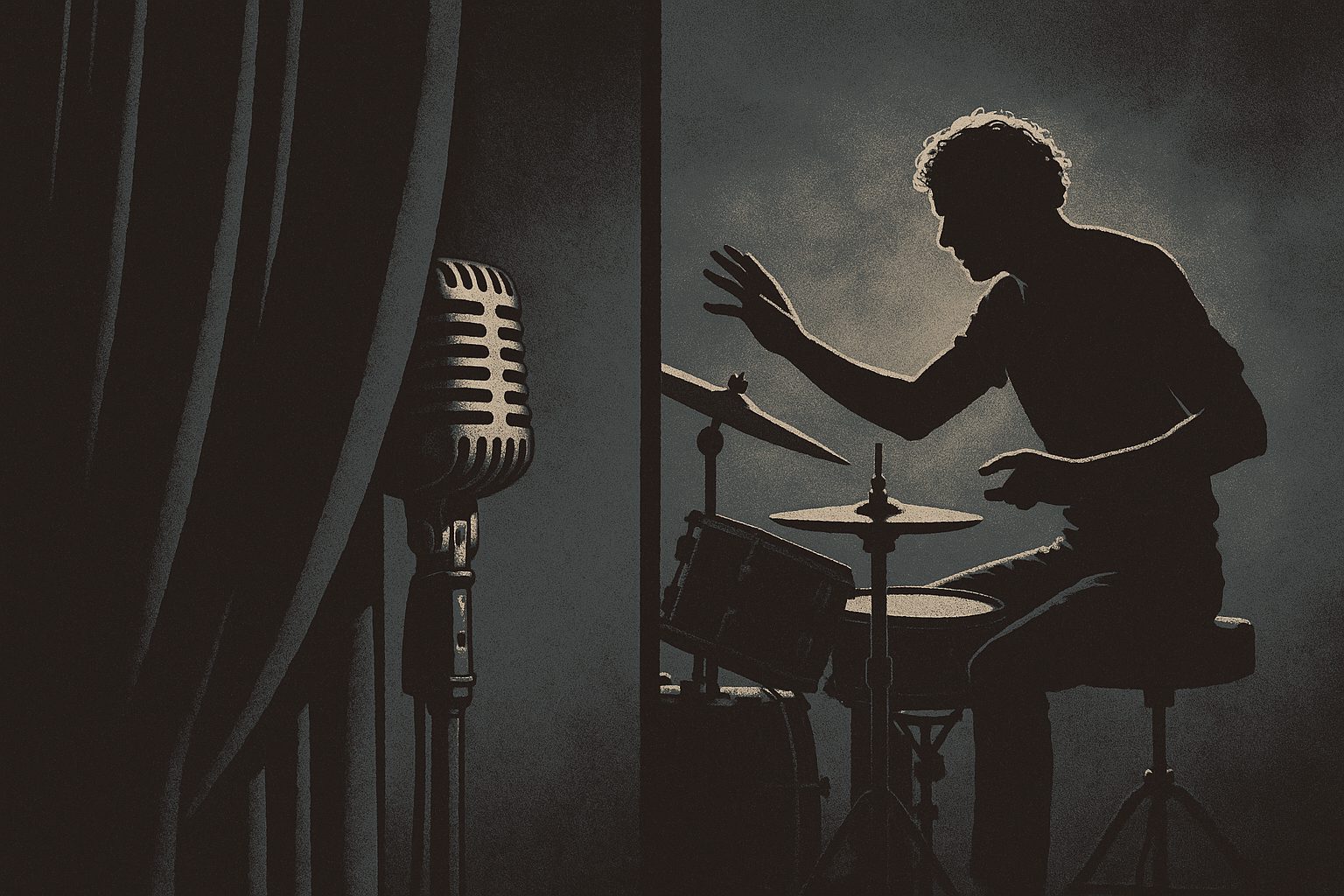 Same machine, opposite honesty: the hidden mic and the stickless drummer.
Same artifice, opposite outcomes, and the only variable that moved was honesty. Backing tracks and session singers are both ordinary, accepted machinery; so, for that matter, is a drummer with sticks playing to a click track that keeps his time for him. The entire moral weight landed on whether someone lied about it. Pop went on to absorb Auto-Tune and pre-rendered tracks wholesale, in the open, and did not collapse, because a medium can take an enormous amount of machine assistance as long as nobody is lying about it. That is the actual rule. It has nothing to do with a percentage.
Why we keep counting the wrong thing
So why does everyone keep reaching for the number? Charitably, because it’s a proxy. The things people genuinely fear, deception and slop, are hard to measure, and “more than 50% human” at least looks like it can be counted. The fears are legitimate. The metric is just pointed at the wrong target, and worse, it lets the actual problems through: a fully-human-typed essay can still be lazy and dishonest, and a heavily-assisted one can be neither.
Yet I can’t dodge the hardest objection, because it’s the one I have the most personal standing to feel: collaborating with a human editor isn’t the same as collaborating with a machine trained on other people’s work without consent. That’s true, and the wrong is real. I filed a claim over it. But it’s a different fight. You can believe the training was done wrongly and also believe the authorship of the resulting work is mislabeled by a percentage. The remedy for the first is at the layer where models are trained: licensing, consent, compensation. It is not a redefinition of what makes a book someone’s. Two problems, two answers; conflating them gets you neither.
And I’d be lying by omission if I pretended this round of disruption is just the last one rerun. I’ve been on the wrong end of technological change twice now, and there are two things that make this time genuinely harder, not just louder. It’s faster: the open web hollowed out my book niche over years, and AI compresses that runway to months. And it’s more general: the usual advice is “retrain into the next field,” which only works if there’s a next field the wave hasn’t reached. Author to developer to what, exactly? I’m a one-person preview of that worry, and I have no idea where this all leads. The honest position holds the reframe and the fear at the same time.
Where the line actually is
None of this says the abuse isn’t real. Concealing AI use to dodge the stigma is wrong. Shipping unedited median sludge is wrong. Cloning a specific living artist’s voice to free-ride on it is wrong. But notice that every one of those is a failure of honesty or of craft, not a failure of math. That line, honest-and-good against deceptive-and-lazy, has been the real one all along, and it never once ran between human and machine.
The question was never how much of a book a human wrote. It was whether a human was answerable for it, and whether you were told the truth. We’ve simply never had to say so out loud before.
A disclosure, since the subject demands it: I wrote this with AI assistance, and not hiding that is the whole point. The thesis, the argument, the examples, the judgment about what’s true, and the decision to stand behind every line are mine. A model helped me work through the arguments and pressure-test the sentences. If that arrangement disqualifies the work, it disqualifies most of publishing history too. I’m just willing to say so on the record.