Holding Both
I use AI every day and disclose it every time, and I think a few companies acquiring the means of thought is one of the most serious things happening in our lifetimes. Those two facts don't fight — and the rage that pretends they do is the surest way to lose the argument that matters.
I read a version of the same essay about once a week now. A writer I’d otherwise stand next to opens somewhere reasonable: the work was taken without anyone’s consent, or the disclosure rules are a polite fiction nobody enforces, or the people getting rich off this are awfully casual about where the thing they’re renting out came from. Good points. The kind I’ve spent my own essays making. Then, somewhere around the third paragraph, the temperature spikes. The data centers are draining the rivers. The billionaires want to own your thoughts and sell them back to you. To hell with all of them. By the last line the writer has said one true thing and six furious ones, and welded them together so tightly I can’t pry the true one loose. I close the tab agreeing with less than I did when I opened it.
That’s a problem. Not the anger — a fair amount of it is earned, and I’ll get to which parts. It’s the waste. A real grievance walks in holding a smaller, weaker set of grievances by the hand, and refuses to let go of them, and they all go down together. I keep wanting to grab the writer by the collar: you had me. You had the strongest version of this. Why did you spend it on that?
The freight worth setting down
So let me do the thing those essays won’t, which is set the freight down and sort it: what’s worth hammering, and what only feels that way. Some of what they’re carrying is real, and it deserves better than to be waved off because I happen to use the tool they hate.
The energy is real. Data centers drew about 4.4 percent of the country’s electricity in 2023, and the Department of Energy’s own national lab projects that could climb to as much as 12 percent by 2028, nearly all of the new demand driven by AI. The water is real, and it bites hardest where it’s most concrete: in Newton County, Georgia, families next to a Meta data center say their wells ran dry and their water ran brown after the build went in, while the county’s water rates were set to climb by a third. The land is real — the substations and the cooling and the truck traffic land in somebody’s actual town, usually not the town where the people approving it live. The livelihoods are real, and I’ve spent whole essays on what this is doing to the working middle of the creative economy. And the ownership question is the one I’d lose sleep over. A few companies are assembling control of something that behaves less like a product than like a utility for thinking, on the stated theory that they’ll own the intelligence and lease it back to the rest of us by the month. If that doesn’t unsettle you, you haven’t watched what concentrated infrastructure does to the people downstream of it.
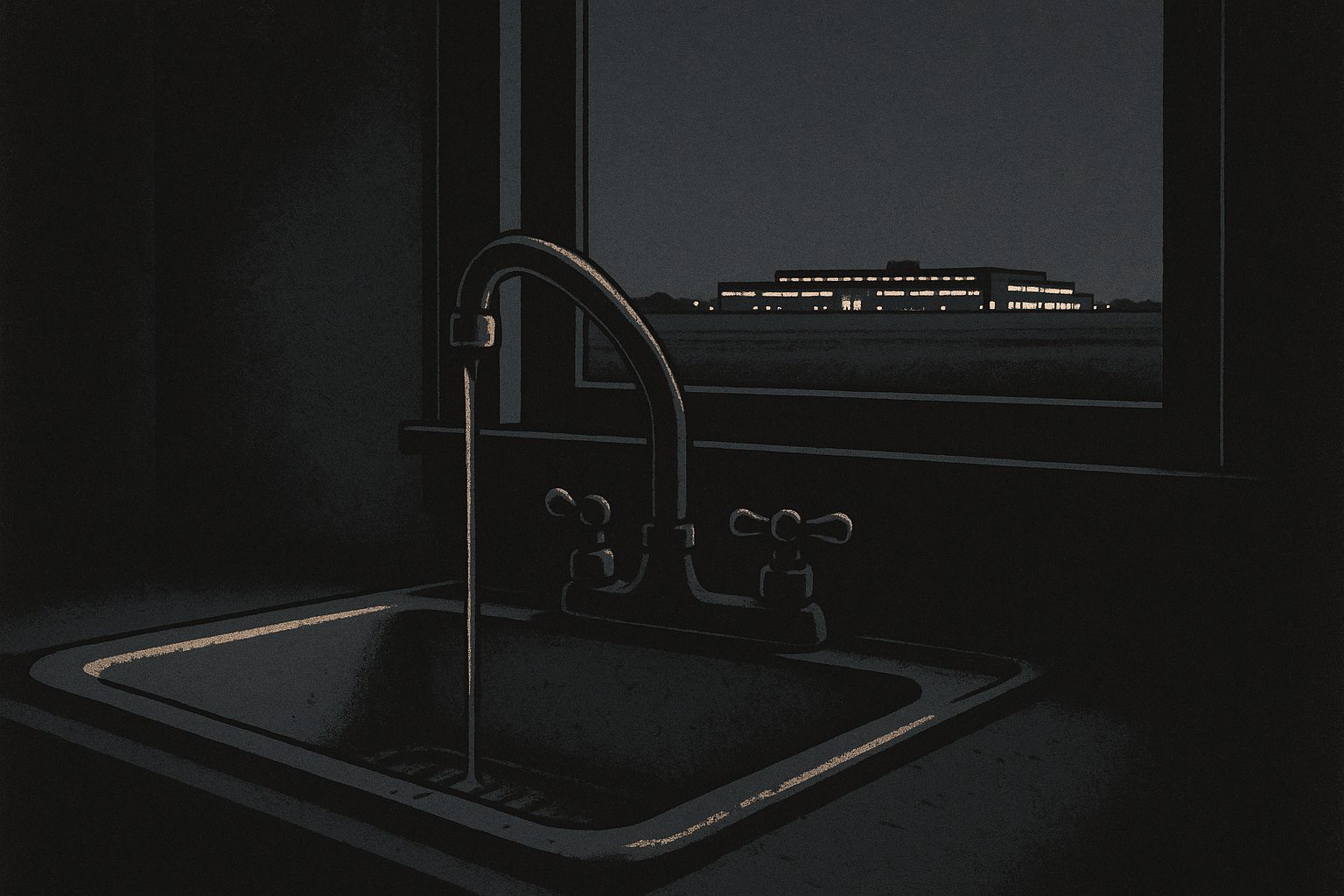 The bill arrives in somebody's kitchen. Rarely the approver's.
I use these tools every day. I tell you so every time. None of that buys the companies a pass on a single line above. Two things hold at once, and the whole point of what follows is that they can: the tool in my hands is a real multiplier, and the structure standing behind it is worth being genuinely alarmed about. The tension stays. I’d just rather name it than pretend it isn’t there.
What I can’t answer from here
Here’s where I part company with the furious version of this essay.
A friend of mine has spent the better part of two years in Louisiana helping build one of these things — a Meta complex out in Richland Parish, the campus they call Hyperion — reportedly past fifty billion dollars and five gigawatts at full build, which would make it the largest data center Meta has ever put up and one of the largest anywhere, dropped into one of the poorest stretches of the country. He’s still down there. The part that won’t flatten into a slogan is this: the place getting the substations and the cooling towers is also getting the paychecks, the road work, the first real economic weather to move through there in a generation. Is that worth what it asks of the aquifer and the grid? I truly don’t know. I’ve thought about it a fair amount and I’m no closer, and I’ve started to wonder whether I have any business weighing in at all.
What I do know is that I can’t answer it from where I’m standing. I live in a comfortable suburb of Nashville. The data center isn’t coming to my neighborhood, and the jobs aren’t either. From that seat it’s very easy, and very cheap, to tell rural Louisiana they’re cooking the planet — to oppose the whole thing in the abstract, where opposing it costs me nothing a family down there actually needed. The people carrying both ends of that trade are mostly quiet about it. The loudest opposition tends to come from right about where I’m sitting: far from the cost, far from the benefit, close to the keyboard.
That’s the tell, and it’s a tell about the argument, not the arguer. When the case against AI leans on its footprint, it’s reaching for the weakest weld it owns. Footprint arguments prove too much: the same logic indicts four hours of streamed video, a working phone tossed for a newer one built in a plant with nets under the windows, a week of clothes designed to survive three washes. Aim it honestly and it convicts almost everything we do, which is exactly why it can’t single out the data center — and why the footprint was never the part of this worth fighting about. The ownership question survives that test. The water bill mostly doesn’t.
The largest levers over a real footprint are the ones that never make it into the argument, because naming them costs the person naming them — the size of a family, the fact of a flight, eating meat, the house itself. We tally the data center’s water and skip the items an order of magnitude bigger, because the big ones sit too close to who we are.
 The machinery that does the real concentrating. It doesn't photograph well.
AI is simply an easy thing to be against: new, branded, with two or three billionaires you can already picture, who do themselves no favors by playing the villain so convincingly. The machinery that does the real concentrating is duller and older and closer to home — a tax code that treats a wage as something to punish and a capital gain as something to shelter. Nobody storms a comment section over stepped-up basis. It doesn’t photograph well. So the anger, genuine and earned, goes hunting for a face, and this industry has handed it a very photogenic one with an annoying hum.
Wanting the furious writer to win
I want the furious writer to win. That’s the strange part. I tell friends this constantly: the surest way to lose an argument is to overstate it. Overstatement is how you hand a strong case to the other side — and on the thing that matters most, who ends up holding a private lien on human cognition and what it costs the people next to the machinery, we’re after the same outcome. Which is why the rage reads to me like a gift to that other side. An argument that handcuffs one real grievance to five flimsy ones doesn’t frighten anyone; it lets the people on the receiving end knock down the flimsy five in public and pocket the real one while nobody’s counting. Every “to hell with all of them” gives the strongest objection worse company, and makes it that much easier to wave off. The angriest critics of this industry keep turning out to be among its most useful friends.
So I hold both, and I’ve quit being sheepish about the shape of it. I use these tools, I tell you when I do, and I think a few companies quietly acquiring the means of thought is one of the most serious things happening in our lifetimes. Those facts sit together fine. The war people imagine between them is the same misfiling I keep tripping over everywhere in this argument: the percentage that measured nothing, the tell that would flag Cicero as a machine, the influence no court could fence. Sort the pile and most of the contradiction turns out to be things left on the wrong shelf.
And the sharpest version of holding both is mine to own. I’ve spent this whole run of essays telling people to move to higher ground — let the machine do the craft, keep the judgment for yourself. That advice already carried one cost I had to answer for; this is the other. It also quietly assumes the machine stays available on terms you can live with. For now, it’s rented ground. The same few companies I’m uneasy about are the landlords of the exact floor we’re all standing on, and the safest move I know how to recommend depends on people I wouldn’t hand my keys to.
What I can’t tell you is whether the fight that matters is winnable from here. It doesn’t live at the keyboard, and it surely doesn’t live in boycotting the one writer who cops to using the thing. It lives in water rights and zoning boards and a tax code nobody storms a comment section about. My friend is still down there in Louisiana. The data center keeps going up, in a parish that needed the work and will still be there when the bill comes, and I honestly don’t know if that was a good trade. I’d sooner be straight about not knowing than certain about the wrong thing.