I Don't Think I'll Be Able to Do It
Messi said it in his own words and was wrong by the widest margin available. I've said it about myself every decade since thirty. I said it again this fall, from a sling, and this time the forecast has a piece of evidence behind it.
On December 14, 2022, four days before the World Cup final, Lionel Messi told reporters the final would be his last World Cup match. His words: “It’s many years for the next one and I don’t think I’ll be able to do it.” He was thirty-five. The man had more information about that particular body than any person alive, he’d just carried it through a semifinal, and he was standing on the largest stage his sport has, saying, in effect, this is the end of the line.
On June 16, 2026, Argentina opened its World Cup against Algeria and Messi scored three goals. Thirty-eight years old. Just taking the field made him the first man to play in six World Cups, and the hat trick tied Miroslav Klose’s record for the most men’s World Cup goals ever. Nobody older had ever scored three in a World Cup match.
The size of his self-assessment miss is what stuck with me. A man who predicts his own end and then hangs on for a few cameo minutes has made a small error. Or what we’ve often seen, a hasty unretirement that doesn’t go well. But Messi predicted the end and then at the next World Cup produced a night that would have been the peak of most careers. The hat trick is the least interesting part of that. The forecast is the part worth studying. The best-informed forecaster in the world, forecasting the one body he lives in, missed by the full width of what was possible.
I’ve made the same forecast about myself at least four times. I started writing this with my arm in a sling, and a couple months later I’m finally finishing it.
The self-audit
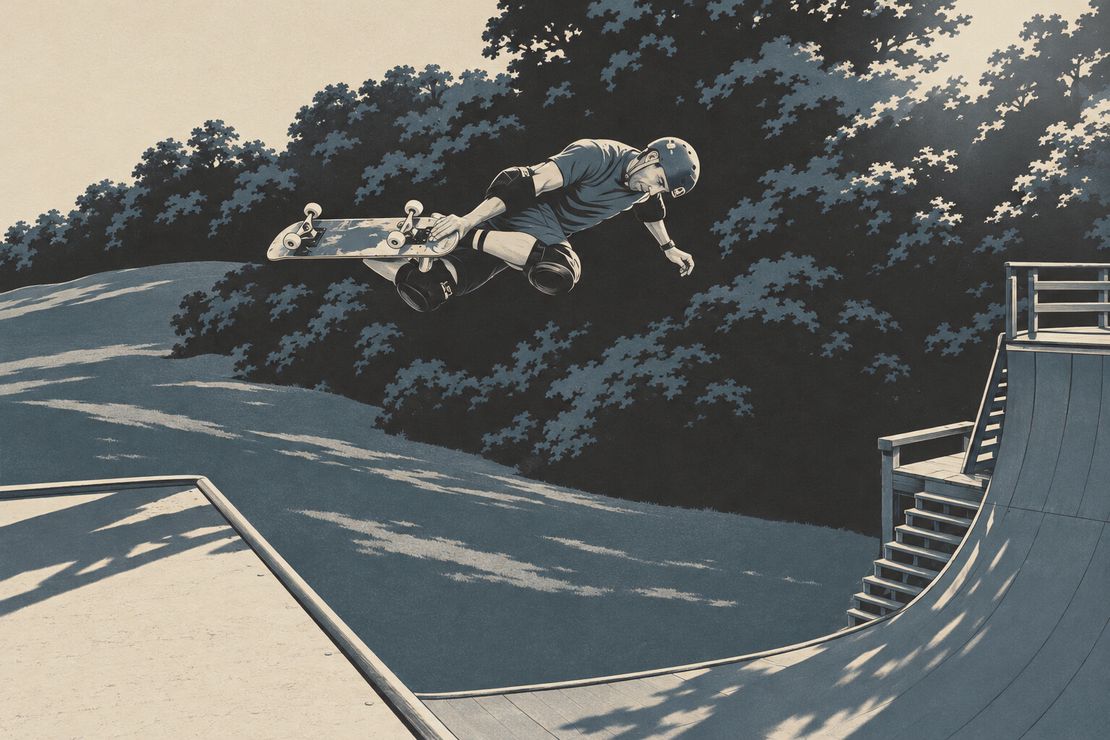
At thirty I was sure skateboarding would be finished by forty. Bodies don’t do that past forty, I thought, with the confidence of someone who had never been forty. At forty, fifty was certainly the end. Vert ramps at fifty are only for a handful of famous people with their names on shoes. At fifty I skated vert with friends who had all made the same forecast about themselves and all been wrong on the same schedule. Somewhere in there I also started jumping mountain bike gaps bigger than anything I’d have dared at twenty. The riding I do now, the gaps and the vert, is more dangerous than anything I did when I was young. Each time, I arrived at the spot where the age limit was supposed to be and found it had moved.
Old accountants tell a joke about audits. Forget the IRS. The nastiest audit is the self-audit, the one where you go through your own return and quietly delete legitimate deductions because they look like they might attract attention. Nobody made you. No agent flagged anything. You imposed a self-tax that no authority ever levied, out of fear of an authority that never showed up.
That’s the decline forecast, exactly. The years between thirty and the actual end are mine. Legitimate deductions. And at every decade I’ve been ready to forfeit them in advance on the say-so of a prediction I have personally watched fail, over and over, for my entire adult life.
I used to think the forecast was just pessimistic. A miscalibration. Adjust the number and move on. I no longer think that. The forecast is fearfully pessimistic, which is a different animal. It comes dressed as prudence. It uses the vocabulary of maturity: act your age, don’t push your luck, be reasonable. And underneath the costume it’s the same thing you feel in that self-audit when you delete the home-office deduction. Fear of getting in trouble, converted into a voluntary payment.
The prudence voice is not always wrong. The eventual limit of age is real. Like all the people predicting the next stock market crash, eventually a forecast is right, and the calendar wins. But the gap between the forecast and the real limit has been, in my experience and in Messi’s, enormous, and everything inside that gap is a year you can either live or pre-pay.
None of this needs a vert ramp. The same forecast shows up as the guitar you decided at fifty you’d never be any good at, the degree you’re too old to start, the career you’re too far into to change. It always arrives sounding reasonable, and it almost never shows its work. If you’ve ever said “I’m too old for that” and then watched someone older do it, you’ve caught your own forecaster in the act, the same way Messi caught his.
Adapt or couch
Middle Tennessee had been in the hundreds for weeks. Consecutive weeks. The people I’d normally skate with had stopped answering the invites, so I’d stopped asking. I don’t blame them. The heat had simply filtered the room down to one person, and that person was me.
I want to be honest about what the heat is, because there’s a cheap reading and a truer one. The cheap reading is that skating in a hundred-plus degrees is tough-guy theater. Some difficulty, chosen on purpose, for the story. There’s some minor truth in that, and the reality of toughing out that kind of heat to do something you love is not nothing. But if you live somewhere with seasons, and most of us don’t live in San Diego, the menu that afternoon didn’t have a seventy-degree session on it. The choice was the heat or the couch. And the couch has a cost too. Skill decays. Timing goes. The reps you skip in August don’t wait for you in October. Where I live, progression is tied to weather adaptability. That reads like a slogan but it’s really just a scheduling fact.
The same filter runs in January. I’m frequently alone in the cold, breath fogging, hands numb on the first few runs, for the identical reason: it’s cold or it’s nothing. Heat alone reads as bravado. Cold alone reads as lonely. Together they’re just what the calendar looks like from a ramp in Tennessee.
So I was out there, and I was not pushing hard, I was surviving. That’s the part I need you to hold onto. I skate differently in the heat. I pull back, I ride efficiently, I try not to fall, because falling when you’re already cooked is a bad idea and I know it. Also falling in the heat means a climb up a story and a half of stairs, which is its own punishment at a hundred degrees. So I was deliberately having the careful version of a session.
That’s the one where I went down hard.
I remember being too much in the backseat landing an air I should’ve bailed, looping out in the flat bottom of the ramp and hitting shockingly hard. There’s a distinct feeling when you hit hard enough to do real damage, and I knew it even as I bounced up onto my feet. I knew it so immediately that in a rare show of frustration I threw my helmet across the ramp in anger and tore all my pads off. And then I settled into the specific loneliness of being the only person available who could evaluate my condition. I decided it was a dislocation. That’s what it felt like, and a dislocation is a thing that sometimes can be put back. So I spent some amount of time in the flat of the ramp, in the heat, writhing around trying to work my own shoulder back into its socket. It didn’t go. It was never going to go, because it wasn’t a dislocation. Eventually I gave up, got myself up, and drove to the emergency room.
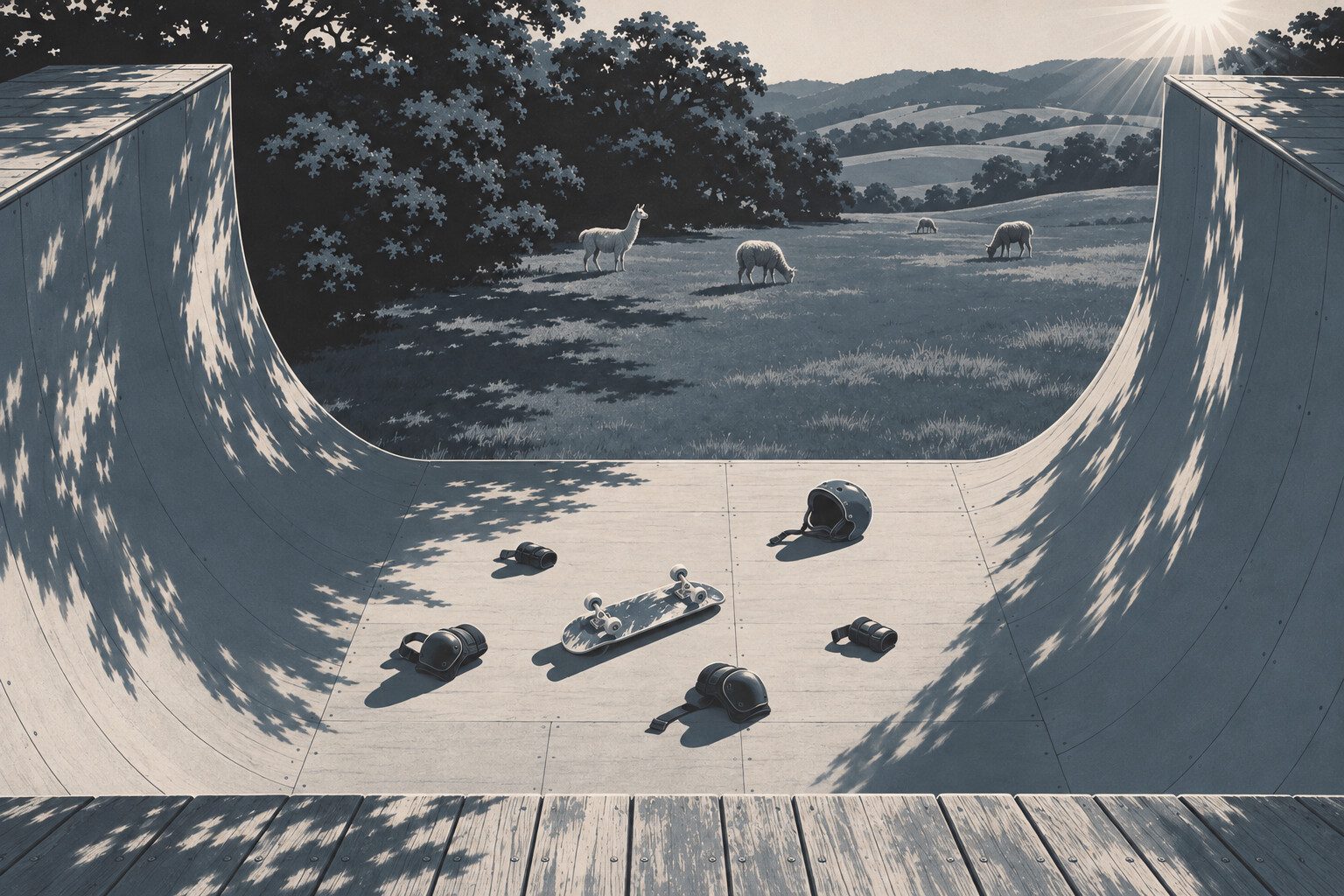 The only second opinion was mine.
My wife calls my skating “cracky.” She’s not wrong, and she’s never been more right than she was that afternoon. I keep the word close, because the other story available to me, the one about carrying something on for a thinning generation of people who still do this, is the most flattering account of a compulsion that exists, and it would get away from me if she weren’t there to say the domestic word next to it.
What the audit found
A shoulder separation. I handed the X-rays to AI first and got a hopeful grade three, a forecast miss in the other direction. The actual doctor said grade five: the ligaments holding the collarbone to the shoulder blade are completely torn, the collarbone rides high, and the joint is permanently misaligned. It’s the same shoulder that’s had two surgeries already. The decision is to skip the third. At least for now.
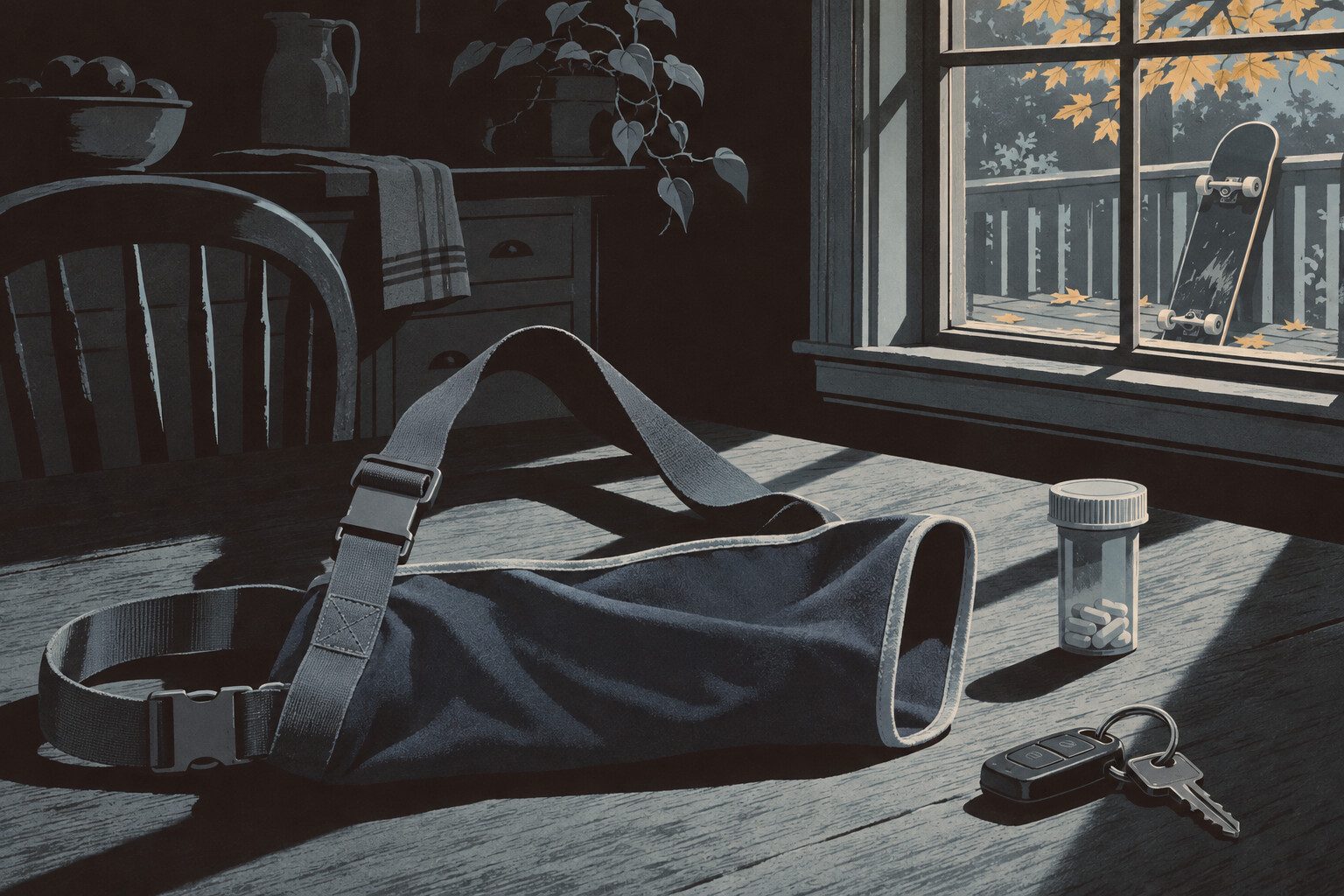 Both still within reach.
It was also my second trip to the sidelines this year. In the spring an old knee injury resurfaced, and that one needed surgery and months off of its own. Add them up and I’ve spent about five months of this calendar year hurt, four of them in physical therapy on two different body parts. That’s inching toward half a year spent recovering instead of riding. It isn’t all about age by any means. Neither injury came from a birthday, and the knee was an old debt coming due. But it’s not entirely not about age either, and four months of PT in one year has a way of handing you a reality check.
Together they did one thing I didn’t expect. It changed what the forecast is made of.
Messi made his forecast from a healthy body. So did I, at thirty, and at forty, and at fifty. Every one of those predictions was pure projection: a guess about the future, made by a person who had nothing wrong with him yet and was afraid anyway. That’s what made them a self-audit. The deleted deductions were legitimate because no authority had actually found anything.
This time the audit found something. The doubt I was sitting with those first few weeks in the sling is not the same doubt I had at forty. That one was fear. This one has a radiograph, two if you count the knee. And I don’t know how to sort them cleanly, which I think is the honest place to stand, because the accountant’s joke doesn’t have a second half. Nobody tells you what to do with the return the year after the audit did turn something up. Which of your deductions are still legitimate? All of them? None? The ones that don’t involve the shoulder?
That question isn’t unique to skaters. It’s the one waiting after the heart scare, the layoff at fifty-five, the business that didn’t make it. The best I’ve managed is to ask what each piece of doubt is made of. The parts that trace back to the X-ray get a vote. The parts that sound exactly like what I was telling myself at forty, before anything was wrong, probably don’t.
There’s an irony inside the injury that I’ve decided not to resolve. I was riding kinda careful, and careful is when I got hurt. Three explanations are available. One: falls don’t track intent, and how hard you’re pushing has less to do with whether you go down than everybody assumes. Two: the careful version of skating is a mode I’ve practiced far less than the other one. I have three decades of reps going for things and comparatively few riding careful on purpose, and it’s possible I’m simply worse at the version I was attempting. Three: the heat had taken something I couldn’t feel. Reaction time, a half-beat of judgment, over-pumping just a bit. Any of those could be true. I can’t prove one, and picking one would turn the fall into a lesson, and I don’t trust lessons that arrive that conveniently. That said, I’m leaning toward three.
The floor
I skate and ride with people my age who have received forecasts far more authoritative than anything I’ve told myself. Diagnoses, with numbers attached, delivered by physicians. A prognosis is the most credible decline forecast a human being can be handed. And what I’ve watched, up close, is that even those routinely under-read the runway left inside them. Friends who were told, in effect, this is the shape of what’s left, and who are still out there years later doing things the forecast didn’t have room for. No performative grit, no mindset, none of that vocabulary. Just a forecast that turned out to be wrong in the usual direction, at the maximum possible authority.
That’s not the whole list, and this is the part I can’t leave out. Not everyone who kept going is still here. Some of the people who ignored the same forecast, took the same kind of risk, rolled the same dice, lost. If I tell you the forecast is unreliable and stop there, I’ve quietly told you that the ones who are gone were doing something wrong. They weren’t. The forecast is unreliable in both directions. It’s too pessimistic about the decline, and it can’t promise you’re the one it will spare. You go anyway. You go because you’ve watched the prediction fail too many times to forfeit on its word. Going has never once meant you win. Still being here isn’t earned. I’ve spent thirty years afraid of saying that sentence the wrong way, and I’d rather say it clumsily than not at all.
A couple months later
The sling came off eventually. The shoulder is now close to healing into whatever shape it’s going to hold, which is not the shape it had. I’ve already begun easing back into skating again. But a question arrived that I’ve never had to answer with evidence in hand.
At forty I would have told you the risk was worth it, and I would have been right, and I would have been guessing. At fifty-six, from the flat of a ramp in the heat, trying to fix a joint I’d misdiagnosed, I still think it’s worth it. But I’d be lying if I didn’t say there’s an ever so slightly creeping doubt about whether it’s going to continue to be worth the same risk when I’m fully out of the woods on this one and ready to push hard again. I don’t know for certain, and it’s the first time I’ve said I don’t know at the moment of a forecast. Every previous version came out with total confidence and was wrong.
Maybe that’s what a finding buys you. The answer stays where it was. What ends is the certainty, in either direction.
The heat broke a few weeks after the slam. It was seventy degrees and I couldn’t skate. My air-conditioned friends got it right. Somewhere in that is a lesson about the diminishing returns of “no pain, no gain,” but I’m probably too “cracky” to learn it.