Just As I Am
We were church people in streaks. The faith never took with me, but I learned what wanting to believe looks like, and lately I've started sensing that want again.
We were church people in streaks. In the Tennessee I grew up in, most people were church people, and most were less streaky than us.
Some years we were there every time the doors opened — Sunday morning, Sunday night, Wednesday supper in the fellowship hall. Then a streak would end, quiet as it started, and months would go by without anyone mentioning it. Then years. Then a gospel singing, or a move, or some private weather between my parents I never saw, and the switch flipped back on. Nobody explained it. You woke up one Sunday and you were a family that went, and a few years later you were a family that didn’t, and both conditions felt permanent while they lasted. It didn’t even really feel strange. As a kid I relished the off times because I got my Sundays back.
I’ve spent a lot of time in churches, long past the years I had no say in it. Once I was grown and could keep my Sundays, every wedding, funeral, and stray family member seeking redemption drew me back, to witness and support. I was never far from it.
What I’m after is bigger and stranger than anything I happen to believe: how gods get made — who does the assembling, what powers the belief, what the finished thing can and can’t do — and the newest candidate for the job, which is being assembled right now, in plain sight. I should be precise, though: I never watched a god get made. The one in my building was finished centuries before anyone now alive arrived. History has kept minting smaller gods since — some so recent their receipts are still in print, and we’ll get to them — but what those pews showed me was the other end of the process, the transmission and the maintenance, the careful handing of a finished god to the next generation so the culture holds together. That turns out to be most of what a working religion is. Which is exactly why the newest candidate is so intriguing: this time it’s the front end of the line that’s running, the actual making, at a scale nobody has seen since scripture. I know the back half of the assembly line by heart. Consider what follows my credentials.
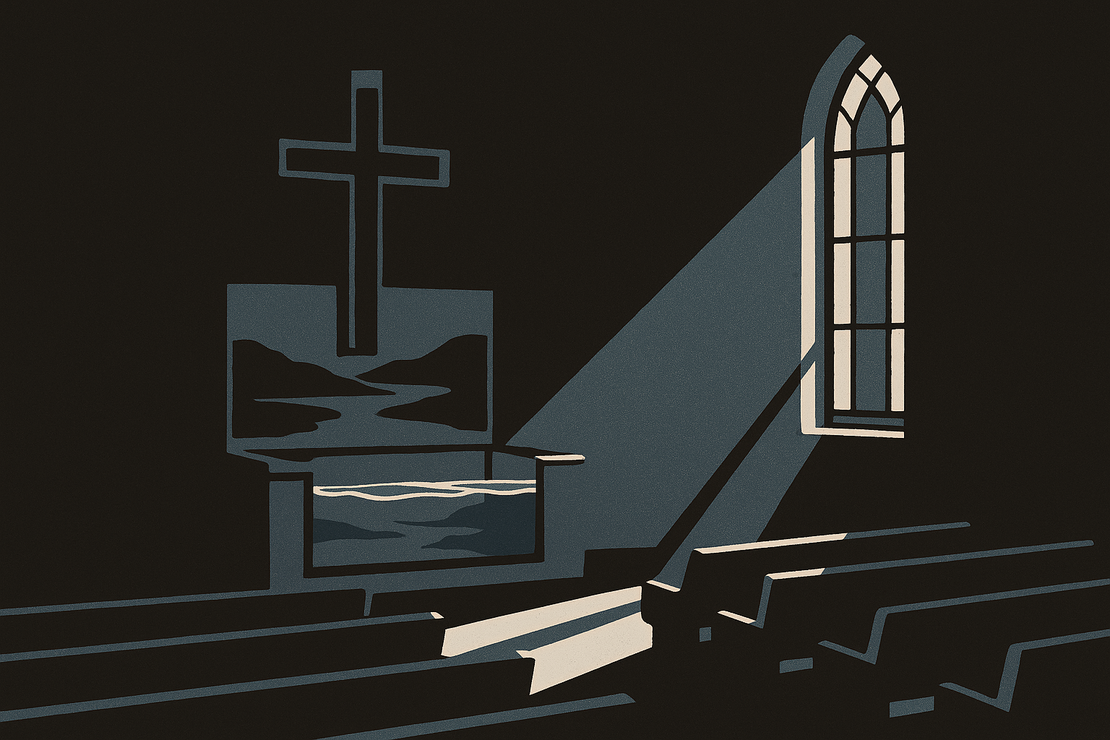
Our church was always either Southern Baptist or Free Will Baptist, which I’ve since learned to describe to people who weren’t raised in it as moderately extreme. Hellfire, but preached in a friendly accent. Like Dylan before 1965, the churches I went to through the 70s and 80s had yet to go electric. The building had hard pews and a baptismal pool built into the wall behind the pulpit like an aquarium waiting on a fish, and everything about the hour ran on rails I could have recited in my sleep: the hymns, the offering, the sermon rising and falling, and then the part the whole service had been aiming at all along.
The invitation
Every service ended the same way, with every head bowed and every eye closed and the congregation singing “Just As I Am” while the preacher stood down front, waiting. If nobody walked the aisle, we sang another verse. There are only so many verses, and I can assure you that was never the constraint. I understood what walking meant socially years before I understood what it meant theologically: the tears, the hugging, the being gathered over. A kid learns the choreography of salvation long before anybody explains the doctrine.
 Just as I am, without one plea. Another verse.
My family walked once, which looks odd from here: a whole family needing salvation on the same Sunday. Surely we didn’t all stray together. But I guess we did, or my parents felt like we did. The doing of it felt like being made — the whole family inducted together, the way the mob makes its men, with fried chicken and blackberry cobbler afterward to seal it. I didn’t think much about that salvation but it would come around again, and much more personally.
A year or two later it was a summer Vacation Bible School, or VBS, an acronym the South expects you to know as part of life like the IRS or KFC. There was a pretty heavy class, I guess you’d call it, and it ended with a hard sell to come up and officially accept Jesus as your lord and savior. I wouldn’t exactly call it peer pressure because the pressure wasn’t coming from the peers. It felt a bit more like an expected part of participating in the experience, so I went along. I don’t regret it; you can’t hold a kid to a commitment he didn’t understand. I wasn’t mature enough to be for it or against it. I was indifferent. I felt nothing where the room around me appeared to be feeling everything — like being the one kid in the theater the movie doesn’t work on. Everybody else flinching and crying at what’s on the screen, and all I could ever see was the projector light. It wasn’t the equipment, either. Star Wars lit me up that same era like it lit up everybody — I knew exactly what it felt like when the movie works. It just never once worked in that building with all the stained glass.
The aquarium
And somewhere in there — after the VBS summer, I think, though I’ve tried and I honestly can’t place it — I was baptized. Full immersion, the Baptist way. The aquarium behind the pulpit finally got its fish.
You don’t get to an aquarium behind a pulpit in one step. Baptism started as a wild man dunking people in a river — John, out in the Jordan, camel hair and honey, plunging whole grown bodies under. The Greek word underneath baptize just means to plunge. Over most of the centuries since, most churches trimmed the rite down to a sprinkle on an infant’s forehead, but the Baptists made their name insisting on the original: whole believer, whole body, fully under water. For a long time that meant the creek. Congregations walked down to moving water in their Sunday clothes and did it the Jordan way, current and water moccasins and all. Then the buildings got nicer and the water moved indoors: a tank sunk into the wall behind the pulpit, plumbed, glass-fronted, sometimes heated, with steps down into it like a small rectangular hot tub.
A lot of those tanks have a river painted on the wall behind them. A mural of the Jordan, hung as scenery behind the plumbing that replaced it. A visiting anthropologist would marvel at it — the congregation dresses in its best clothes to watch a child be lowered backward into a tank of water by a man wearing waders under his robe, everyone cries, and afterward there is a potluck. I’m not mocking it. Every sacred thing sounds like this when described from outside; inside is where the sacred lives. I’m just reporting that it’s possible to be soaking wet at the exact center of the rite and still be outside it.
Here’s the strange part: I can barely remember it. The hinge of my eternity, the one moment that whole machine existed to produce, and I couldn’t tell you what was said over me, what I wore, whether the water was warm or cold. I can still walk you through birthday parties and bicycle stunts from those same years. Whatever the water was supposed to write on me, the ink never took. My memory ran its own quiet accounting and filed the biggest day of my soul’s life somewhere behind a memorable birthday cake and a beat-up Huffy.
Almost nothing else survived that fog. The one thing that did is my parents’ faces. It made them so happy — a pride with a shine on it I didn’t often see — and the pride confused me in a way I wouldn’t have had words for then, because pride was for things you did, and I hadn’t done anything. I’d walked a few feet and gotten wet, with assistance. What I see in those faces now is relief — a rescue confirmed. As far as they believed, their boy was safe forever, in the only ledger that really matters, and the pride was love wearing doctrine’s clothes. I can’t hold that against anybody. But notice what my memory kept and what it dropped. The water, the words, the eternity — gone. Their faces — kept. Even then, some part of me knew where the weight in that room really was.
Nothing on the line
People talk about losing their faith, and I’ve read enough of those stories to know mine isn’t one. Loss isn’t the shape of it. There was never anything to lose. What there was instead, for a kid, was a long apprenticeship in sitting still while a room wants something — and, if I’m honest, in arranging my face to match. I learned to perform the thing I didn’t feel, because I was eight or ten or twelve and performing it was the price of the potluck and the peace. I’d call that my first fluency in a language I’ve been reading everywhere since. And I never turn down cobbler.
There was one more thing that kept me feeling like a visitor, and nobody else in the building seemed to find it strange. The way people talked about talking to God was so literal. And not loosely literal, the way you’d describe a feeling. They reported back on prayer the way you’d report on a phone call: God told me to take the job. We prayed on it and got our answer Tuesday. He laid it on my heart to speak to you. And I would sit there running quiet diagnostics on myself, because I had never once heard anything back. Not a voice, not a nudge I could honestly tell apart from my own wanting. I spoke out loud and waited, listening carefully for a response. Nothing, ever. C-3PO and R2-D2 came through fine; it was only heaven I couldn’t pick up. For years I genuinely wondered whether something was wrong with my receiver — whether everybody else had been issued equipment I didn’t get. Though I’ll admit I noticed, even then, that the answers people got back had a way of agreeing with the people who got them.
The word in print
For a good stretch of my adult life, all of that curdled. I came out of those pews with a hostility toward performed piety that I carried like it was a virtue — the loudest public pray-ers, the fish on the bumper of the car that just cut you off. I kept it to myself, but I felt it. It took me an embarrassing number of years to notice that my contempt was aimed at people doing exactly what I’d done in the pew, only with less choice about the room they’d been born into. My family’s streaks had accidentally shown me the door — every off-year another proof that the room was optional, a seed of honesty my parents never knew they were planting. Most of the people I sneered at never saw a door. And I shouldn’t pretend the door made it free. The stakes were never much different; I just ate the consequences internally, paying in the quiet currency of not being myself.
The external bill came years later, and I wasn’t expecting it, because the week it arrived should have been one of the best of my life. My wife and I and another couple, close friends, had created a board game together — designed it, funded it ourselves, printed a thousand copies — and the local paper gave us a cover story. A feature, in print, about a thing we had made. Somewhere in the interview, describing how opposite the two couples were, my wife said it for both of us, in passing, as a plain fact: atheist. Nobody was confessing and nobody was declaring; she said it the way you’d say your hometown. Then the paper came out, and the word sat there in print, and my parents read it. What came back was disappointment — complete, leveling, the brutal kind — and it rolled right over the cover story like the story wasn’t there. Mostly what I remember feeling was shock; the hurt arrived later and stayed longer. I had made something good enough to be newsworthy, and the only thing my family could see was one honest sentence. It took me years to read that week the way I read it now: theirs were the baptism faces running in reverse. The pride at the tank had been relief, their boy safe forever. The disappointment was the same arithmetic with the sign flipped: I had just been announced unsafe, in print, where God and the neighbors could both read it. They had been proud of something done to me, then crushed by something I’d made, because of one word it carried. Love wearing doctrine’s clothes, again. There was never a free way to sit in that room. There still isn’t.
 The only sentence my family could see.
If you didn’t grow up where I grew up, the voltage in that one word might not translate. In the South, and across most of the middle of the country, atheist lands as an accusation. It’s one of the ugliest labels you can fasten to a person’s name in print — strong enough, as I found out, to flatten an accomplishment. The polls have said some version of this for half a century: Americans will accept almost any identity in a candidate before they’ll accept that one, and no serious contender for President has ever worn the word openly. You declare your love of God and country, as if they’re inseparable beliefs, or you keep your unbelief to yourself. I’ve long joked that we’ll know the acceptance work is done when an open atheist can run for the office. Nobody’s laughing yet, mostly because nobody’s running.
And underneath the joke sits the thing that took me longest to say plainly: none of it was ever a choice. I didn’t pick unbelief off a shelf, and I couldn’t return it — I tried, more than once, sincerely, and learned that you can no more decide your way into a belief than decide your way into a different height (graduating high school at 5'2", I tried that too). Which is the part the disappointment never accounted for. You can only be disappointed in a decision, and there wasn’t one. The same goes for them. They didn’t decide to be afraid for me any more than I decided to give them cause. It’s also why I reach for the language of acceptance at all, claiming the shape of that fight and none of its scale: being held in contempt for something you can’t change is a story this country knows by heart. The difference is the roster. The other versions of that fight eventually drew crowds. This one recruits thin, because belief in a god isn’t one opinion among many in most of the culture — it’s the baseline, the thing even broad-minded people quietly require before extending full respect. Unbelief may be one of the last unchosen things polite company still holds against a person.
What the building was doing
The contempt didn’t last. I’ve softened, and politeness had nothing to do with it. I paid attention to what that stained-glass building was doing, separate from what it was claiming. The casseroles that showed up within hours when somebody died. The man who stayed sober one more week partly because Sunday was coming and people would look for him. The widow with somewhere to be. And the old people. All the old people, who, to a kid with bicycles to ride and fish to catch, had seemingly signed up for the weirdest social club. But all they wanted was togetherness. I’m getting up there in age myself now, and I get it. I still think the premise is wrong. But I no longer think the premise is the point. A church, done correctly, is a machine for holding people tight, and the fact that I believe the blueprints are fiction has turned out to matter less than I once needed it to.
Here is the part that surprises people, though it stopped surprising me a long time ago. The kid who could only see the projector grew up wanting the movie to work. I want to believe — I’d take the comfort, the company, the someday reunion, all of it, gladly. What I can’t do is get there on what’s been offered. The nearest I’ve come to naming my position is this: atheism toward what’s been offered so far. It’s a review of the catalog, and the catalog isn’t closed. I’m not claiming to know what’s out past the edge of things. I’m declining to furnish it on hope. That’s what a man with a lottery ticket does, picking out the big new house and planning the vacation he hasn’t won. I don’t know what’s next. Nobody does.
The room that wants
There’s a reason I’ve told you all this. A new room is filling up, in a building still under construction. A machine that answers is taking questions people used to carry to buildings like the ones I grew up squirming in — what should I do, what’s true, how do I live with this — and I can hear something in the sound of the crowd that I’d know anywhere. I spent my whole childhood in that sound. It’s the sound of a room that wants.
And I think I understand what that room is there to get, because it’s what the pews were handing out all along, under the doctrine. The togetherness kept people in the room. The redemption got people in the door. But the thing they carried home and used all week was plainer than either: moral philosophy. An hour where somebody stood up and told them what matters, what to forgive, who to aspire to be — a weekly dose of how to live, administered in close company. That was the take-home product of every Sunday I ever sat impatiently through, and a machine that answers is the first thing since the church to hand it out one person at a time: the sermon, personalized, on demand, at two in the morning. If a god does get made out of this thing, the raw power may be what fills the room. The how-to-live is what will keep it full.
And here’s the part that would have undone me as a kid in that pew: this time, everyone hears back. Ask, and something answers — in words, with specifics, every time, for everybody. The literal call-and-response I spent my childhood assuming I’d been left out of is now simply true. My receiver was fine all along. There was never a transmitter — until we built one.
Nothing in that building ever stuck to me — not the water, not the words, not even the hellfire. A kid nothing sticks to ends up watching, and I’ve come to think the pew was training for exactly this. I know what it looks like when belief is being assembled in real time, because I sat through the assembly every Sunday of my streaked-together childhood, close enough to see the parts move and far enough back to see the whole machine.
Same seat, then. Except this time everyone can see the projector, and I can already feel the room wanting to believe anyway. I’m listening.