Nobody Told the Scribes
The monastic scribes had a good four hundred years, and nobody sent word it was ending. The paid-creator era is a window of the same kind, and the consolation on offer isn't comfort.
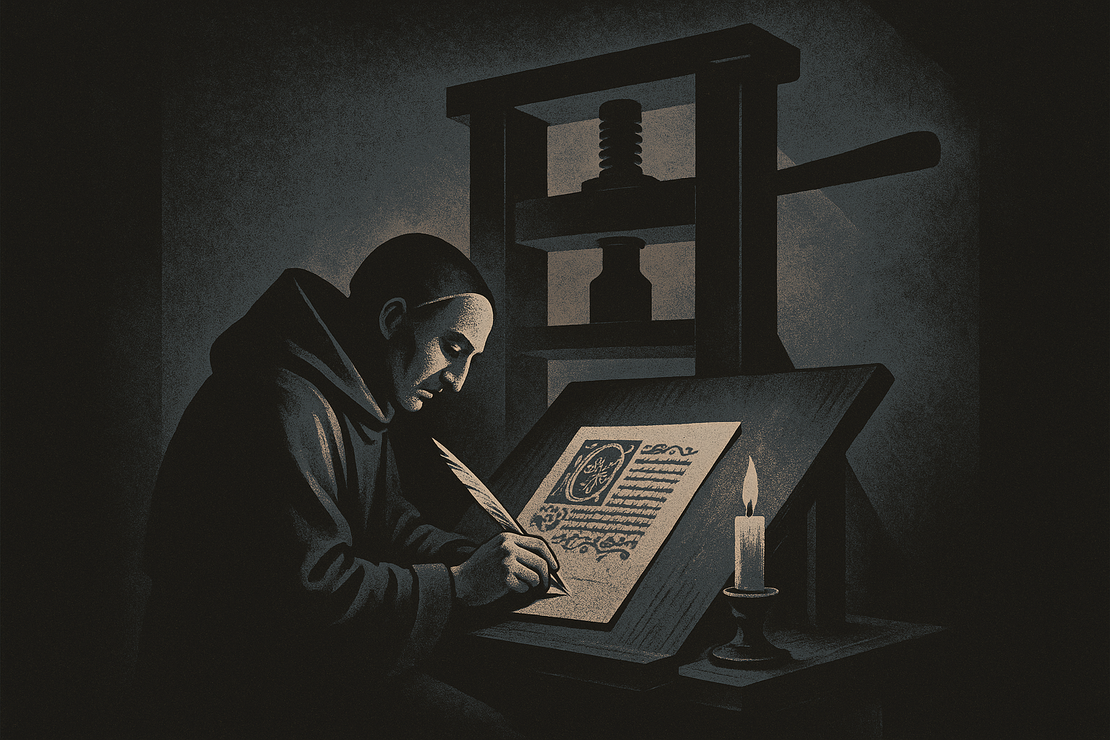
In 1492 a German abbot named Johannes Trithemius wrote a passionate defense of the monastic scribes, the monks who copied books out by hand, one letter at a time, the way it had been done for a thousand years. He was alarmed by the printing press. He argued that the copying was holy work, that a hand-inked page held a devotion no machine could stamp into paper, that something sacred would die if we let the contraption take over. It’s a genuinely moving little book with quotes like, “He who gives up copying because of the invention of printing is no genuine friend of holy Scripture.” He titled it In Praise of Scribes.
He had it printed.
I had not heard of Trithemius until recently but his complaint I knew well, it’s in my feed every morning wearing new clothes. The abominable machine makes too much, too fast. There’s no soul in it. The people who did the work the hard way are being buried under a flood of cheap product, and something we can’t quite name is slipping away. Every word of that is true right now, about AI. Every word of it was also true in 1492, about type — the scribes had every one of those complaints but the em-dash. That should tell you something, and it isn’t the comfort people usually reach for. It’s better than comfort. It’s an explanation.
Here’s the pattern, plainly, because the whole thing hangs on it. Every livelihood is a rent on a scarcity. Somebody can do a thing most people can’t, or can’t do fast enough, and the gap between what’s wanted and who can supply it is where the money lives. Cristiano Ronaldo’s scarcity is about doing something most of us can’t, and doing it better and longer than almost anyone. For his explosive athleticism, prolific goal-scoring, and unmatched work ethic, he charges the Al-Nassr soccer club north of $200 million a year in rent. The German scribe’s scarcity, while earning a bit less, still had real value for its time. The scarcity was literacy and patience. And the printing press erased it. The scribes were as good as they’d ever been; the craft simply stopped being scarce, and the rent died with it. The same reversal came for portrait painters and switchboard operators and the men who sawed ice out of frozen lakes for a living. It’s happening now, this decade, to a particular kind of person who makes things for a paycheck. I’m one of them.
The window nobody sees
We are terrible at seeing this while it happens, worse still at remembering it afterward. Only two generations ago a family could not only survive but thrive on one income. And not just fancy white-collar incomes with clean hands. Plumbers, electricians, and factory workers alike could support a family with one earner. One wage, a house, kids, a pension waiting at the end. Maybe even a Chevy Bel Air. That world was real, and it was recent, and it is thoroughly gone, and here’s the rub: almost no one can tell you why. Ask around. You’ll get “greed,” or “inflation,” maybe “NAFTA,” or just a shrug. The real answer is a tangle of a dozen threads — a postwar accident of scarcity we mistook for the natural order, a workforce that doubled, inflation, a second paycheck quietly bid away into the price of a house near a good school — and even the economists don’t agree on which thread pulled hardest. That disagreement is the point. When the people paid to explain it can’t, the rest of us were never going to.
That’s what it looks like once a window has closed: a new normal no one can quite explain, filling the space a whole way of life used to occupy. And the space where an explanation should be never stays empty for long. People will take almost any story that names a culprit, because a culprit you can point at — a neighbor, a newcomer, a them — always goes down easier than a tangle of forces with no face. A lot of the anger in any era is grief for a closed window, hunting for a face to blame. Which is the quiet, urgent case for naming the thing plainly: an explanation is what you reach for before someone hands you a scapegoat instead. The people who lived through those changes never saw the shape of them. We might, this time. We’ve watched it happen often enough to know the shape before it’s done. And naming it while it happens beats pretending it isn’t.
Now the one that’s ours
For about fifteen years, call it 2010 to 2025, you could make things — videos, posts, songs, newsletters — put them online, and if enough people liked them, make a living. Not usually a big one. Rent. A car payment. Enough to quit the other job. For a select few, a life-changing amount. We named it the creator economy, and the name did what names do: it turned a temporary arrangement into a permanent-sounding feature of the world, a career as solid as carpenter or nurse. Kids grew up planning to enter it.
It ran on a scarcity almost nobody inside it had to think about. There was more attention in the world than there was decent stuff to fill it, and the platforms were young and starving for supply. So they paid: cash, through ad splits and creator funds, and in kind, by handing your work an audience for free. People inside it thought they were being paid for talent. They were being paid for a bottleneck. Making something watchable still took a person, and a person has a body and a day and a limit, and that limit was the whole market. Your one good video could matter because there were only so many good videos a human could make in a week. That’s scarcity.
AI dissolves the limit. When a machine can turn out a hundred cute dance videos in the time you do one dance, the person’s day stops being the bottleneck, and the bottleneck was the business. You cannot outdance the machines. This is the scribe again, down to the bone. A scribe’s real product was time: the year a human hand needed to reproduce one book. The press didn’t out-write anyone. It made that year worthless. The model is doing the same thing to your day, and the day was what you were being paid for. Not the dance.
So that’s the hard part, no cushion on it. Here’s the part that consoles, and I mean the structural kind, the kind worth knowing.
What the camera did
Go back to 1839, the year the camera arrived in public. There was a whole working class of portrait painters — the jobbing ones, the people who made rent painting your beloved’s face for the parlor wall because a painting was the only way to keep it. Inside a generation the camera did their job faster, cheaper, and truer to life, and the floor fell out from under the portrait painting trade.
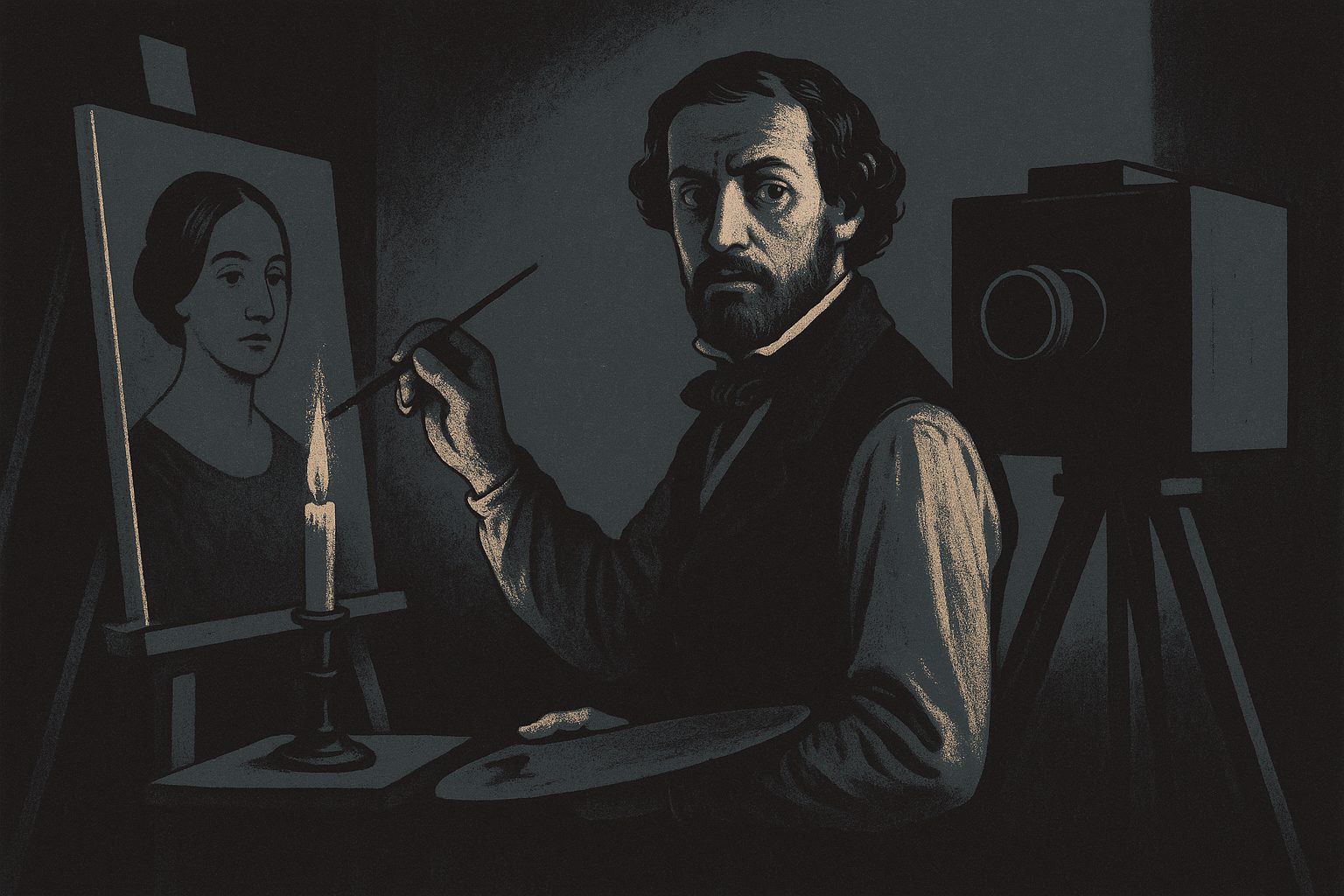 1839. The machine that would end the portrait trade, already standing in the studio.
But watch what it did to the painting itself. Once the machine owned accuracy, the painter had no reason left to chase it, and quit. The job of looking exactly like the thing was finished, and finishing it freed the brush for everything else: smear, suggestion, distortion, light, mood, paint that admits it’s paint. The blurry radical work we now file under Impressionism walks straight through the door the camera opened. Painting got fired from a four-hundred-year job and became more itself than it had ever been allowed to be.
That’s the shape worth carrying. When a machine takes the part of a craft that was only ever labor — the exact copy, the reproduced book, the daily quota of watchable stuff — it can free the human part to become what the labor had been crowding out. It doesn’t always. But it can, and it has, and knowing that is worth something while you’re trying to come to terms with machines perhaps displacing the thing you have to offer.
One caveat, because I’ve made that sound smoother than it was. The portrait painter who lost his living in 1845 did not get to enjoy Monet in 1875. He just lost his living, and telling him his ruined trade would one day set French painting free would have been a grotesque thing to say to a man who couldn’t feed his children. Precedent comforts the species, not the person it lands on. My friend Travis Foster has been a commercial illustrator for decades. He already survived one flood — the stock-art boom that gutted commercial illustration in the 2000s, when a nine-dollar download started beating a day’s work — and he did it by reinventing what he sold. Now he’s facing the second, the one that draws from a sentence in seconds, and whether he reinvents again or this is the flood that finally takes him is anyone’s guess. We may be holding paddles on different sides of the same leaky boat. Nobody’s told us how bad the leak is, either.
The old transitions took a generation, slow enough that a differently-trained kid could grow into the world that replaced you; the one we’re now facing is running in years, and speed is where the cruelty pools. And every window before this took one trade at a time, so there was always somewhere else to go: the scribe could set type, the portraitist could pick up a camera. This machine is coming for many trades at once, which makes “learn the next thing” a thinner promise than it’s ever been, because the next thing may be on the list too.
What the rent was holding up
There’s another hidden loss we don’t always register, and it’s easier to miss because it doesn’t land on any single person. Sometimes a rent is quietly paying for something that has nothing to do with the rent.
For most of the last century, the thing that funded local news was classified ads. Garage sales, used cars, job listings, apartments for rent. A newspaper had a near-monopoly on the small ads in its town, and the money from all that mundane commerce paid for the courthouse reporter and the school-board beat and the guy who noticed the mayor’s cousin kept winning the contracts. The journalism was almost a side effect; the ads carried it. Then Craigslist did the small ads for free, the monopoly evaporated, and the reporting it had been secretly subsidizing went down with the ship. We didn’t decide to defund local news. We just moved our garage sales online, and it turned out the newsroom had been living on that money all along.
And there it is. Watch me do the very thing this essay warns against. Craigslist. One company, one face, a culprit you can point at. The small ads scattered — Monster took the jobs, Realtor.com and Craigslist the apartments, AutoTrader the cars, eBay the junk in the garage — a dozen sites pulling the bundle apart at once, and no single one of them was the killer. Craigslist is only the name that stuck, because a name is easier to hold than “the classified monopoly came unbundled.” I knew all that walking in and reached for the face anyway. The reflex doesn’t spare the one naming it.
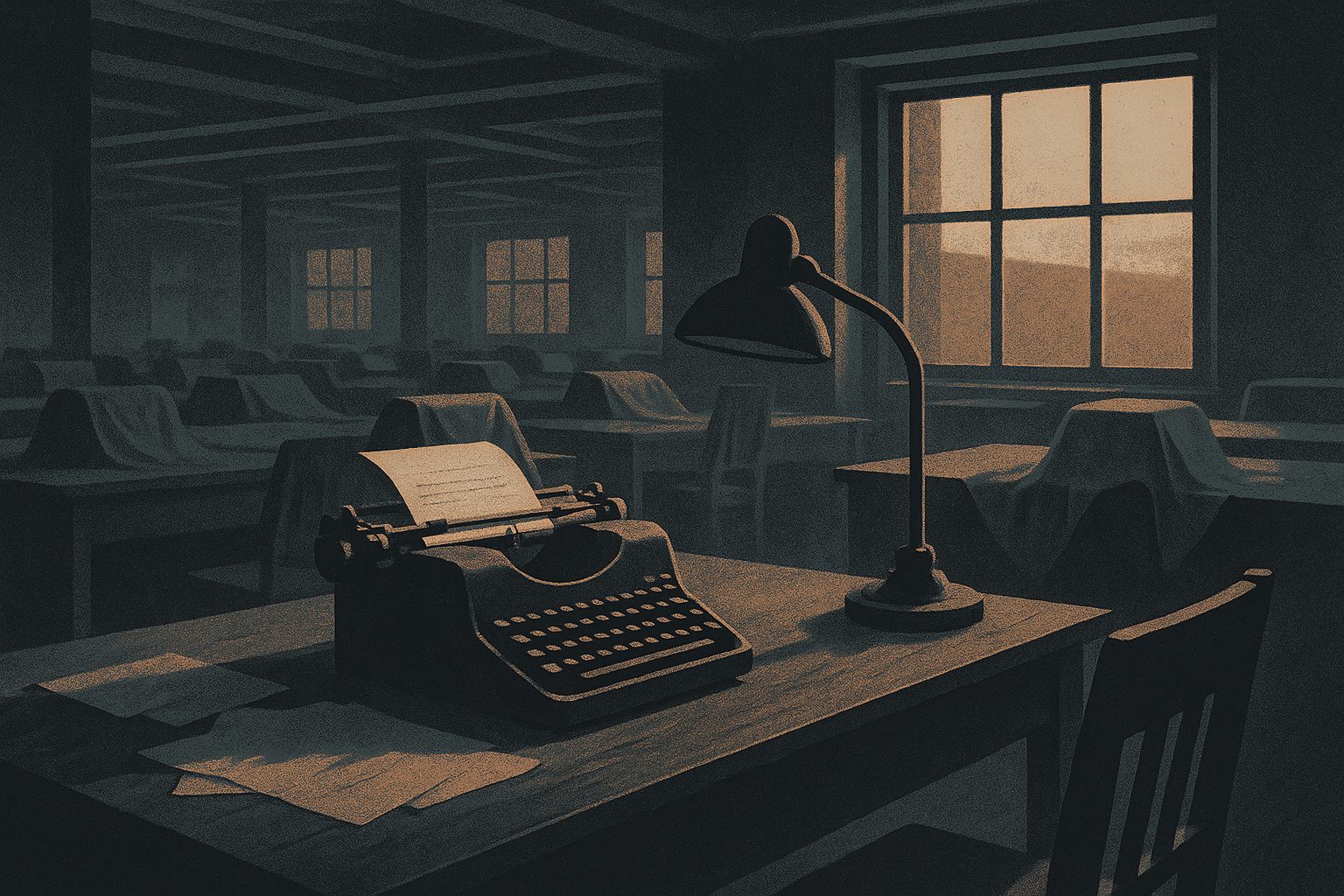 The watchdog's desk, after the ads that quietly funded it moved online.
Sit with that, because a rent almost always turns out to be holding up more than the person collecting it. So it’s fair to ask what the creator economy has been quietly funding, what rides on it that we’ll only notice once it’s gone. I don’t have a clean answer, which is why it’s worth asking rather than asserting. But I’d guess it’s the vast amateur middle: the millions of people making small, strange, specific things for the few hundred people those things were exactly for — the channel restoring one model of 1970s cassette deck, the newsletter on medieval bread, the woman mapping every mural in her city. That layer got as big as it did because it could almost pay, and almost-pays is the first thing to go when the money dries up. We may find, a decade from now, that we didn’t lose a job category. We lost a whole ecology of niche human attention we never knew we were renting.
Where the rent goes
So where does the rent go? Because it does go somewhere. It never simply evaporates; it relocates to whatever is still scarce. When one wage stopped being enough, the money families used to keep went somewhere: into the price of the few things still scarce, and mostly into land, the house in the right school district. The scarcity moved from labor to land, and the rent followed it there, quietly, where almost nobody thought to look.
Creation’s rent is moving the same way, and you can already see where. Once making the thing is free and infinite, the making stops being worth much, and everything the machine can’t flood is worth more: a real person on the other end of it, a relationship you can’t fake at scale, a life the work visibly came out of, the plain fact of having been there. Those get their own essays; this one just needs the shape. The value didn’t disappear when the making went free. It moved to the parts a machine can’t fake, and it’s waiting to see who follows.
Trithemius got one thing exactly right and one thing exactly wrong. He was right that something real was dying. The scribes weren’t imagining the end of their world, and neither is anyone watching the feed fill up with things no hand ever touched. He was wrong that it was the end of anything more than the scribes. Books didn’t get worse. There came to be more of them than any monk could have dreamed, and people learned to read who never otherwise would have, and the thing he loved survived in a form he’d have called vulgar and we call ordinary.
That’s the honest shape of it, held in both hands. We have done this before, many times, and lived, and that is true and worth knowing and it is not the same as “it’s all gonna be OK.” A window is closing on people right now who will not be made whole by the news that French painting once bloomed, or that the printing press democratized literacy. The pattern is real and the pain is real and neither one cancels the other. What I’ve got to offer is the explanation — a scarcity ending, a rent coming due the way rents always do — and that’s more than it sounds, because a loss you can see the shape of is one you can stand inside and maybe just maybe come to terms with. The scribes couldn’t see it. We can. We are not the first people to lose a world. We might be the first ones who get to know, while it’s happening, exactly what kind of loss it is.