Nothing Got Faster
Everyone assumes the machine made me faster. It didn't. What changed is that ideas stopped dying as fragments — and here's the record of one published paragraph being argued into existence, including the three times the machine was confidently wrong.
For about thirty years I had an idea problem, and it was never a shortage.
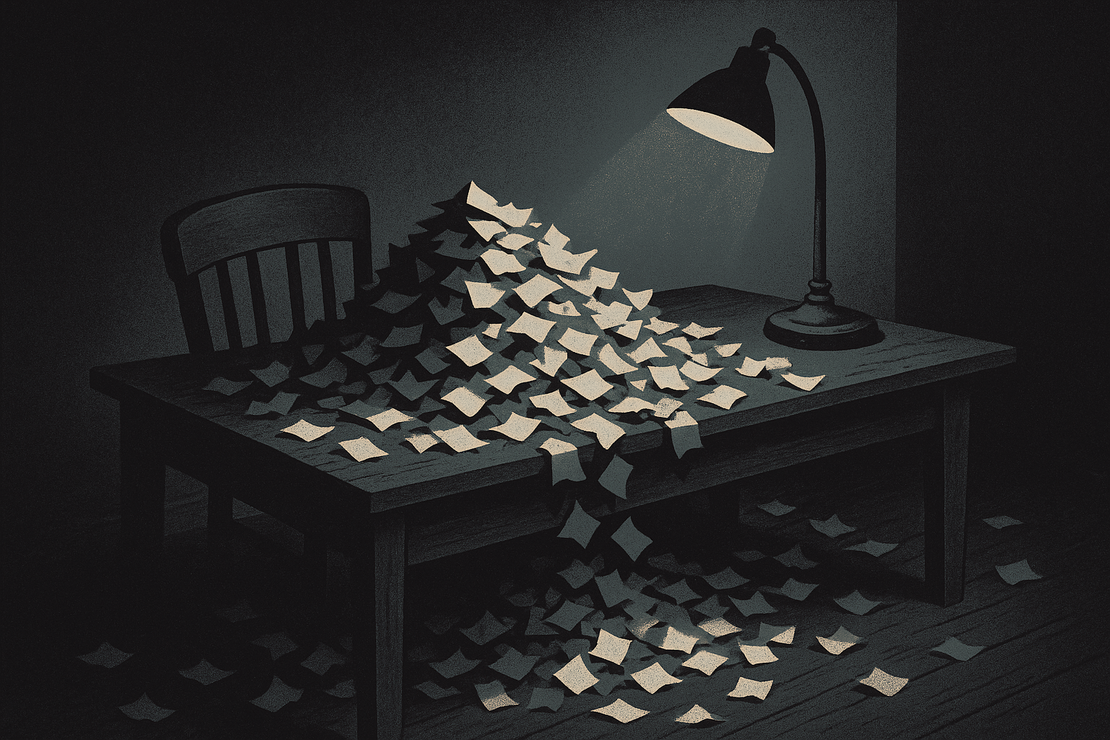
They arrived the way I assume they arrive for everyone, constantly and half-formed. Something I noticed in a parking lot. A connection between two subjects that had no business being connected. A line I’d read or heard in a podcast interview that snagged on something I couldn’t name. I wrote plenty of them down. They’re scattered in notebooks, text files, an email folder, the Notes app, anywhere I could flag things for myself as if leaving notes for a smarter roommate who never moved in.
Almost none of it became anything because a fragment doesn’t finish itself. You can look at it. You can copy it out more neatly. You can find it again four years later and discover it is exactly as unfinished as the day you filed it, which is a specific and unglamorous kind of loss, and I suspect most people reading this have a folder just like mine.
Since June I’ve published more than forty essays, and people who knew me before have noticed. The explanation they land on is always the same one, and it’s wrong.
The wrong explanation
The assumption is speed. The machine writes fast, therefore I write fast, therefore more essays. It’s a reasonable guess and it has the great advantage of being easy to check, which is probably why everyone reaches for it first.
I write at roughly the speed I always wrote. It might be faster than most, but that speed was never the point. Sitting down with a formed argument and getting it onto the page is the part of this job I have always been able to do, because I did it for money for fifteen years across six million words of computer books with incredibly aggressive deadlines and an expiration date. Drafting was never my bottleneck. If drafting had been my bottleneck, the notebooks would be full of finished things nobody wanted rather than unfinished things I did.
The bottleneck was upstream of the writing entirely. It was that a half-thought has no way to become a whole one on its own, and I did not have anybody to push on it. That could be a personal fault, I’m not sure, but it was a blocker nonetheless.
The gap was narrower than loneliness. I had friends, colleagues, a literary agent, a handful of editor friends. Nobody, though, who would sit with a fragment at eleven at night, take it seriously enough to argue against it, and still be there twenty minutes later when the argument turned. And then hang in there another two hours while I poked at it from a different direction. That is a genuinely unreasonable thing to ask of another person, and I never asked it.
So the fragments sat. That’s the whole story of the thirty years. The ideas were there and the hours were there. What turns a noticing into a claim is argumentative pressure, and pressure was the part I could never get.
What actually happens
I’ve written about the posture before, so here is only the short version: the useful configuration is adversarial, you bring a position and it pushes back, and the thing that makes it work is that nothing gets produced. That essay describes the loop from inside. What it doesn’t do is show you one.
So here is one, start to finish, on a paragraph you can go read. My side of it is exactly as I typed it. The machine’s side is trimmed to the lines that matter.
In August I published an essay called The Forge Was a Side Effect, which is the piece where I turn on my own advice and admit that the taste I keep telling people to build was a byproduct of work I would refuse to do again. It has a passage near the end where I try to explain how I can be choosing difficulty on purpose while also taking every shortcut on offer. That passage went through a version I hated, three replacements I rejected, and one correction that came out of the argument rather than out of either of us. The finished thing is public. Everything underneath it is what I want to show you. And yes, I did just refer to a machine and me working together as “us.” That was not a slip.
Three swings
Here’s where it started. I’d written a rough version; the response came back with six line-level repairs and a rewritten passage ending like this:
Its draft
Then I lean on the banked judgment to pick the difficulty back up on the far side, more as the manager now than the managed.
The repairs were real work and I want to be precise about that, because the flattering version of this essay would skip it. One fixed a comma splice and a tense wobble I hadn’t noticed. One swapped “that judgment and taste” for “the banked judgment,” on the grounds that my “that” had no antecedent within reach and that banked would quietly set up a line two sentences later about whether I’d have built any taste to spend. One caught that “back up on the back end” repeated a sound. Every one of them was offered as revertible, word for word, which is a small thing that matters enormously.
I read it and something was off, so I said so:
Me
I don’t love “manager than the managed” even though the idea is close to being right. Also manager undersells what I’m actually doing
Back came three replacements, with a confident recommendation. The best of them reached for the essay’s own metaphor:
Its draft
Then I lean on the banked judgment to pick the difficulty back up on the far side, the smith this time and still the steel.
That’s a good line. It’s better than what I would have written on a first pass, it’s built out of the essay’s existing imagery instead of imported from somewhere, and the case made for it was persuasive. I have no doubt I could have shipped it and been reasonably happy.
It’s also wrong, and I couldn’t tell you why for about a minute.
The part that only I could do
Then I could, and here is exactly what I typed, unedited:
Me
Hmm, I’m worried all of these miss because they don’t cover what actually happens - isn’t the idea that the real work is decision-making based on work done by delegated agents? Meaning, I used to be a single agent and the difficulty was doing every single piece of work, writing every word, coding every line, etc. Now I’m more in the Rick Rubin role (don’t reference him again, this is a reference just for here) of looking at every granular piece of agentic work and deciding “again, funnier” or not
Notice the hyphen in there, my quick and dirty stand-in for an em-dash, the mark everyone now calls the number-one AI tell. Yes, that’s how I actually write, even in prompts. The reply began:
The machine
That’s a sharper idea than any of my three.
Three swings from a machine that had just made six real repairs to my sentences, all three missing, and the thing that landed came out of me at eleven at night in a message with a stray hyphen in it. That’s the argument of this whole essay and I didn’t have to make it. It happened, it’s on the record, and I’d have shown you the version where I was wrong if that’s how it had gone.
The parenthesis is the most useful part of the transcript. Don’t reference him again, this is a reference just for here. I reached for a person I’ve written about before to think with, and in the same breath I fenced him off from the text. The discussion is allowed to contain things the essay is not. That distinction is most of what I actually do now, and I have never once managed to explain it as economically as that accidental aside does.
Then a thing happened that I want on the record for the opposite reason. I’d mixed two sources in that message without noticing. Rubin is music. Again, funnier is what a marketing director typed at a machine until it sounded like my friend Terry, and I had a whole unpublished essay parked under those two words. The response recognized the phrase, stopped, and went to check that file, the one that became Again, Funnier, on the grounds that one essay shouldn’t spend another one’s core idea. That’s a rule I wrote, applied to me, by the tool, at a moment when I had forgotten it. Nobody’s judgment was overridden there. Mine was simply absent, and the checkpoint held anyway. I’m a forgetful human, mind you, and I know it.
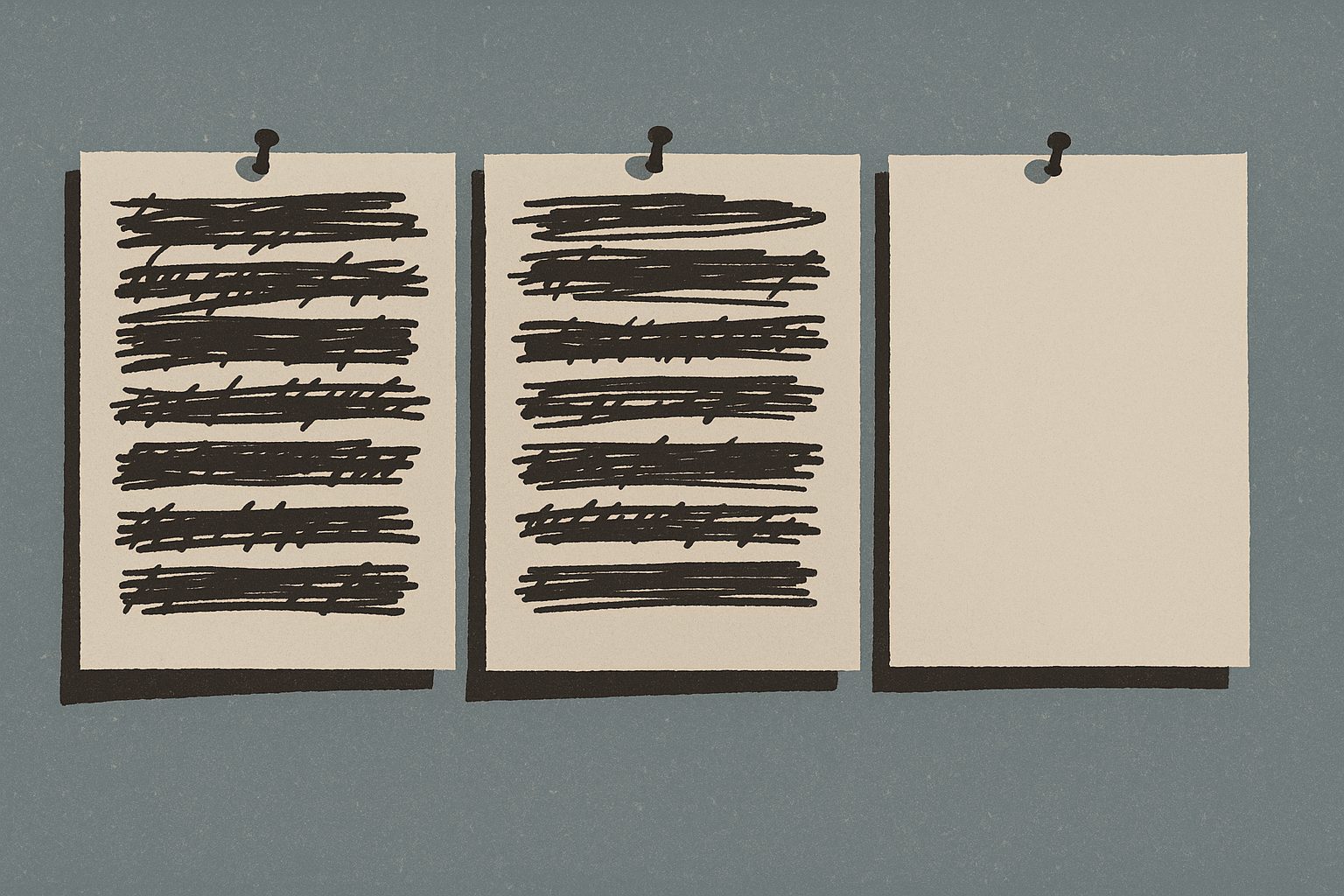 Three passes at one paragraph. The third one is the one you can go read.
The passage that came back is the one that published:
Published
From inside it’s a change of unit. I used to be the only pair of hands; the difficulty was doing every piece of the work myself, every word, every line of code. Now the pieces come back finished, and the difficulty I kept is the verdict on each one: hold it, send it back for another pass, or kill it outright.
Which was right, and still short one thing, so I went again:
Me
All it’s maybe missing is why the thousand small verdicts are still difficult. And I think that can echo back to the rote rests - everything I weigh in on now is a real decision, there’s no busy work, and they are relentless
And that produced the clause the paragraph actually needed, the one that makes it land instead of merely explain:
Published
And nothing dilutes them anymore: every one is a real decision, the busy work that used to space them out is gone, and they do not let up.
What the record shows
Three messages from me. The machine repaired sentences I’d have shipped flawed, missed the central idea three times running, and caught a rule of mine I’d forgotten. I supplied the one thing it couldn’t reach.
I can’t give you a percentage of me versus the machine in the finished product and I’m not going to try, because the unit doesn’t exist and any number I invented would be a worse description than the transcript. What I can tell you is what the shape looks like: the stops were mine, the language was collaborative, and the one moment that decided what the paragraph was about came from thirty years of me.
That’s also the answer to the thing people are really asking when they ask about speed. Nobody types write me an essay comparing the printing press to AI and gets Nobody Told the Scribes. The fifteenth-century abbot who published a defense of hand-copied manuscripts and had it printed doesn’t fall out of a superficial prompt. He’s the end of a long argument about what a closing window does to the people inside it, fearful people like me, and finding him took a night of pushing on a fragment that had been sitting in a file, unfinished, for a long time.
This points to what may be the real superpower the machine has unlocked in me, and I’ve been slow to see it: the ability to harness a lifetime of random hobbies, interests, and ideas and direct them creatively.
The part I can’t resolve
Still, none of that gets me out of the crack the Forge essay opened. The fragments resolve now. But I have no way of knowing whether the ones that resolve are the ones that deserved to. The machine has no opinion about which of my half-thoughts were worth finishing and which were delusional or vain; it will help me finish a bad one with exactly the same energy, and it will do it well enough that I might not notice. The old process had a brutal filter built into it, which is that finishing anything cost so much that only the ideas I couldn’t stop thinking about survived the expense. I did not choose that filter. I have not replaced it with anything.
All I know for certain is the bottleneck moved, the fragments got finished, the output went up, and none of that is speed. What I lost was a filter I never knew I was running, and what I’d like to know, and can’t, is how many of the things in those notebooks would have died of neglect and deserved to.