Six Notes Down
The bass riff under Ice-T's I'm Your Pusher is six notes long. Getting to the bottom of them runs through a 1972 nightclub scene, a garage in LA, two misread anti-drug records, a rap beef settled by the Zulu Nation, and a shark movie.
I bought Ice-T’s Power on vinyl the year it came out, and the standout single from the jump was “I’m Your Pusher.” The bass riff under it has stuck with me for almost forty years. It’s six notes long.
This is the first post of Tiny Bass Lines, a weird little project where I’m learning favorite bass lines on a Fender Fullerton ukulele bass and filming them on the coping of my mini ramp between skate sessions. The name works both ways: tiny bass, tiny lines. It opens with old-school hip hop, where the idea came from, and goes out from there. Each post is one line, where it came from, and a tab, with the playable version living at tinybasslines.com.
I’m a beginner on bass, and at music in general. How a Nashville native got this far without an instrument is its own story, and so is the day a luthier friend decided I counted as a bass player anyway. I struggle with plenty. Recreating timing I hear isn’t one of those things, and that makes this riff the right place to start: a handful of notes, endlessly repeated, where the whole job is holding each one for exactly the right length and muting the one that would ring over.
The album has a memorable cover photo with Ice-T, DJ Evil E, and his then girlfriend Darlene Ortiz in a swimsuit with a shotgun. The photo was shot by Glen E. Friedman, the same Glen Friedman whose pictures of Dogtown-era skaters ran in SkateBoarder. A skate photographer framed a riff I’d end up playing on a skate ramp. I’ll take that as permission.
I’m going to take the long way to the tab. Six notes, two bars, looped for five and a half minutes in 1988, turn out to have a lot of history packed into them, and most of it explains something you can hear. If you just want to play it, skip to the line.
A song for a nightclub scene
In early 1972 Gordon Parks Jr. was making his first feature, Super Fly, on the streets of New York. He wanted Curtis Mayfield and his band in it, playing the act in a nightclub while the story happened in front of them, and he needed a full song for the scene. That request is where the whole Super Fly soundtrack started.
The song was “Pusherman,” and it was recorded first, at Bell Sound in New York, during the same stretch as the filming. Months later the rest of the album got cut in Chicago, with Johnny Pate writing arrangements for a full orchestra and Morris Jennings on drums. “Pusherman” has none of that. It’s the only track on the record with Tyrone McCullen on drums and the only one without Pate’s strings and horns. It’s the working band, close to how they’d sound in a club.
That’s why the bass is so exposed. With no orchestra stacked on top, the bass line carries most of the song’s structure, and the man playing it was Joseph “Lucky” Scott: a Chattanooga kid in his early twenties, nephew of the Impressions’ Sam Gooden, who became Mayfield’s bassist and then his musical director. Scott played a Fender Jazz with flatwound strings and plucked hard enough that the notes land almost like drum hits. He didn’t read music when he started.
He’s also in the movie. The cast list credits him as himself, a member of “The Curtis Mayfield Experience,” on the nightclub stage with Mayfield, Master Henry Gibson, Craig McMullen and McCullen. Somewhere in a 1972 film print, the line I’m trying to play is being played by the person who made it up.
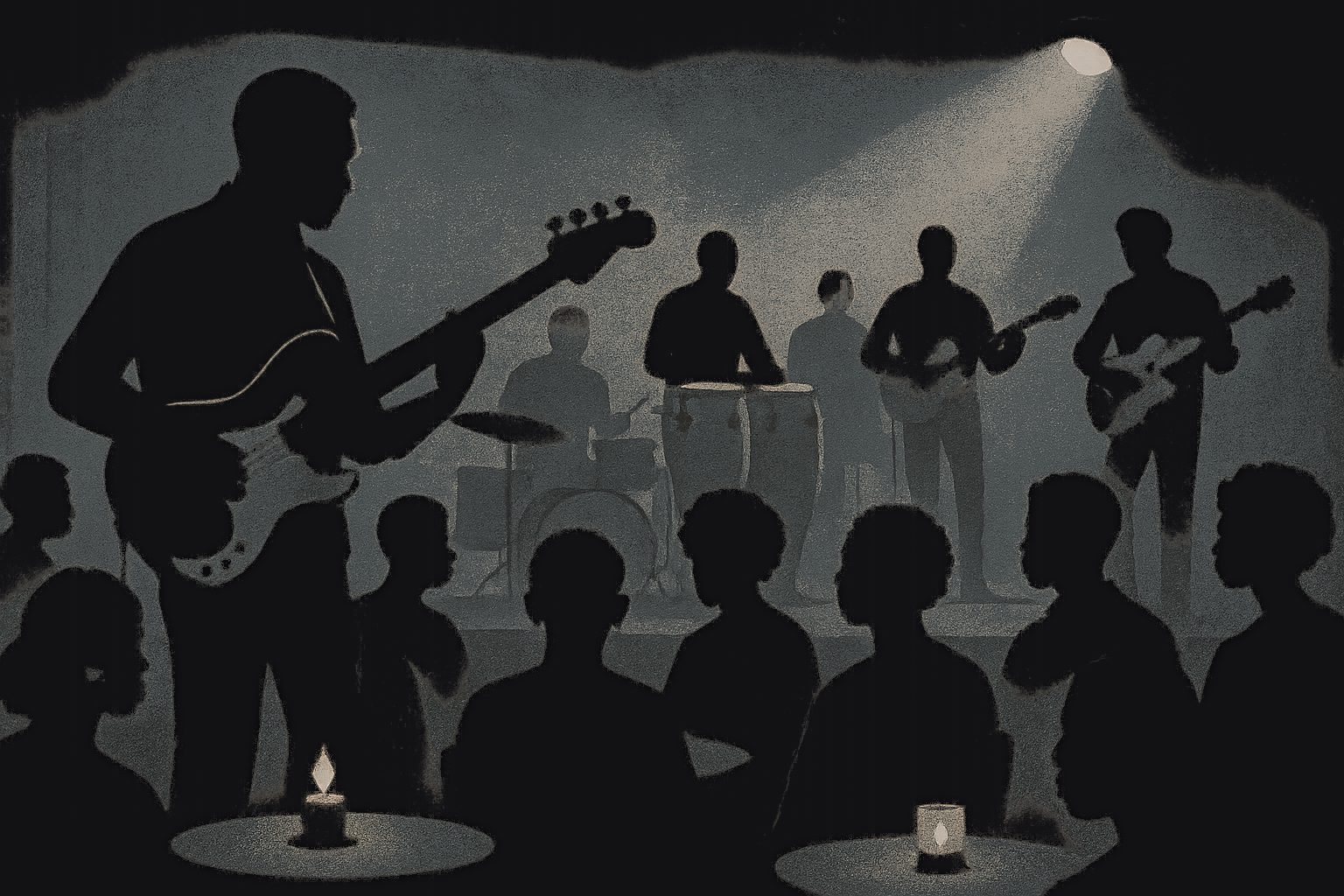 Pusherman was written for a nightclub scene, and the band that cut it played it on screen.
I couldn’t find anything from Scott about how he came up with it. If he ever talked about it in an interview, I haven’t found it yet.
Mayfield against his own movie
Super Fly is a film about a cocaine dealer who wants one last score, and it was accused, then and since, of making that life look great. Curtis Mayfield more or less agreed. He thought the film treated dealers too neutrally, and he wrote the soundtrack to argue with it. His widow, Altheida Mayfield, later put it bluntly: “Curtis thought ‘Super Fly’ was a commercial to sell cocaine.” The songs were his rebuttal. “Freddie’s Dead” is about a man the business uses up. “Pusherman” is sung from the dealer’s side, and it makes the dealer sound like what he is.
It worked, commercially at least. The album hit number one, sent “Freddie’s Dead” and “Superfly” into the top ten, and outsold the movie it was attached to. In 2019 the Library of Congress added it to the National Recording Registry, its short list of recordings judged important enough to American culture to preserve for good.
Hold onto that setup, a song written against drugs and dressed up in a dealer’s clothes. It’s about to happen again.
A garage in LA
By 1988 Ice-T was a few years into being the rapper LA had to offer New York, and his producer was Afrika Islam. Islam was twenty-one and already had a long résumé. He grew up in the Bronx as Afrika Bambaataa’s apprentice in the Zulu Nation, joined the Rock Steady Crew at ten, and hosted Zulu Beats on WHBI in 1981, often called the first hip hop radio show. He’d come out to LA to DJ, met Ice-T, and ended up producing nearly everything on his first three albums.
Their pick of “Pusherman” was deliberate. Ice-T has said his image at the time was the player, the hustler, so they went into the Super Fly album and decided to build his music on blaxploitation records. The song was meant to set up a look as much as a sound: a rapper in a perm and tailored clothes, who didn’t look like Run-DMC.
What they didn’t do was sample it. Ice-T has told the story of making the track in DJ Evil E’s garage, on a fourteen-track machine with a vocal booth built into a closet. His friend Pimpin’ Rex was hanging around, not booked for anything, and Ice-T told him to get in the closet and sound like Curtis Mayfield. Rex did. That’s him singing the hook, credited on the sleeve as “Pimpin’ Rex (Royal Majestics).” Mayfield gets a songwriting credit on the record because his song was re-sung, not lifted.
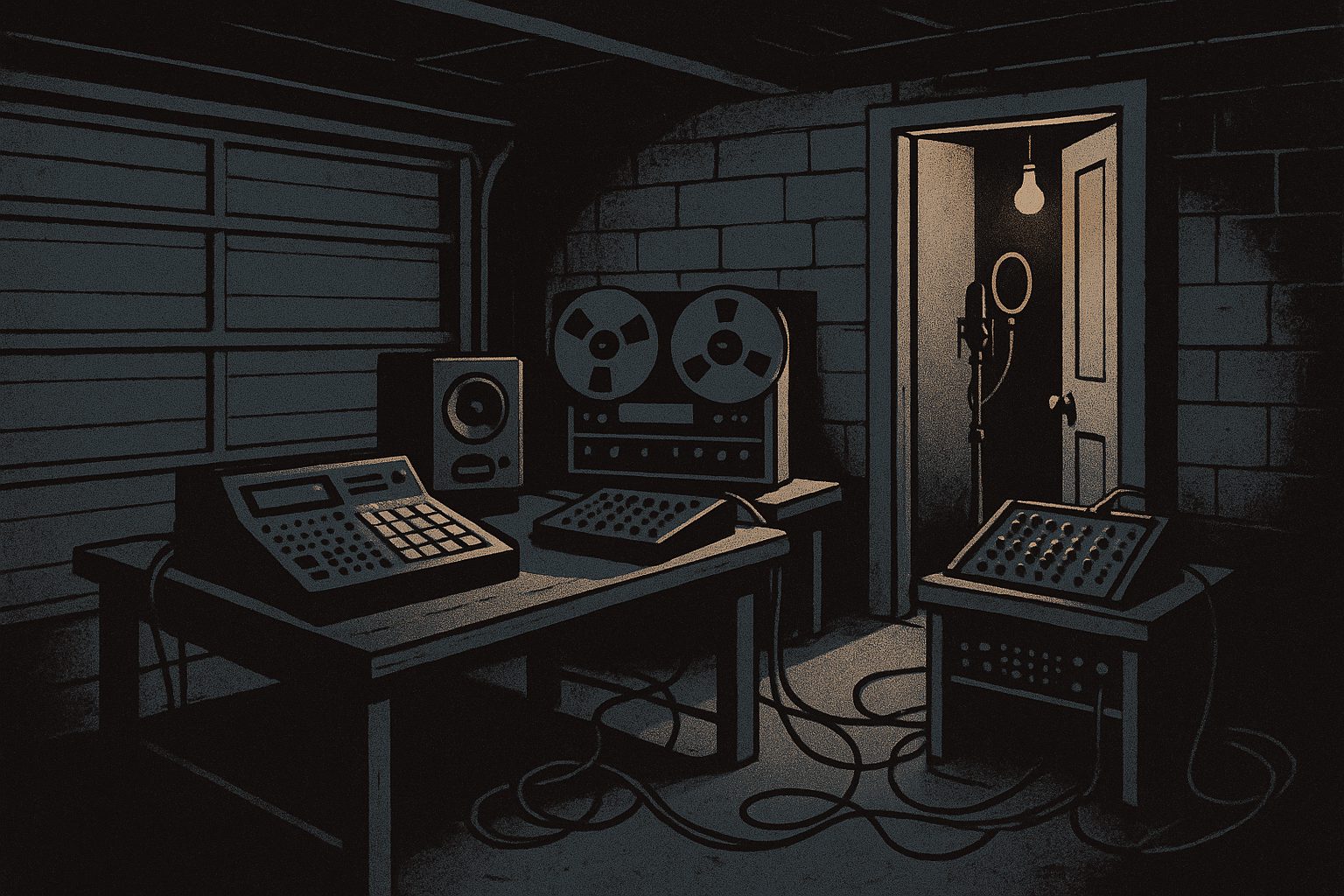 Syndicate Studios West: a garage, a 14-track, and a vocal booth in a closet.
The bass got the same treatment, played on a keyboard instead of sampled. No musician is credited anywhere on Power. The only credit that touches the instruments is “Programmed by Afrika Islam,” which fits Islam’s background. He came up in the Zulu Nation, where “Planet Rock” was built on Kraftwerk. Yes, that Kraftwerk, the German electronic band: Bambaataa borrowed the melody of “Trans-Europe Express.” And Ice-T’s first records came out on labels called Techno Hop and Electrobeat. An electro crew rebuilt a 1972 bass line on a synth, and it sounds exactly like that.
Ice-T later called “I’m Your Pusher” the first rap record with a singing hook, and said the hit felt like cheating, too easy, so he never did it again. The second half I believe. The first half doesn’t survive Whodini’s “Friends” from 1984, or Steven Tyler singing the hook on Run-DMC’s “Walk This Way” in 1986, or the one I thought of first, T.J. Swan crooning the hook on Biz Markie’s “Nobody Beats the Biz” in 1987. A sung hook was certainly unusual on a rap record in 1988, it just wasn’t new. Ice-T has never been one to undersell.
The same misunderstanding, twice
“I’m Your Pusher” came out in August 1988, in the worst years of the crack epidemic, deep in the “Just Say No” era, a few months after Ice-T’s “Colors” put LA gang life on movie screens. A rapper releasing a single called “I’m Your Pusher” that year was going to get heard a certain way.
The joke is that the product is the record. Ice-T’s pusher deals tapes and twelve-inches, and the high is the beat. Ice-T didn’t sell drugs before rap. His old hustles were a different department, which LL Cool J would bring up later. On Larry King he described the song as an anti-drug record about getting high on music. Plenty of people heard the title and stopped listening there.
So it happened twice. In 1972 Mayfield wrote anti-drug songs for a movie people thought was selling drugs. In 1988 Ice-T took Mayfield’s song about a dealer, kept the costume and the rhythm, swapped the merchandise, and got accused of selling drugs anyway. Sixteen years apart, the same song got misread for the same reason.
Turning down LL
There’s a moment in the middle of the song where Ice-T plays record dealer and LL Cool J’s records get waved off. In 1988 that was pointed. LL was the biggest solo star in rap, a year past Bigger and Deffer, and Ice-T has said the problem was simple: LL kept saying he was the greatest rapper alive, and an LA rapper who let that go wasn’t going to be taken seriously in New York. A lot of writers have decided it was about LL going soft with “I Need Love.” That’s their theory, not Ice-T’s.
It didn’t stop there. Ice-T went harder on “The Syndicate,” on the same album, mocking how many times LL tells you he’s bad on one record. LL waited a couple of years and answered on “To da Break of Dawn” in 1990, a diss track with room for Kool Moe Dee and MC Hammer too. His shots at Ice-T went after the perm and the car-thief past.
Then it just ended. Afrika Bambaataa, Islam’s old mentor and the head of the Zulu Nation, shut it down. LL wanted to be part of the Zulu Nation, and that settled things. Ice-T has called the whole thing record business, with nobody’s life on the line. The two of them didn’t actually meet until about 2012, when they ran into each other in Monte Carlo at a television convention.
That’s the part I love, because of why they were at a television convention. Ice-T played his first cop in New Jack City in 1991 and has played a detective on Law & Order: SVU since 2000. LL spent fourteen seasons as a federal agent on NCIS: Los Angeles. And ten years before NCIS, he was the cook in Deep Blue Sea, the guy with the parrot who outlasts the sharks, and for a lot of people that’s still who LL Cool J is. The record dealer and the guy he wouldn’t stock both ended up with badges. A whole generation knows them as TV cops and has no idea one of them once turned the other’s records away.
For the record, I’m not picking a side. “I’m Bad” is one of my favorite records of that whole era, and it’s on my list for this project.
The line
Here’s “I’m Your Pusher,” with the drums. Hit play, then mute the bass and play along.
Hold the E, and don’t play the one
Everything hard about this riff is in the holding and the stopping. The fretting hand barely has a job: two frets and an open string, no shifts. What took me a week was the E at the end of bar one. It arrives a little early and keeps ringing over the start of the next bar, so the bass plays nothing right where every instinct says to play. The drums hit the downbeat and the bass refuses to. I’d been doing that by feel for years, humming along, without knowing it was the whole trick.
Then I saw it written down. Notation still makes me count on my fingers, so I’m learning it one line at a time, on lines I already know by ear, and Pusher’s lesson was the tie: the curved line that splits the E at the bar line and joins it back together. That curve is the notation’s way of saying what my ear already knew. Hold the E. Don’t play the one.
The riff also taught me to ask what scale a line is in, which is apparently the first question and the one I’d never thought to ask. This one more or less is its scale, played downhill: jump up, walk home. That settled the one note I play differently from the machine transcriptions, an A where they hear a G-sharp. The A is in the scale and the G-sharp isn’t. It isn’t Lucky Scott’s note either; he took that spot somewhere else entirely. I’m keeping the A.
It took me a while to hear why that matters. The first bar walks with the drums. The second leans against them, the bass dodging every place the drums land, and the space between the two is the groove. A synth could keep that in 1988 while losing Scott’s slides, which tells you which part mattered.
The uke bass, for once, is the right tool
The 1988 bass is a synth. The 1972 bass is a man with a Jazz bass and a heavy right hand. Playing it on a uke bass means skipping a generation.
Most uke basses use fat polyurethane strings that thud. The Fullerton is unusual: it ships with metal roundwounds, nickel wrapped over a nylon core. Roundwounds are the bright, ringing kind, the opposite of the flatwounds Scott played, so on paper this is the wrong string for the job.
In practice it gets closer than you’d expect. The short scale keeps the tension low and the notes don’t hang around, and a hard pluck near the neck with the tone rolled back takes off most of the shine. A hard, percussive attack with a quick decay is a lot of what “Pusherman” sounds like at the bottom. I can’t get his tone on a uke bass. I can get nearer to it than the instrument has any right to.
The note-by-note breakdown, where your fingers go, how to read the notation, and a printable line sheet are all at Tiny Bass Lines.
Somewhere in a 1972 film print Lucky Scott is on a nightclub stage, making this up. In 1988 a guy in a garage closet is singing Mayfield’s words back at him over a keyboard doing an impression of his bass. I’m the third one, on a ramp, with the record I bought when it was new, still trying to get the E to last exactly as long as it should and still not playing the one.