
The Anti-Engagement Product
There is a class of product whose success metric is the user disengaging: falling asleep, finishing the book, putting the controller down. Sojourn is one. Almost everything in the standard playbook inverts.
Sojourn, the bedtime-story app I’m building, has a success metric that most product people find hard to accept. The metric is that the listener falls asleep. The numbers a product person lives by — session length, retention, daily actives — all point the wrong way here. The whole machine is tuned to end the session as quickly and gently as it can, and then to not only be entirely fine with you not opening it again tonight, but to celebrate that. The audio fades to silence on a timer. There is no streak, no notification, no come-back-tomorrow nudge, no social anything. The product is, in the most literal sense, trying to get rid of you.
I used to think that made Sojourn a strange exception. It doesn’t. It makes it a member of a category that is everywhere, that has existed for centuries, and that the software industry has almost entirely forgotten how to see: products whose success is the user leaving.
I wrote in The Intimacy Economy about Sojourn as an intimacy-economy product, built for two specific people instead of an audience. Here I look at it from a different angle: what the product is trying to get them to do, which is stop using it.
The inversion
Walk down through the design and the inversion is at every layer. The narrative decelerates on purpose; the writing is a deceleration curve, sentences settling rather than escalating. The audio thins out as the session goes. The interface, such as it is, gets quieter, not louder, the longer you’re in it. The whole product builds a ramp toward the user closing their eyes and the screen going dark, and then it congratulates itself by going dark too.
Set that against the default consumer-software product and you can see how strange it is. The default product is a slot machine that has read your file. It measures its own health in how often you return and how long you stay, it fights every exit with a notification, and a session that ends with you putting the phone down and not picking it back up is, on the dashboard, a small failure. Sojourn is built to manufacture exactly that failure, on purpose, every night, and to call it the win.
That’s a category, not a quirk of one app, and the category needs a name, because you can’t defend a thing you can’t say. Call it the anti-engagement product: a product whose interaction loop is designed to terminate, and whose success is measured in the cleanness of the termination.
You already own a dozen of them
The reason the category feels exotic is that we’ve only recently started expecting software to retain us. Step outside software and the anti-engagement product is the normal kind of thing, not the weird one.
A book is an anti-engagement product. It wants to be read and then closed, and a great one wants to be finished and kept on a shelf where you do not interact with it for years. Publishing always knew how to measure this — read-through, completion, whether it earned its place on the shelf — even while the rest of consumer software was busy forgetting that completion was ever a metric.
A single-player game with an ending is an anti-engagement product. The credits roll. It does not chase you back with a daily reward. Its success is that you spent your last session with it reaching the end of the story, which is to say the best outcome the product can produce is that you are now done with it forever. The games that understand this make their closing hours their best hours. The ones that don’t bolt retention loops onto a story that wanted to end, and they feel worse for the trying, like a dinner guest who won’t leave.
Closure. How did we let it slip away? Imagine a movie where instead of the credits rolling at the end, it just asks you to stay around another two hours for the sequel, and when the sequel ends you’re hit again from a new angle you weren’t expecting to go ahead and finish the trilogy right now. But wait, don’t get up, there’s bonus content with a Q&A queued up to watch at hour seven.
The failure we sense in that sequel that didn’t need to get made even has a name. We all have an internal sensor for the moment a beloved series has run out of things to say and keeps going anyway, and we named it after the Happy Days episode where Fonzie jumped a shark on water skis. Jumping the shark is just attention-grasping in narrative form: the franchise milked a few seasons past its own ending because the IP still prints money, degrading a little with every grasp. The rarer and braver move is the show or film that believes in itself enough to stop while it’s still the thing you loved, and lets its success be a finished shape instead of an open vein. Knowing when enough is enough is a creative decision and an anti-engagement one, and it costs the same thing both times: the money you would have made by refusing to leave. Two examples of the latter I encourage you to seek out if you’ve never watched: Extras and Patriot, which each called it done after two seasons (Extras allowed itself a single farewell special) and are glorious for doing so.
A habit-busting recovery app, done honestly, is the purest case of all: its success is that you no longer need it. The discipline that has thought hardest about ending a relationship well isn’t in consumer tech at all. It’s in clinical practice, where the word for it has been “termination” for a hundred years, and where ending the relationship cleanly is understood to be the whole point of the work.
And the long unsexy tail of physical tools — the kitchen timer, the corkscrew, the good hammer — are all anti-engagement by default. None of them wants your attention. They want to do one thing and be set back down. We only started treating “wants your attention” as the natural state of a tool when the tool moved onto a screen that could be sold ads. As much as I appreciate the comedic value in a hypothetical hammer that nudges you to literally see every problem as a nail so it can sell you car insurance, I’ll respectfully decline.
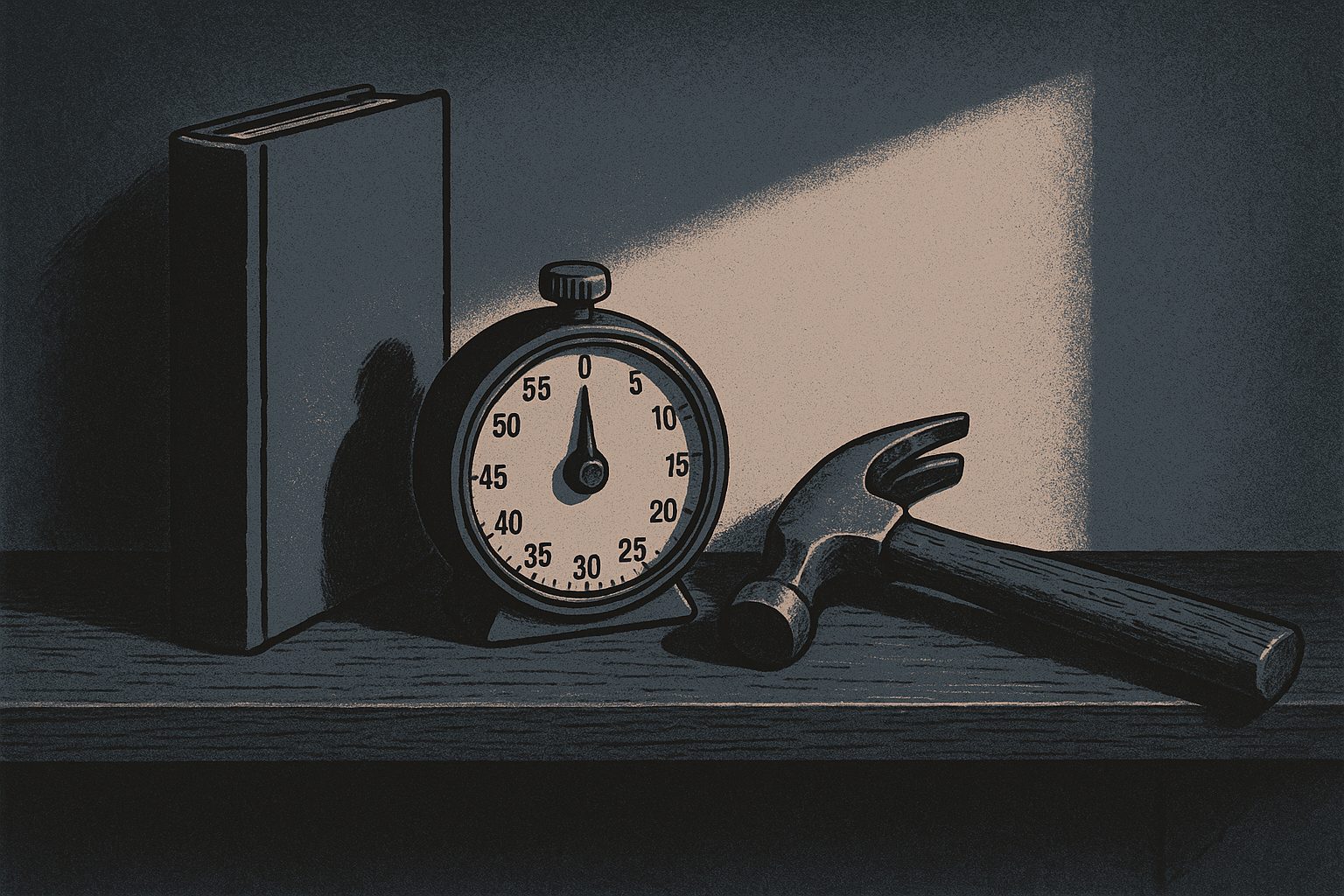 Tools that do one thing and get set back down.
What it actually takes
If you wanted to build an anti-engagement product on purpose, the shape is recognizable. The interaction loop has a built-in end state and the product steers toward it instead of away. Success is measured as completion (read-through, the session finished, the ritual performed, the artifact made, the credits rolled) and not as return. Re-engagement is the user’s decision, never the product’s solicitation — and the first thing that rules out is the “we miss you” email three days after you stopped, the most passive-aggressive sentence in software. The visible, idle state of the product is quiet. And somewhere there’s a terminal artifact, a thing that holds the cumulative value without demanding per-session loyalty: a finished book, a completed arc, a kept object that exists outside the app and survives it. It’s that memory stick I bought at the Trashcan Sinatras show that I referenced in The T-Shirt Economy, which served as a digital keepsake of that one-off experience.
The hardest of these to fake is the willingness to let you not come back tonight. You can dress up a retention-first product as anti-engagement, and the whole wellness-app aisle is full of exactly that: engagement maximization in a soothing voice, the same casino with a soft-spoken celebrity trying to keep you coming back with a meditative hook. Real anti-engagement has to be in the architecture. It’s the difference between a product that is relaxing and a product that is, structurally, trying to lose you, and means it.
Why there are so few
If the category is so old and so natural, why is it rare in software specifically? Four reasons, and none of them is that the products are bad.
The business model fights it. Subscription economics assume the user comes back monthly, and the team gets paid to make sure they do. An anti-engagement product can absolutely use a subscription, but it has to be honest about what the subscription buys: the standing option to use the thing, not the obligation. You can ignore Sojourn for two weeks and lose nothing, then open it on a Tuesday and it works exactly as it did the last Tuesday you needed it. That’s a clean value proposition and a miserable thing to defend in a board meeting.
The money fights it. Every consumer pitch deck has a DAU (Daily Active Users) chart, because for two decades engagement has been the agreed-upon proxy for value. An anti-engagement product is a bad pitch by definition. “Here is the graph of people using our product less, which is good” is a true sentence and an unfundable one, so the founders have to be more patient, or get their money somewhere stranger.
The playbook fights it. The vocabulary of consumer growth — funnel, retention, virality, churn — is the vocabulary of engagement maximization. There is no equivalent body of received wisdom for the other direction. “It’s the app that wants you to leave” is an accurate description of Sojourn and a headline I would not wish on a marketing team. So I wish it on myself instead.
And the theory fights it. If the value isn’t in time-on-product, you have to be able to say what it is in — the artifact, the ritual, the cumulative effect, the trust — and naming that takes real work, more work than pointing at a dashboard and saying “number go up.” Designing for cessation is harder than designing for engagement, not easier, because every default in the toolchain leans the other way. You are sanding against the grain of every framework you’re handed. Yet I still think it’s worth the doing.
What carries Sojourn
I’ll keep this short, because the relational half lives in The Intimacy Economy, and just name the anti-engagement load-bearing parts. The terminal artifact is a small and entirely optional one. At the end of a season, if a set of stories happened to be worth keeping, you can have them printed into a real book and mailed to you, a physical keepsake of the nights you spent reading them aloud. It isn’t a goal the product nudges you toward or a level you clear; it’s just a nice thing to be able to do with stories that turned out to mean something. And that’s exactly why it counts as anti-engagement: whatever value it holds lives on a shelf, outside the app, and never once asks you to come back tomorrow. The subscription pays for the option, not the streak. Falling asleep is the terminal state, treated as success and not as a problem to be re-engaged; there is no “you didn’t finish” guilt-trip, because finishing wasn’t the point and sleeping was. And the deepest cut: the listener, one of the two people the product is most for, has no interface at all. The product’s surface area to them is zero. You cannot engagement-maximize a person you never touch.
The AI underneath all of this isn’t incidental, but it isn’t the point either. It’s what lets one person produce a deep catalog of stories at a register a tired partner will accept, which is the thing that makes the whole quiet, unscaled, un-engaging configuration affordable to attempt at all. The machine is in the basement so the room upstairs can stay dark.
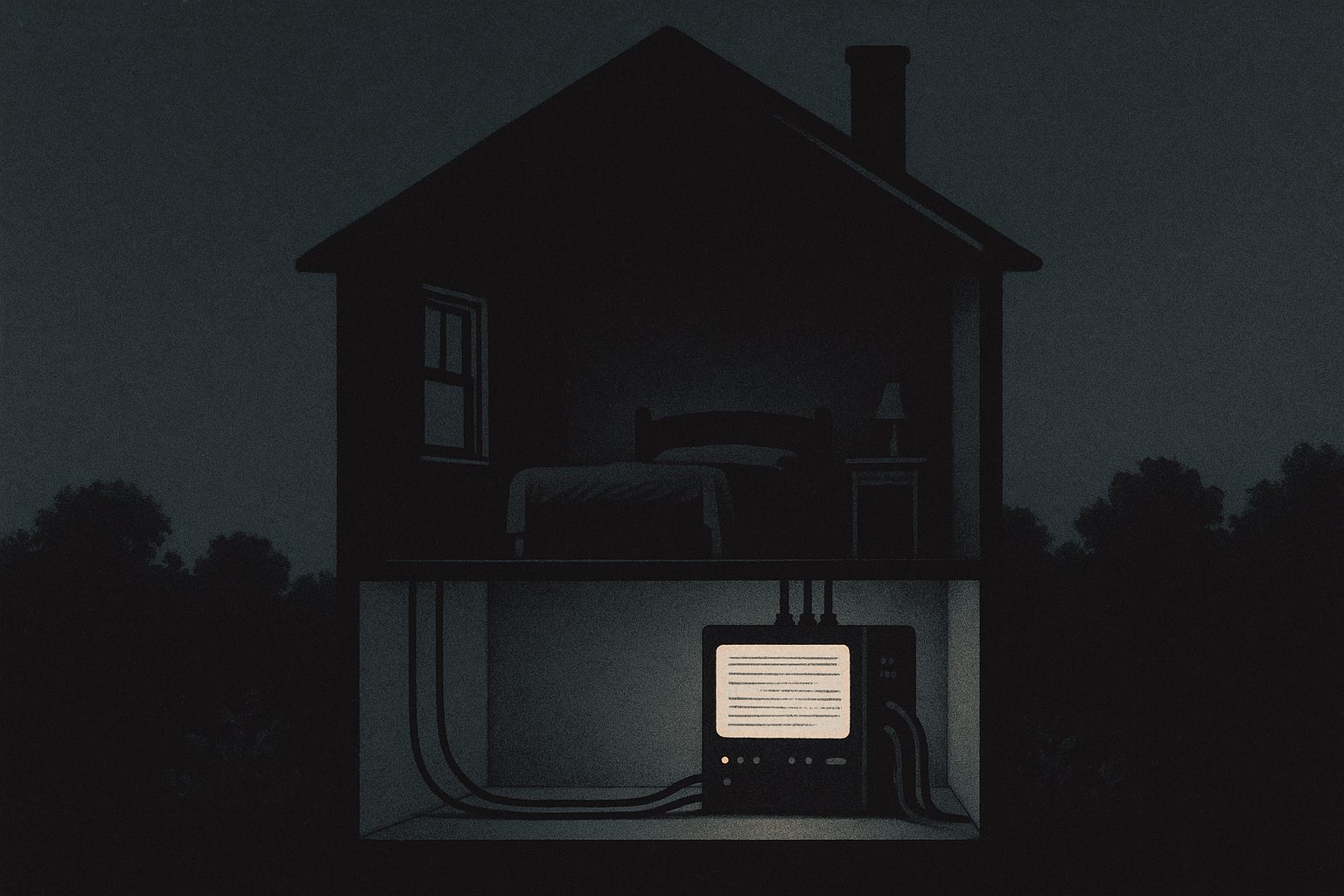 The machine is in the basement so the room upstairs can stay dark.
The other economy
Here’s the broader bet, and I’ll make it quietly because anti-engagement products don’t shout and this essay shouldn’t either.
The attention economy is not the only economy. The dominant frame treats your attention as a substrate to be captured, held, and sold, and it has been so dominant for so long that we mistake it for the nature of software rather than one configuration of it. Even as we’re exhausted by it. The anti-engagement product treats your attention as a finite thing it is helping you spend well and then hand back. That’s an older theory of the relationship between a maker and a user than the feed by a wide margin. The watchmaker, the bookbinder, the carpenter who builds you a chair you’ll use for thirty years and never think about again: all of them anti-engagement makers, all of them paid for the quality of a thing you mostly don’t interact with. The internet briefly convinced itself that category had been a mistake. I think it’s about to be remembered.
Partly that’s an ethics argument, and it really is one. But it’s also just economics. As the attention economy presses against its own limits, as the feeds get more crowded and the nudges more desperate and the audience more numb to all of it, the thing that starts to feel rare and valuable is the product that respects the limit instead of attacking it. There is a real and growing market for the product that wants you to leave, precisely because almost nothing else does.
The category needs a name, a playbook, and more people building in it. The name is “anti-engagement product” until someone finds a better one. The playbook is being written one product at a time, mostly by makers who don’t yet know they’re inventing a category, who noticed only that engagement maximization keeps producing worse and worse things, and then quietly started building the opposite. Sojourn is one of them, unproven and trying. The next decade will produce a lot more, if we get good at noticing them, and at protecting the strange conditions they need to exist.
The best thing a product can do, sometimes, is the thing the dashboard can’t score: work well once, and then leave you alone.