The Blade and the Rock
I've built mountain bike trails with hand tools and ridden the kind a machine cuts in a day. The difference was never care. It's a four-foot blade that can't ask above-or-below-this-rock.
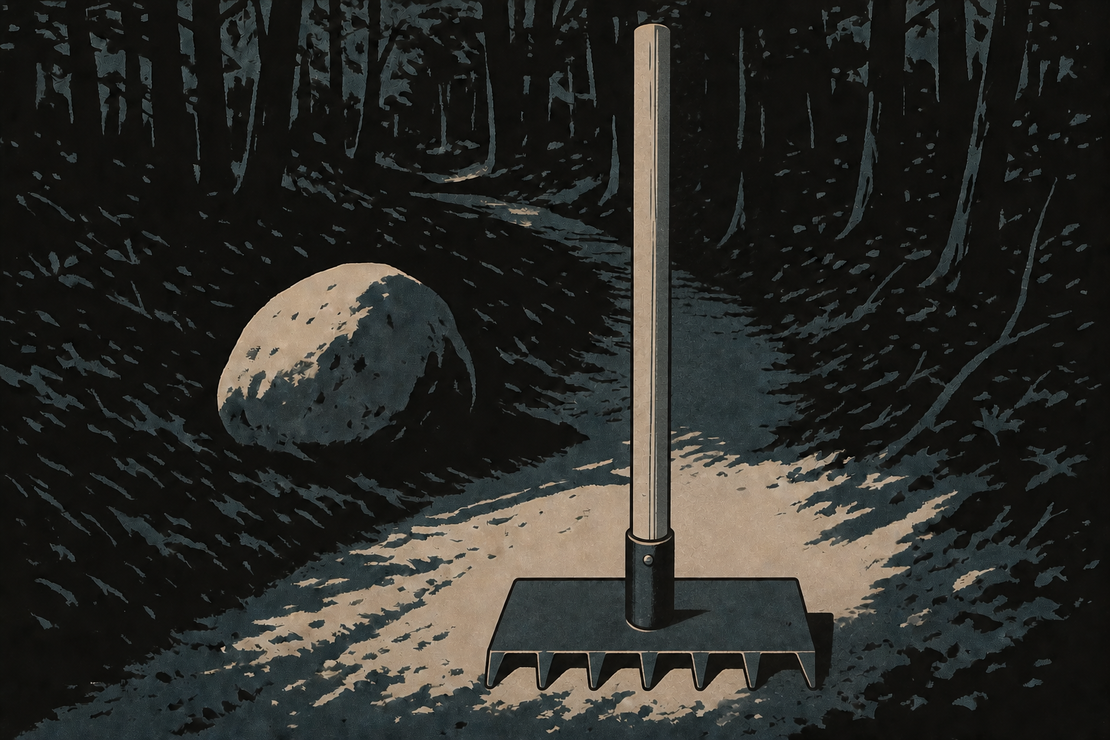
There’s a tool called a McLeod that shows up on every hand crew that’s ever built a hiking or mountain bike trail: a heavy flat blade about the width of your two hands on one edge, rake tines on the other, on a long ash handle. I’ve spent my share of days behind one, on a crew cutting new trail through the woods the slow way. It’s real work. Progress on a good day was measured in yards. And here’s the thing I remember most clearly about the process: it wasn’t the digging. It was the stopping.
Every few feet, something in the ground would put the work on pause. A rock the size of a microwave. A root as thick as your wrist. A tree standing exactly where the nicest line wanted to go. Or, where I live in middle Tennessee, ridiculous amounts of invasive honeysuckle. And the crew would straighten up, lean on the handles, and argue. Uproot the honeysuckle? Usually yes. Above the tree or below it? More often a debate. Below is a straighter line but it’ll erode over time and expose roots and be a rowdy bump in no time. Above works but requires a little uphill hook in an otherwise flowy line that steals speed. It also cuts the uphill roots, which are the ones a tree on a slope is really hanging by, weakening it and risking a tree fall later. Somebody’s seen a trail fail exactly this way before; somebody else rode one that didn’t. Two minutes, maybe five, then a verdict, and the digging starts again until the next rock or tree calls the next meeting. Every obstacle a stoppage, a discussion, and a judgment call.
I’ve also ridden plenty of trail cut by machine: a mini excavator walking the corridor, an operator who’s genuinely good at his job, doing in a day or two what a hand crew does in a month. Nobody in that machine is lazy or lying. The operator is making real judgments the whole time: where the corridor goes, how the grade rolls, where the water sheds. Gasoline-powered machines over ham-sandwich-powered humans operating at a fraction of the pace. Most of the time the trade is flat-out justified. The machine saves a month of volunteer weekends nobody had to give up, and the trail exists instead of not existing. For beginner trails it might even be the best way to build trails with a more polished tread.
But the two trails are different, every rider feels it, and I’ve come to think the difference is the blade.
Wider than the rock
This sounds obvious but you cannot make a decision finer than your tool’s blade. A McLeod resolves to about ten inches, so above or below this rock is a live question: the tool can express either answer. An excavator blade is four feet wide. When the blade is wider than the rock, the question doesn’t get answered badly. It just never gets asked. The rock is simply inside the cut, and the machine moves on, and there was no moment when anyone decided anything about it. The operator isn’t coarse. The question has no expression at that resolution. It’s hard to eat a grain of rice with a spatula.
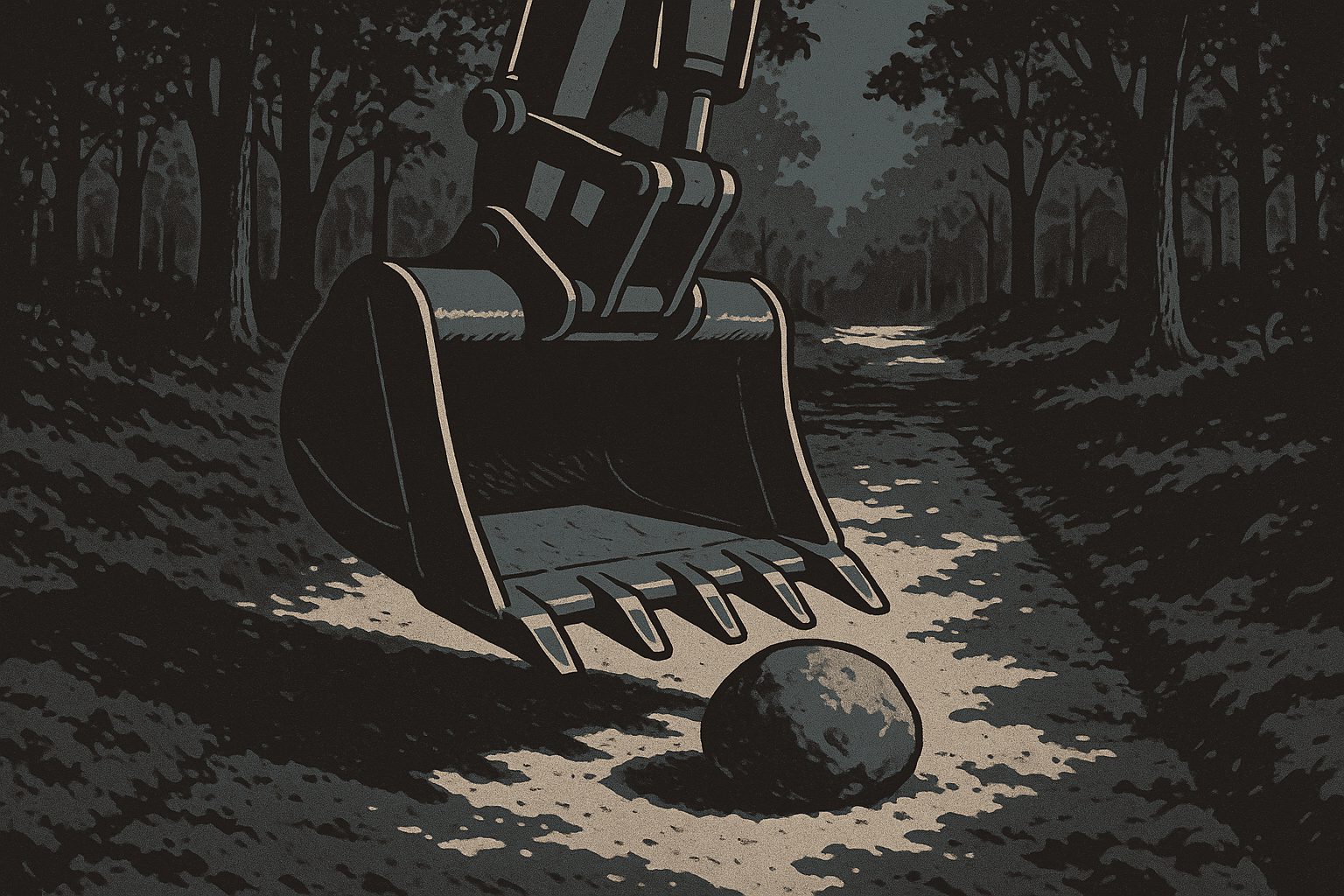 Nobody decides anything about this rock. It is simply inside the cut, and the machine moves on.
That’s half of it. The other half is where the decisions live, and this is the part that took me longest to see. The hand crew doesn’t stop every few feet on principle. It stops at the rock. At the root, at the tree, at the spot where you can already see the water starting to gully. The terrain decides where judgment happens. Checkpoints aren’t evenly spaced along the work. They’re event-triggered, called into existence by the material, and they cluster wherever the material pushes back.
Put those two halves together and you get the actual shape of what a faster, coarser tool does. It doesn’t reduce judgment by some percentage. I know better than to count; percentage was never the unit, and an essay that starts tallying checkpoints has already lost. What it removes is a decision class. The operator makes every route-level call the crew makes, and he cannot make the per-rock class at all, because his blade can’t ask the question. Not fewer of the same decisions. All of one kind, none of another.
I want to be precise about how this differs from a worry I’ve already put on the page. In The Forge Was a Side Effect I said the AI machine hands me pre-sorted research and I’m left “choosing inside a narrowing something else performed”: fewer options at each decision, and no way to see what fell out. That crack is about the inputs. This one is worse, and it’s different in kind: a narrowed option set at least presents itself as a choice. You stand there holding it, aware you’re choosing. An automatic, unmade decision leaves no trace at all. You don’t know you didn’t stop at the rock. There’s no rock in your memory to have an opinion about. There’s a new machine-cut trail down the street from me with rocks shouldered off into the woods on both sides, every one of them a decision nobody made. The trail is smooth right there, and smooth doesn’t testify.
Approve every token
Now carry this to the desk, because it was never really about trails. A model drafting your prose is the excavator posture: a thousand small decisions happening inside the generation, at machine speed, and you meet the trail already cut. The word-level choices, the sentence-rhythm choices, the this-clause-before-that-clause choices, all inside the blade, resolved without ever having been questions.
Here’s the thought experiment that convinced me this is structural and not just a vibe. Imagine an AI that required your approval of every single token. Maximum resolution: a checkpoint at literally every word. Surely that re-injects the judgment?
It doesn’t, and it fails three separate ways, which is what makes the experiment worth running.
First: approving is not choosing. Saying yes to an offered word is recognition. It’s narrow multiple-choice instead of fill-in-the-blank. Writing the word is search, and the search is where the alternatives live: the five words you tried and discarded, the phrasing that died on the way to the page. Again, Funnier built this mechanism already: the superfan hears the record that shipped and never the ten thousand takes it beat. Survivors only. Token approval makes you a superfan of your own sentence, at the highest resolution possible — a checkpoint at every step and never once a fork.
Second: uniform spacing is the wrong shape. Judgment clusters at features because the terrain triggers it. That’s the whole point of the rock. Spraying approval evenly across every token isn’t more judgment; it’s judgment with the discrimination removed, and any honest human would habituate into rubber-stamping before the end of the first paragraph. The crew that stopped at every shovelful would argue about nothing, and get precisely nothing done, because nothing is what most shovelfuls contain.
Third — and this one I only know because I stood in the woods for it — some of the judgment is social, I’d even argue a form of rest. The crew argues because the pace permits it. Hands still, leaning on the handles, taking a drink of water, somebody’s five-year-old memory of a gullied switchback entering the record. The excavator removes that by physics, not by choice: engine noise, one seat. And one person approving tokens, alone, forever, never gets a second opinion back either.
So: judgment is not a quantity, and you cannot re-inject it by subdividing. Which means every framing of AI assistance as a dial — more human control, less human control, find your percentage — is measuring in a unit the problem doesn’t have.
The caddie and the excavator
If it’s not a dial, what is it? A golf course got me there.
Nobody disparages a professional golfer for using a caddie. Think about how strange that is for a minute. Amateurs are left entirely to their own devices; pros — at the highest level, in the open, on television — get an expert who helps with the read, the club, the line. Which is to say: the judgment. The part every argument in this run of essays says is sacred. And the golf world doesn’t blink.
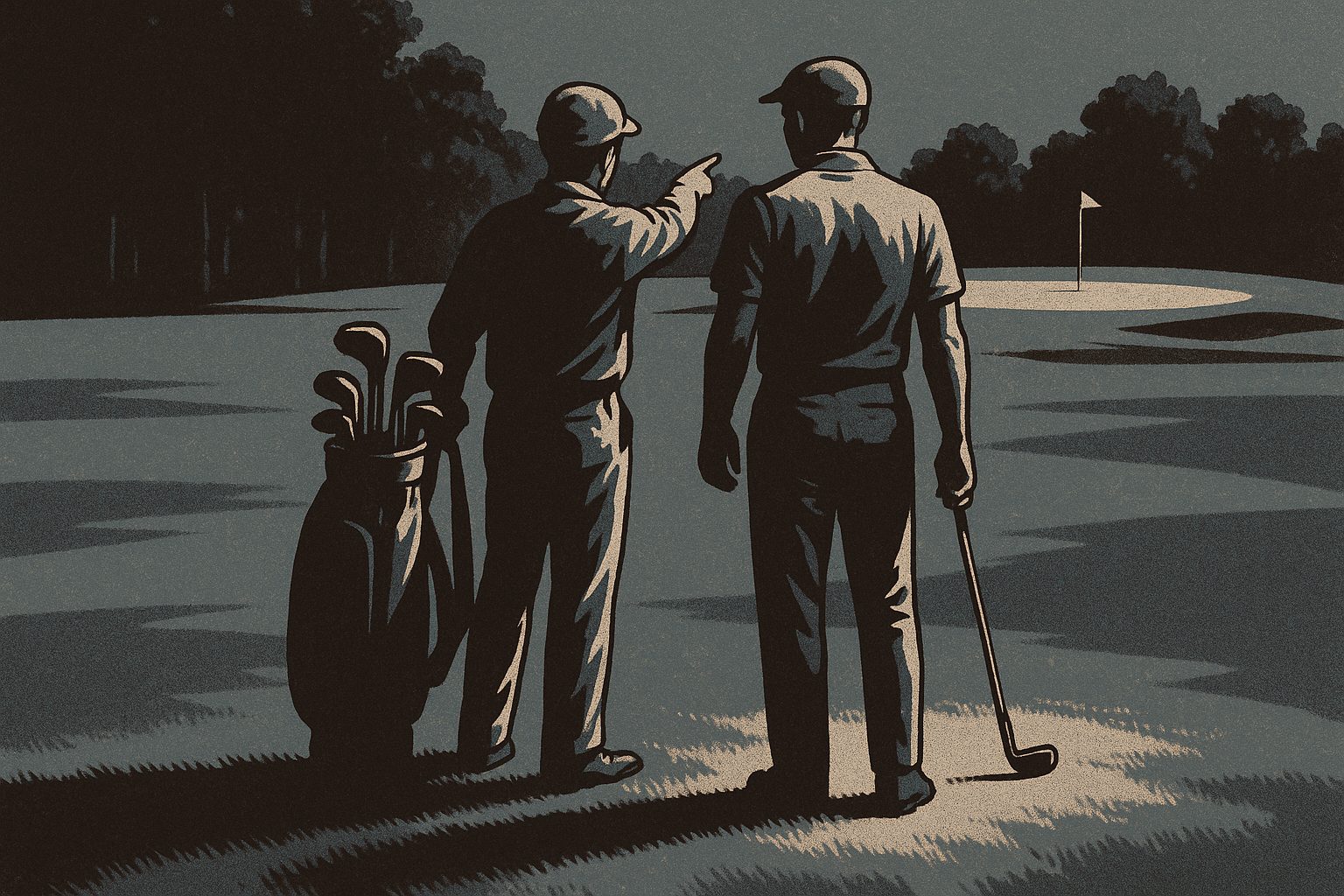 Two people at one stop, one decision. The player still has to hit it.
My first guess at why was that the caddie doesn’t swing the club. Execution stays with the player, so honor is preserved. But that doesn’t explain what golf actually tolerates. A caddie moves real judgment: the club, the read, the number, sometimes the plan for a whole hole. If handing off decisions were the offense, he’d be the scandal of the sport. Now push it the other way: a robot that perfectly swings whatever club the caddie hands it is cheating past argument, and the reason is that the swing is where the golfer’s work lives, and nobody was standing there to do it.
Here’s the boundary that holds. A caddie doesn’t remove the stop. The player still walks up, assesses the approach, the wind, the slope, still holds the decision in his hands, still overrides: it’s an 8, and the caddie shrugs and hands it over. The caddie adds another voice inside the same checkpoint. Same stops, thicker deliberation at each one. Maybe argues the 8 to a 7 if the decision is borderline. The trail excavator does the opposite: it doesn’t improve the decision at the rock, it removes the rock as a decision point.
That’s the discriminator: does the assistance happen at the checkpoint, or instead of it?
Run my own practice through it and the sorting is almost embarrassing in how clean it comes out. The duck that argues back is a caddie: I bring the position, it pushes back, I decide, and the stop survives, thicker rather than fewer. A model drafting the whole essay is an excavator, and everything I’ve ever described as “shoving the draft around until it’s mine” is me walking the finished cut looking for the rocks I never got to meet. When I worked out where the human hand goes in AI writing — comedy wants the hand at the setup with the model reckless below it, literary prose wants the hand in the sentences the whole way down — I was drawing checkpoint maps without knowing the word for it. The hand goes wherever the checkpoints have to survive.
And before the caddie becomes too comforting, notice what he has that the model doesn’t. He’s paid on the winnings. He’ll tell you it’s a 7 when you’ve already pulled the 8, and he can stand there until you put it back. Stakes, and a stopping rule — the missing counterparty, present and holding the bag. His read comes from walking the course with the outcome landing on him. The model at my desk has neither. So the caddie isn’t a reassurance that assistance is fine. He’s a specification of what assistance would have to be: a measuring stick the current tools mostly fail.
The cockpit had to be built
There’s an essay of mine this cuts directly into, and I owe it the collision. We Already Voted With Our Lives made the case I still stand behind: judgment versus execution is the real line, the autopilot proves you can hand off the flying and keep command, so fly the pilot model — keep the judgment human, put your name on it, climb into the plane.
What that essay didn’t say — its “where the analogy stops” section lists authorship and credit and meaning, and walks right past this — is why the cockpit arrangement actually works. It isn’t the pilot’s virtue. It’s that the cockpit is a built structure of checkpoints: instruments, alarms, cross-checks, a second seat, callouts a crew is required to say out loud, a loop engineered over decades so that the human’s judgment has designated places to happen and can’t quietly not-happen. Aviation built a machine for making sure the stops survive for human verification, and then measured it in crashes that stopped coming.
The desk has none of that by default. The writer who “flies the pilot model” with a blank prompt window is a pilot in a cockpit with no instruments, no alarms, no second seat, nothing but her own intention that the judgment stay hers. Every user of these tools claims the judgment stayed theirs. The claim is sincere. It’s also unfalsifiable, which is the trouble: intention isn’t a checkpoint structure. Keep the judgment human is the prescription I’ve spent a whole arc repeating, and by itself it’s empty. Nothing at the desk makes a stop survive contact with a tool that’s fast, smooth, and agreeable. Climb into the plane was right. The correction is that the desk doesn’t come with the cockpit, and the cockpit is the apparatus, not the chair: the alarms, the cross-checks, the second person required to say the number back to you. What the desk offers instead is a machine that says yes, let’s fly every time, to anyone, in any condition, because agreeing is the one thing it’s sure how to do. Aviation’s stops can ground a flight. Nothing at your desk can, unless you put it there. You’re building the cockpit yourself, checkpoint by checkpoint, or you’re not in one.
Where the line falls
This also amends the essay of mine it argues with most directly. Everyone’s a Ringer to Somebody traced the cheating line from quill to typewriter to laptop and found it always indexes to the self: every person draws it at their own feet, calls everything behind it quaint and everything ahead of it fraud. The best answer it could give was formative friction: ask what the friction was doing to you. A self-side criterion, honest about being one.
The trail hands me a second criterion, and it isn’t about the maker at all: can the tool resolve the feature in the material? That’s terrain-side. And here’s the evidence it isn’t just nostalgia wearing a tool belt: no trail purist on earth wants trail clawed out with bare hands. McLeods, rakes, shovels, wheelbarrows — tools, every one, and nobody laments them, the way no writing purist laments the word processor. The line isn’t nostalgic, it’s not drawn at the tool I learned on, which is where the ringer reflex always puts it. It falls where the blade stops being able to read the terrain. That’s a place you can point to in the material, argue about in public, and be wrong about, which makes it a different kind of line than any I drew in that essay. The ringer’s line moves with you. This one stays with the rock.
Too steep and too twisty
Our hand-built trail had a characteristic failure, and I helped build it in. Working at a crawl, we calibrated everything to the speed of a person standing still. We built the whole first stretch too steep and too twisty, because at digging pace every grade feels mellow and every turn feels wide. We never met the trail at the speed it would actually be ridden until it was cut, and then the bikes told us in about four minutes what the shovels hadn’t noticed in weeks. The machine operator, covering the whole line in a day, holds the run in his head at something much closer to riding tempo: the global shape, the flow, the way section hands off to section. He catches exactly what we missed.
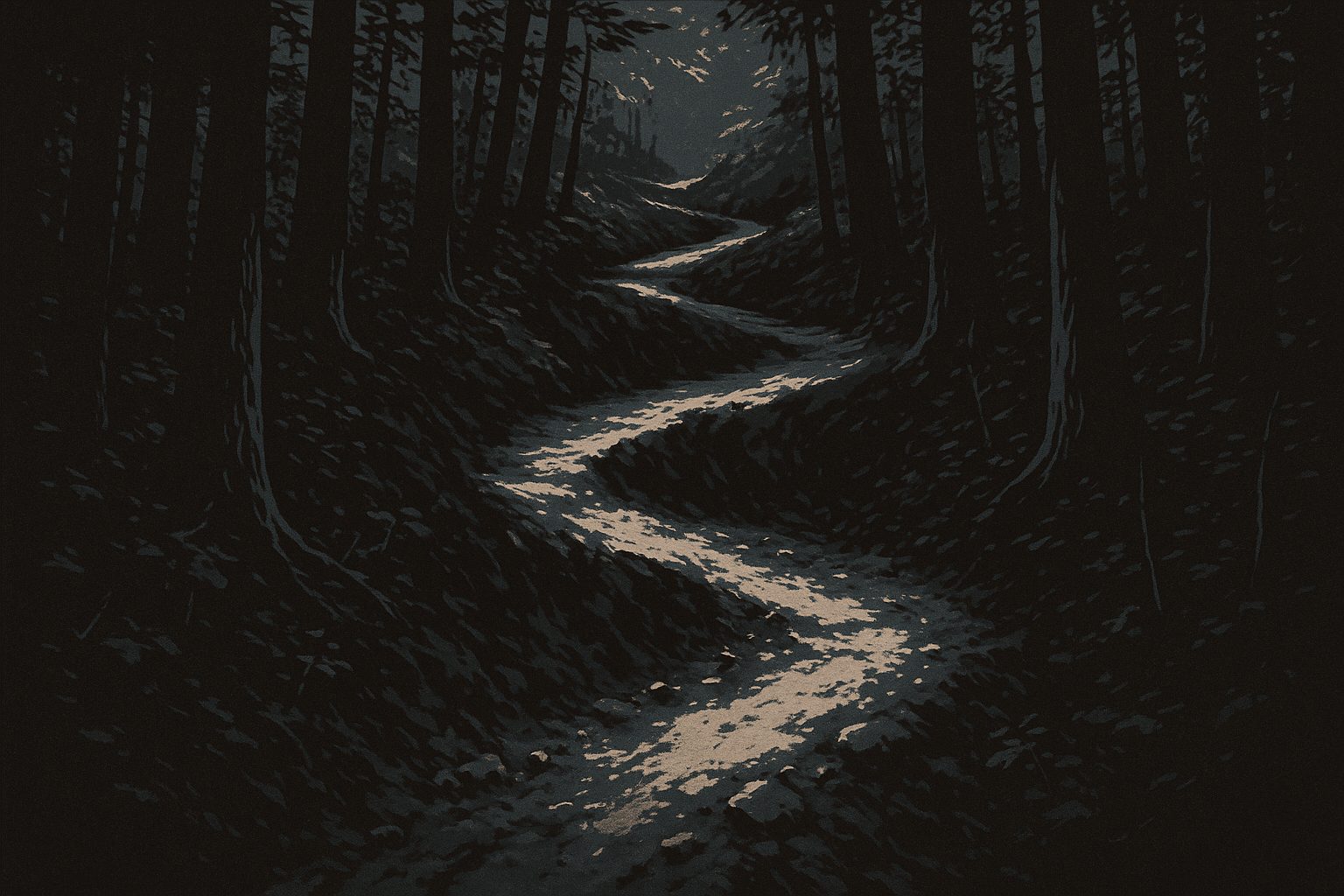 At digging pace a brutal grade feels mellow. The bikes disagreed in about four minutes.
His machine also has a constraint we didn’t. It’s less sure-footed than we were on a steep grade, and it has to climb what it’s cutting, so it pushes him toward mellower climbs whether he’s thinking about riders or not. Mellower is what a rider wants. You can read our version of that lesson right off our trail: the entry climbs are the most brutal thing out there, because they’re the first thing we built. Get deeper into the system and you can feel us find the groove, learning to imagine the trail at riding speed instead of trusting what our hands and feet were telling us at a standstill.
So every working tempo has a blind spot. Slow work over-indexes on the local and loses the global feel. Fast work catches the global and paves the local. Those are different artifacts, not a good one and a cheap one. Plenty of riders will tell you machine-built isn’t lesser, it’s just different, and they’re not wrong.
And the hardest version: a trail is ridden at speed, and an essay is read at speed. Nobody consumes anything at the tempo of its making. The reader moves through my paragraphs at something far closer to the machine’s drafting pace than to my crawl, which means the fast maker is, in one narrow and completely real sense, better calibrated to how the work will actually be met. The hand crew’s advantage was always the stops.
A map of where the stops were
One more turn, because the newest tool in this story knows something about checkpoints too.
The AI watermark that arrived this year works by a keyed statistical lean in the model’s word choices. Anthropic hasn’t published its scheme, but every published one shares that shape. The detail that matters here: the signal can only ride on the tokens where the model had real options. Where the next word is forced, there’s no room to lean; where many words would do, the lean lives. The mark exists precisely where a choice was available to be made. Which means a watermark is, incidentally, a map of where the checkpoints were: the machine’s own record of the rocks.
Almost. The divergence is the actual finding. High entropy for the model is not high stakes for a human. Ten interchangeable synonyms give the mark plenty of room and cost the prose nothing: a rock the size of a pea. And the obvious next word — the one the model lays down with total confidence, no options, no lean — is exactly the word a good writer refuses, because the model’s confidence peaks precisely where the median lives. The machine is smoothest exactly where a human would have swerved. So even a perfect map of the model’s choices can’t show you the stops that never happened — the blade doesn’t record the rocks it never felt.
Which brings me back to a sentence I once had to leave hanging. Ringer ended on a confession: a machine had offered the right patch for a hole in my argument, I’d taken it, and the essay closed on “I wrote this essay, and I still can’t call it.” I couldn’t, with what that essay had to work with. This one gives me a way.
Run it through the only structural test I now trust. I found the hole myself. The stop was already there, because I’d built it into how I work. The machine spoke at that stop rather than in place of it, one more voice at a checkpoint that would have happened anyway, and I made the call. That one’s clean.
What the test can’t tell me is the forge question, and it stays open: who learned what in that exchange, and what fifteen years of taking such patches does to the taker. A checkpoint can survive the assistance and still teach the machine more than it teaches you.
But the question I started with in the woods finally has its answer. It was never whether a machine touched the trail. The machine-built trail is real trail; the operator’s judgment is real judgment; some of you will ride the machined line and prefer it. The question is what happened at the rock. Did you stand there and argue — with a crew, a caddie, a duck, any second voice inside a stop you built and kept — or is the ground smooth right there, no memory attached, because the blade was wider than the rock and the question of your judgment never came up? Smooth doesn’t testify. Build the stops, or meet the trail already cut: at any speed, with any tool, that’s the whole difference between the two.