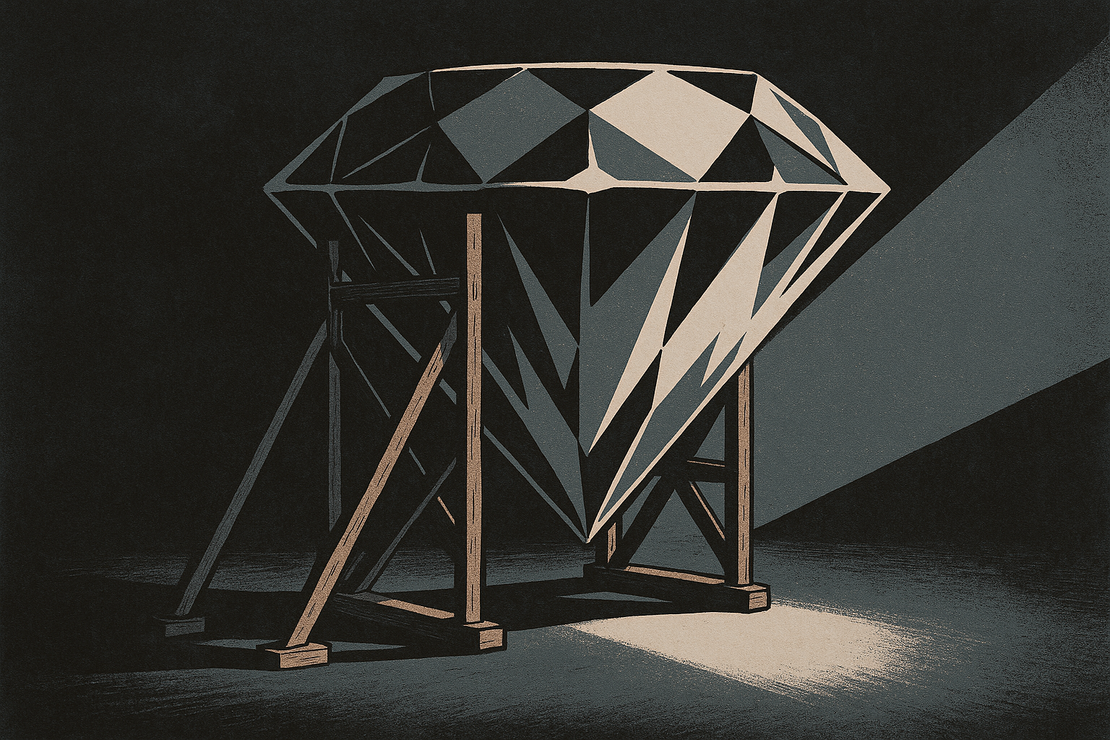
The Diamond Was Always a Story
A chemically identical stone, grown in three weeks, for a fraction of the price. It didn't disrupt the diamond. It said out loud what the premium had always been for.
My wife designs rings. She has the eye: proportion, the way a stone sits in light, when to use a flat rose cut vs. an elongated cushion or an old mine cut, and when the positioning of each reads as intention instead of approximation. What she didn’t have, until fairly recently, was room to use it. A mined center stone of any real size is a four- or five-figure commitment before she’s sketched a single prong, so every design was an expensive bet, and you don’t place many bets when each one costs a mortgage payment. Then lab-grown diamonds got good and cheap in the same handful of years, and the bet got a lot smaller. Now she works the way a painter works: try it, rework it, chase an idea three rings deep just to see where it wants to go.
I’ve told her, more than once, that lab diamonds are her AI.
I mean it exactly. The thing AI did for me — dropped the cost of an attempt low enough that I could stop rationing my attempts — is the thing the lab stone did for her. It’s a means-eater pointed at her craft: it ate the bulk of the expense, the scarcity, the financial flinch before every idea, the part she’d have skipped if she could. It left the eye alone. The design, the judgment, the hand that knows when a ring is done: the machine of cheap carbon touches none of it, because none of it was ever for sale in the stone. The stone got cheap. The work didn’t.
Which is the whole idea here, but it took me a while to see why, because I started where everyone starts.
The cheap reflex
Say “lab-grown diamond” to most people, at least until recently, and watch the lip curl. It’s not a real diamond. You might as well have said cubic zirconia or flashed a McLovin driver’s license. It reads as fake. Cheaper for a reason. And cheap in the one venue where economics is effectively a reflection of love. Brutal. The thinking is the mined one came out of the earth after a billion years of formation, and the lab one came out of a reactor in three weeks, and surely that gap is the difference between something and nothing.
Here’s the inconvenient physics. There is no structural gap. A lab-grown diamond is not a simulant, not a cubic zirconia, not glass pretending. It is carbon in the same crystal lattice, grown by the same chemistry and mechanics the earth used, just faster and on purpose. Same hardness, same fire, same everything an instrument can measure. Put a good lab stone and a good mined stone in front of the gemologist who sold you the idea that one is real, and without a machine she cannot tell you which is which. Even the FTC gave up the distinction in 2018, striking “natural” from its definition of a diamond. They are the same object with two different birth certificates.
That “on purpose” part is where I think people actually flinch, and it deserves a minute. The mined stone is an accident. Carbon that happened to sit at the right depth and pressure for a billion years, found by luck and dug out at ruinous expense, and nobody intended any of it. The lab stone is the same object made deliberately, on a schedule, to spec. We are strange about that. A found thing recovered at great human cost reads as a gift from the universe; a made thing with no blood spilled reads as inventory, somehow less valuable. Anyone who has watched people sneer at AI work will recognize the shape of the objection — it was made on demand — and I feel the pull too. But the market has already run the experiment. Every mined stone still has its billion years. The lab twin has none. If the accident were where the value lived, mined prices would have shrugged off a twin that lacks it entirely. The prices fell anyway.
So whatever you were paying the premium for, it was not in the rock. It couldn’t have been. The rock is identical. The premium was attached to the provenance — to the billion years, the mine, the rarity — and the moment a factory could produce the identical object, the only honest question left was whether that provenance was ever worth what we paid.
It wasn’t. And the reason it wasn’t is the best-documented marketing operation of the twentieth century.
The thing in the rock was a sentence
Diamonds are not rare. A big flawless one is — but that was never what the ritual ran on. The one-carat stones that fill engagement rings are a reasonably common commodity whose supply was held off the market, for most of a century, by a company that understood the one thing worth understanding: scarcity you can manufacture is better than scarcity you have to find. De Beers sat on the supply. Then, in 1947, a copywriter named Frances Gerety, working late on the N.W. Ayer account, wrote four words — A Diamond Is Forever — and those four words did what no mine could. They turned a stone into a promise, the promise into a ritual, and the ritual into a rule. The engagement diamond was not a tradition De Beers inherited. It was one they wrote. The two-months’-salary benchmark wasn’t handed down from some Age-of-Romance Warren Buffett to carefully calibrate what devotion is worth either; it was an ad, a number chosen to set a floor on what you’d spend to prove a commitment. We didn’t discover that diamonds meant love. We were told, very expensively, for a long time, until the telling felt like memory. You can measure how completely the sentence won by how fast the culture began quoting it back: within a decade Ian Fleming had lifted it for a Bond novel, and by 1971 Shirley Bassey was purring it over the opening credits, a marketing line laundered into a torch song and a tuxedo, which is about as thorough as cultural capture gets.
That’s the ritual the lab stone walked into. And the wreckage only looks like disruption if you thought the value was in the rock. Lab-grown didn’t break the diamond. It unmasked it. The falsehood in this story is eighty years old: it was the scarcity, not the stone, running quietly and profitably the whole time. All the lab diamond did was produce the identical object the story called priceless, and the story couldn’t survive being tested against its own product.
You can watch it happen in the prices. Lab-grown stones cost a fraction of what they did a few years ago and keep falling toward the cost of making them, which is what happens to a thing whose price was production plus margin and not enchantment. Mined diamonds, meanwhile, are in price decline but still carry a fair amount of the enchantment markup at the counter. The real tell comes the instant you try to resell; the secondhand market has always known what the showroom won’t say. When the artifact is identical, the only thing holding the number up is Gerety’s sentence. And for the first time the sentence has a counterargument it can’t shout down: the identical stone in the next display case, at a fifth of the price. Structurally the same, also forever.
The strongest version of the provenance argument is the hard-asset one, and it has real history behind it. Jewish families fleeing Nazi Germany sewed diamonds into coat linings because a fortune could cross a border in a hem: small, hard, and worth roughly the same on whichever side you came out. That last property was the cartel’s doing. A stone kept its value in Lisbon or New York because De Beers held the price everywhere, so what a family was carrying, at bottom, was the world’s continued belief in the sentence. The stones did their job. The job depended on the story holding.
There’s an older version of this story, and for fifteen centuries it ran the other way. Alchemists chased chrysopoeia, the transmutation of base metal into gold, from the Hellenistic Egyptians clear through Isaac Newton, who poured more years into it than into gravity. They never managed it. Gold stayed gold, uncounterfeitable, because its scarcity is enforced at the level of the element: forged in collapsing stars, and the only way anyone’s ever made more is a few atoms at a time in a particle accelerator, at a cost that makes mined gold look free. Gold’s scarcity is merely unbeaten — no one has found a cheap way to grow it, and until someone does, the rarity holds. But diamond is carbon, one of the most common things in the universe, in a certain arrangement, and arrangements can be learned. The lab stone is alchemy that finally worked, only the thing it transmuted wasn’t lead into treasure. It was a priceless stone into a cheap one. The alchemists failed at gold because gold was genuinely scarce; we succeeded at the diamond because it never was. The success is the proof. And the periodic table gets the last word here the way it did with van Meegeren’s fake Vermeers, except this time it rules in the opposite direction: chemistry convicted the forged painting, and chemistry acquits the lab stone.
When the eye can’t tell, the market certifies
There’s a tic the industry developed once the stones became indistinguishable, and it should sound familiar to anyone watching AI. If you can’t see the difference, someone will sell you a way to certify it. Lab stones now get laser-inscribed on the girdle. Origin reports, blockchain provenance registries, a “Natural Diamond Council” spun up to defend the honor of the mined rock with the budget such defenses require. It’s the verified human badge, applied to carbon. I’ve written before about how you can’t reliably police the line between an influence and a copy, and how the tells we use to spot a machine tend to dissolve under scrutiny. Same shape here. When the eye genuinely cannot tell, the distinction doesn’t vanish. It gets manufactured back into existence and sold to you a second time, as a certificate, by the people with the most to lose from your not caring.
This is probably gonna hurt
Here’s where this stops being about jewelry.
If the diamond premium was a story all along — value with no maker, no craft, no struggle behind it, only a rarity someone arranged — then the lab stone collapsing it is not a tragedy. It’s a correction. Nobody was robbed of anything real. A fiction got priced honestly for the first time, and the losers are the people who were charging for the fiction, plus anyone left holding it as a hard asset when the repricing came.
Now hold that next to the thing everyone’s afraid of with AI. A lot of creative work is formation-real: earned in the doing, answerable to a person, the kind of value a cheap twin can’t touch. Some of it isn’t. Some creative premiums are diamonds — priced by gatekeeping, by a guild holding supply off the market and a slogan telling you the markup is love. AI, like the lab diamond, is going to produce the identical-looking object and force the question: was this premium formation, or was it De Beers?
For some of it the answer will sting, and some of the people it stings are ones I’m supposed to be on the side of. If the value was real, it survives the twin. If it was a marketing sentence, it was always going to lose the argument eventually — the machine just learned to argue.
Telling those two apart is the entire job. It’s the harder skill I keep circling, except here it’s pointed at worth instead of effort. Which premiums are forever because someone built something, and which are forever because someone wrote forever on the box.
Back to the bench
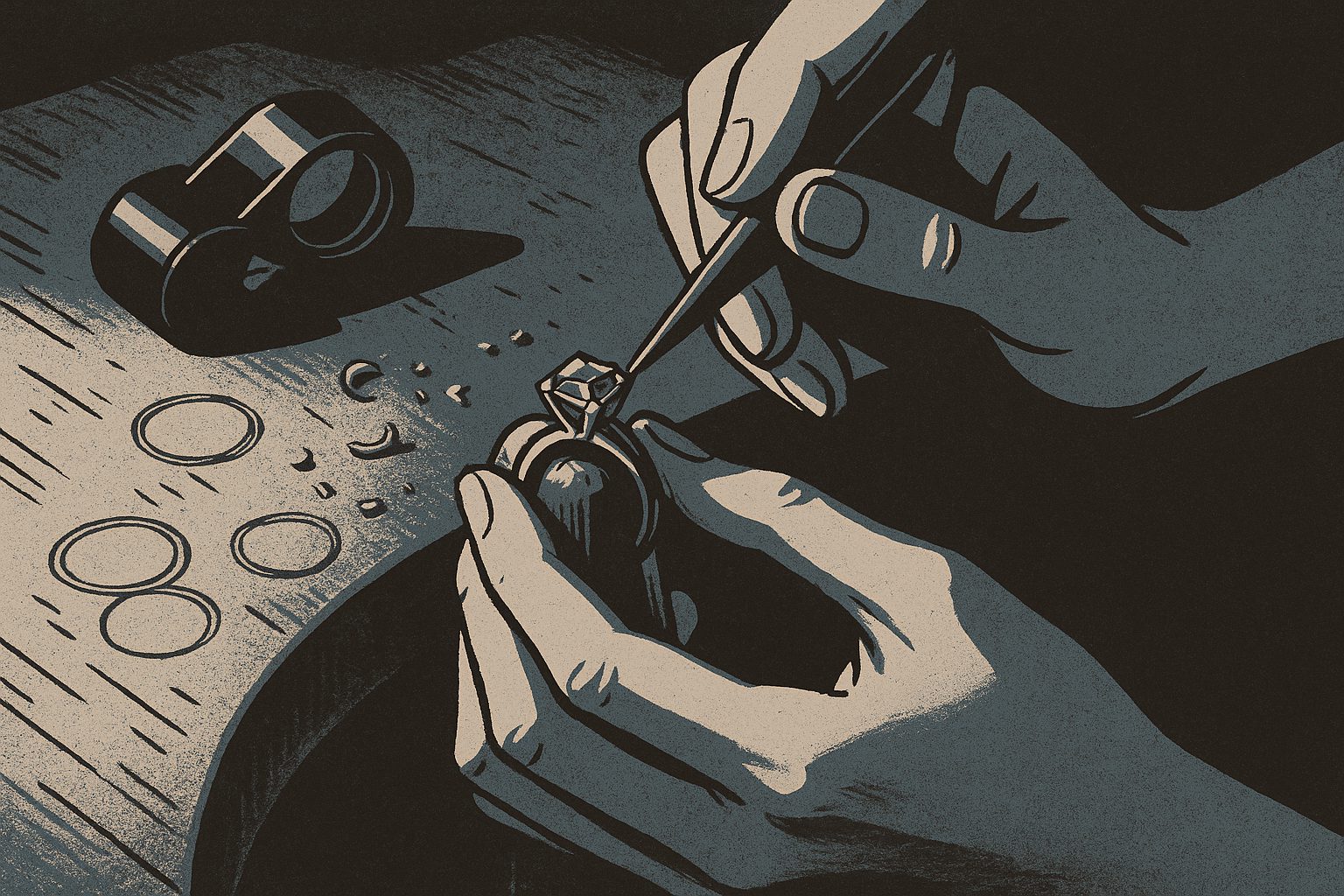 The hand, where the value was sitting the whole time.
My wife is still at it, by the way, designing more in a month now than she used to manage in a year. Nothing about her work got cheaper in the way that matters. The cheap part was the part that was never hers to begin with: the rock, the commodity, the thing a reactor can grow on a Tuesday. What’s hers is exactly what the falling price can’t reach: the eye, the proportion, the antique Asscher aesthetic, the judgment about when a ring is finished. The stone stopped being the expensive thing. She became it. And in truth, she always was it.
That’s the version of this I trust. The value didn’t disappear when the rock got cheap. It moved — out of the stone, where it was never really sitting, and into the hand, where it was the whole time. The lab diamond didn’t take anything from her. It just stopped letting the rock take the credit.
A diamond is forever. The sentence, it turns out, was the only durable thing in the box.