The Gate Was the Product
Some creative reputations were earned and some were just gatekeeping, and cheap AI is quietly exposing which is which. A field guide to the galleries, labels, and imprints that were protecting the work — and the ones only charging rent to get in. Written from the ungated side, where I've always stood.
Nobody anointed this. No imprint vouched for it. No agent shopped it. No editor at a masthead you’d recognize read it first and decided I was worth a slot. I wrote it, I published it, and the only gate it passed through was the one between my draft and the internet, which is to say no gate at all. I mention this not as a sovereignty flex — plenty of unvouched-for writing deserves to stay unvouched-for — but because it’s the vantage point for everything that follows. I’ve spent a working life making things (books for publishers, apps that shipped under other companies’ names), plenty of it the kind of work that gets anointed, none of it under my own name. I’ve been in the rooms; I was just never the one they stamped. That’s a useful place to stand when you want to ask what the anointing was ever actually worth.
In The Diamond Was Always a Story, I argued that the diamond’s premium was a story, and that the lab-grown stone didn’t destroy it so much as expose it. The value was never in the rock; it was in a sentence someone wrote and a scarcity someone arranged. Then I widened it. Every livelihood is a rent on a scarcity: the scribe’s patient literacy, the single wage that once bought a house, the fifteen-year window when there was more attention around than decent stuff to fill it. The rent lives in the gap between what people want and who can supply it, and when the gap closes the rent dies, however good the work was on the way out.
So this one sorts the rents. They are not all the same kind of thing, and which kind you’re holding is everything once the flood arrives: the flood of cheap, competent, machine-made work now rising against all of them. I want to turn that question away from the jewelry case, toward the gallery, the imprint, the festival, the playlist, the whole apparatus that decides which creative work gets to be worth something.
Forges and tollbooths
Some creative premiums are forges, where the price tracks something a person actually built: earned judgment, a sensibility you can’t fake, the formation that usually comes from doing the thing badly for years until you could do it well. Forges look like they’re about craft. They’re about the judgment those years of craft were quietly building. That’s a scarcity too — everything is — but it’s the deepest kind, the last thing a flood reaches, because the thing being paid for was never on the surface of the artifact. A perfect copy of the output doesn’t reproduce it.
The cleanest example is the one that looks least like craft. Rick Rubin has produced some of the most important records of the last forty years, and by his own account he has “no technical ability” and knows “nothing about music.” He doesn’t run the board. He played guitar in a college punk band and calls what he does on a fretboard rudimentary. What he brings is taste. On the Beastie Boys’ 1986 Licensed to Ill it was welding rock riffs onto hip-hop beats. Less than a year later with The Cult it was hearing past a finished, $360,000 album the band had already soured on — “soup,” the singer called it — and re-cutting the same songs raw until they became Electric. Same band, same songs; the one variable was his judgment. That’s the forge in its purest form: the ear that knows what a record wants to be. Real, earned, and genuinely missed when it goes.
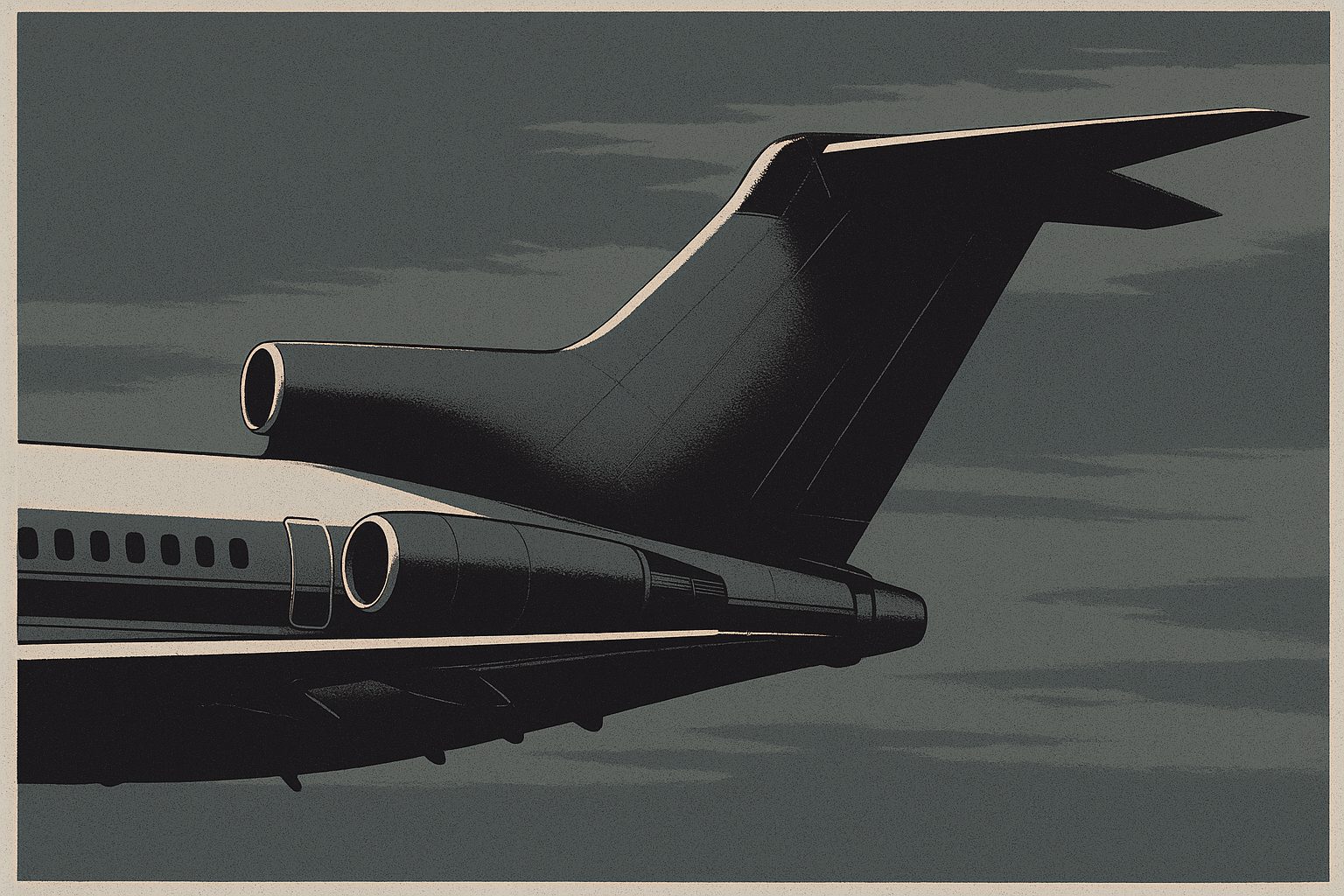 1986. Rubin's gag on rockstar excess: hand the kids their own private jet, then fly it into a mountain. He couldn't have drawn it; he just knew it should crash.
Other creative premiums are tollbooths. The price tracks access untethered from ability. Somebody stands at a narrow place on a busy road, controls who gets through, and the markup is rent on the passage, not payment for the work. The work might be good or it might be mediocre; the tollbooth doesn’t especially care, because what it’s selling is the scarcity of having been let through.
Rubin sharpened that ear inside one of these. The label he co-founded with Russell Simmons, Def Jam, was a tollbooth the way every record label was: it didn’t make the music better, it controlled who got pressed, promoted, and played. That cut was rent on access to being heard. The forge and the toll in a single company.
AI is the lab diamond for the tollbooth kind of premium. It floods the narrow place with competent, identical-looking output until waiting in line at the gate stops meaning anything, and it forces the question every tollbooth spent decades making sure you’d never ask. Was I paying for the work, or was I paying for the access? For the forges, the flood can match the execution — even a master’s — and still miss what you were paying for, which was never in the artifact: the judgment that made it, and will make the next call too. Part of that judgment is timing: being first to hear the thing everyone will later find obvious. Once the first ear proves the sound, the imitators rush the door; they have the move, not the ear that found it, and it has already moved on. For the tollbooths, it’s 1947 all over again, the year a copywriter promised us a diamond is forever, and the slogan is now wearing off.
A field guide to the gates
So let’s walk the forge/tollbooth apparatus and sort it, because the whole argument lives in the sorting.
The anointing ladder — art school to agent to gallery to prestige imprint — sells the right to be counted as a real artist. Its defenders will tell you it protects quality, and sometimes it did: a great editor is a forge, the Rubin kind of judgment aimed at a manuscript instead of a mixing board, and it’s real. But it was always the small part of what the ladder charges for. Strip it out and what’s left is mostly a tollbooth: a sorting mechanism that converted the scarcity of its own approval into a premium on everyone it approved. AI doesn’t flood the editing. It floods the approval, by making competent work cheap enough that the gate can no longer pretend its stamp was the same thing as the quality.
Prestige scarcity (the gallery wall, the numbered edition, the velvet rope) is closer to pure De Beers, the diamond cartel that made a common stone feel rare by sitting on the supply. It staples artificial scarcity onto work that is often infinitely reproducible and charges for the staple. Supreme turned that into an empire: a forty-dollar cotton box-logo tee that resells for hundreds, not because the cotton or even the logo is particularly special but because they made only so many and dropped them on a Thursday. Same move as the diamond, a century on, in streetwear. This one was always a tollbooth wearing a forge’s clothes, and it’s the one I’ll shed the fewest tears for.
Gatekept distribution — shelf space, playlist placement, the festival slot, the residency — is a tollbooth the internet already half-dissolved and AI finishes off. And a lot of what reads as merit here was never merit: the table of new hardcovers at the front of the bookstore isn’t the booksellers’ favorites, it’s co-op placement the publisher paid for, and most of us go a whole lifetime thinking that table means good. I had books in those stores once, well back from that table, and I would never have quietly turned one of mine face-out when no one was looking. Not once. When a few people controlled the few channels, getting through them was worth a premium because getting through was the whole game. The channels multiplied; the toll kept charging anyway, on momentum.
The signature markup is the slipperiest gate, and Jeff Koons is standing in the middle of it. Koons is one of the most expensive living artists in the world. His signature works are giant balloon animals in mirror-polished steel, and one of the dogs sold for $58 million. He also hasn’t personally fabricated most of his art in decades: at his peak he ran a 16,000-square-foot studio where as many as a hundred and twenty assistants executed his work on a color-by-numbers system, so a hundred hands would read as one. A balloon dog is a Koons because he says it is, and the market has never once flinched. That’s the whole puzzle in one man: is the name buying you rare vision you’re glad to keep paying for, or a scarcity that was arranged, authenticated, and about to stop being scarce? Same signature, two completely different things, and the flood is what tells them apart. There’s a sharper blade buried in Koons: that a workshop of anonymous hands producing identical work under one name is the very thing we’re now told to fear about machines, and got called genius when the name was his. But that one gets its own essay. Here he’s just Exhibit A that the name and the work were never the same thing.
The part that costs people I like
It would be cheap to run this as nothing but good news. Tollbooths made us stand behind unnecessary velvet ropes, and AI is cutting those ropes to set us free. But it’s not that simple…there’s a cost.
When a tollbooth collapses, that is a correction, not a tragedy. Nobody is robbed of anything real; a rent that was being charged on access stops being collectible, and the work that was actually good is still actually good.
But the gate falling takes more than the gatekeeper. It takes the people who only ate because the gate rationed supply, and some of them are real makers I’m squarely on the side of. The midlist novelist whose living depended less on being read than on being scarce. The working illustrator whose rate held up because there were only so many of her in the phone book. The scarcity that protected the tollbooth was also, accidentally, the thing that fed some genuine talent, and when it goes, the talent doesn’t automatically get fed some better way. Both of these are true at once and we shouldn’t flatten either into the other. The correction is right. The cost is real. Anyone selling you only one of those is selling you something.
What’s left when the gate is gone
What survives the flood is the same thing the diamond left behind. When the arranged scarcity drains out of a thing, the value doesn’t vanish. It relocates, out of the gate where it was never really sitting and into the maker, where it was the whole time. The forge outlasts the flood precisely because a cheap twin of the output can’t carry it. Taste you can’t counterfeit. Judgment that took a life to build. The specific, answerable sensibility of a person who did the work the hard way and would do it again. None of that was ever in the gate’s gift to grant or withhold. The gate just took credit for it, the way the rock took credit for the diamond.
Which means the skill the flood demands of all of us, buyers and makers both, is the same one this whole publication keeps circling: telling the forge from the tollbooth. Refusing to mourn a toll as if it were a craft, and refusing to wave off a craft as if it were a toll. It’s harder than it sounds, because the tollbooths spent a century dressing as forges and the disguise is good.
There’s a hopeful ending buried in the first example, though it isn’t the one I first reached for. The Beastie Boys made Licensed to Ill borrowing Rubin’s ear whole, barely an instrument in their own hands on it. They also got nothing for it. By their own account the multi-platinum record paid them zero, and getting out of Def Jam took lawsuits in both directions and ended with them dropping the royalty claim in exchange for their release. They didn’t graduate out of that room. They bought their way out at full price. Then they made Paul’s Boutique at Capitol, a record only they could have made, with none of the people they’d just paid to leave behind. That’s the distinction standing in one band: the toll stopped the day they stopped paying it, and the ear went with them. A toll is a gate you keep paying to pass. Taste is something you build — badly at first, for years — until it’s yours for good and nobody can bill you for it again.
I started by telling you nobody anointed this. That’s not modesty; it’s the proof of the thing. A few years ago an unvouched-for maker publishing straight to the open road was a curiosity at best, because the gates still rationed who got heard. They ration less every month. I’m not predicting the correction from a safe distance. I’m standing in the middle of it, a guy who got to make a life out of doing the work without ever being let through, which a generation ago wasn’t really on the menu. The gate dissolving is the only reason someone like me gets a say at all. So you’ll forgive me for not grieving it too hard. I’m what comes through when there’s nothing left to charge a toll.