The Intimacy Economy
Small room, no scoreboard, and the artifact left to do its own arguing. It doesn't scale to mass. I've been quietly building my projects into that shape anyway.
Making a living from creative work has come down to two options. Run the brand economy: become a person worth following, and let the work be the marketing for the merch. Or run the performance economy: sell the one thing that can’t be copied, being in the room. AI is squeezing artists toward both, because the artifact itself is going free and the value is migrating to identity and tribe. I walked through all of that in The T-Shirt Economy, and it ended somewhere bleak and mostly correct. I’m a horrible salesman, so I wasn’t thrilled.
Both paths monetize an audience: reach, affiliation, a crowd that knows your name. I stopped the essay one path short, on purpose, because the third one doesn’t. It’s smaller, slower, and almost invisible to the metrics everyone watches, and it’s the one I’m actually building toward. For lack of a better name, the intimacy economy.
A third configuration
The brand economy and the performance economy are, underneath, the same machine: identity-affiliation at scale, audience as tribe, the maker as a public persona the audience consumes. Substack, Patreon, the merch table, the stadium. The unit is I am the kind of person who follows this, and the whole apparatus is tuned to make that unit cheaper to produce and easier to count. Think Swifties, Deadheads, Juggalos, Parrotheads: membership in any of those groups is a message about identity.
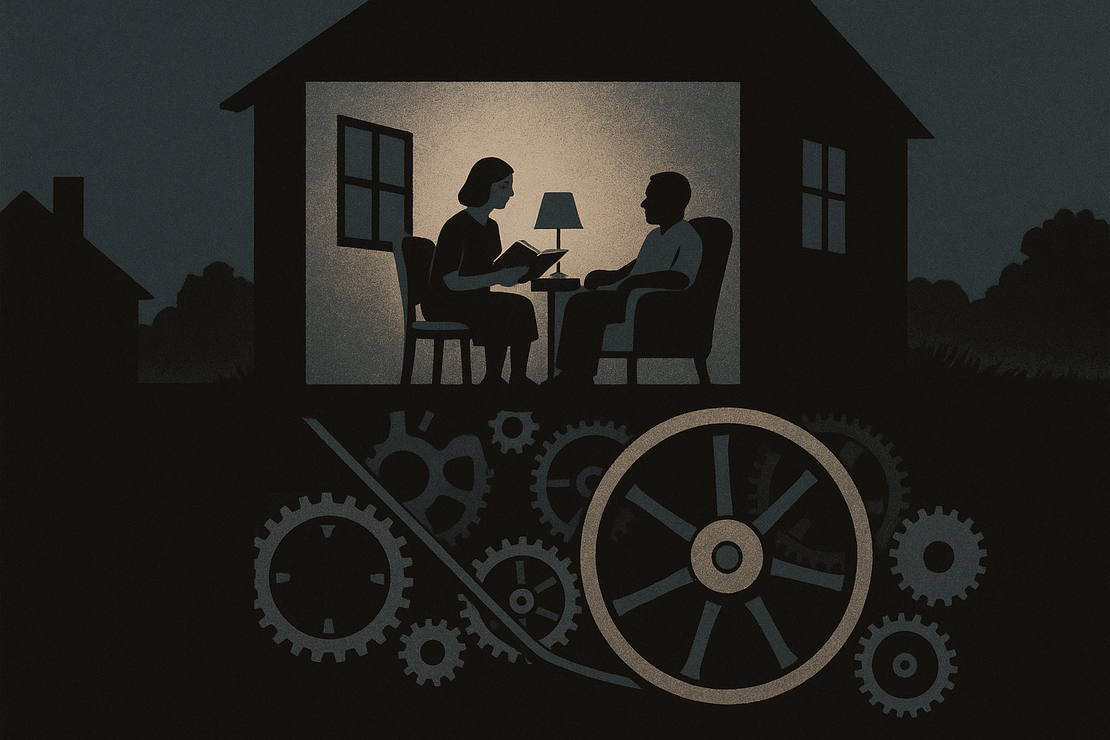
The intimacy economy inverts that machine at every load-bearing point. It is built for one specific person rather than an audience. The artifact carries the relationship — the job a persona does in the brand economy. There is no scoreboard: no streaks, no stats, no share sheet, no public reaction surface, not even any Faygo or margaritas, because the intimacy is private and a counter would only cheapen it. The community is small enough that everyone in it has been on both ends of an exchange, so reciprocity isn’t a policy, it’s just the shape of the thing. And the tools, including the AI, stay in the basement generating the substrate. The relationship the person actually has is with another person.
It does not scale to mass. That’s the defining property, and I’ve made peace with it. You can make a living in here. You cannot make a fortune, because the mass moves that turn a living into a fortune are exactly the ones this configuration refuses. What the t-shirt economy literally cannot see, because it has no instrument pointed at it, is that a lot of makers would take that trade in a heartbeat.
The moves it makes
Each move the intimacy economy makes is a place where the brand economy would reflexively build the opposite, which is the easiest way to recognize the configuration: look for what it declines.
It narrows to a specific person instead of broadening to an audience. It’s the opposite of “I’d like to buy the world a Coke.” Every commercial instinct says widen the funnel; this says pick one reader and build for them, on the theory that work made to fit one human fits others better than work made to fit everyone fits anyone. A slingshot, not a shotgun.
It makes the artifact the load-bearing object, and the interaction merely the means. A letter, a book, a mixtape, an heirloom: the thing exists outside the system that produced it, and outlives the subscription that paid for it. A feed is the reverse: pure interaction, and it leaves nothing behind you’d want to keep.
It refuses engagement mechanics on principle. This is the hard one, because every product manager I’ve ever worked with will, within about ten minutes, suggest a streak. Every investor asks for the DAU (Daily Active Users for the luckily uninitiated). Every distribution channel pays you in reach. Declining all of it means saying no to a great many things that wear the costume of growth. It’s nearly un-American in its abject refusal to sacrifice attention to the god of growth.
And it keeps the tools underneath the floor. When AI is employed, it never addresses the user, never becomes the thing the user has a relationship with. It generates the substrate and then gets out of the way so that two real people can be more present to each other. The difference between that and an AI companion is the difference between a piano and a player piano. A piano is an instrument; everything in it exists so a person can play it for another person. A player piano performs the human part itself, and leaves you alone in the room with a machine doing an impression of company.
The band from the merch table
The Trashcan Sinatras were in The T-Shirt Economy, selling me a memory stick of a show minutes after playing it. What I didn’t tell you there is what the band had already been through, because that half of the story belongs here.
They took the advance from Cake, their first record, and did the least rock-star thing imaginable with it: bought a studio in Kilmarnock, Scotland, and named it Shabby Road. Then Go! Discs was swallowed by Universal in 1996, the band was dropped, the studio had to be sold, and bankruptcy followed. They didn’t play again until 1999. The artifact economy took back everything it had fronted them.
The comeback is the part this essay cares about. When they returned in 2010, the tour opened in a fan’s living room in Portland: fifty tickets at a hundred dollars each, three hours of songs for the people packed onto the couches. The living-room gigs became a recurring part of how the band tours, and Wild Pendulum, the 2016 album, was funded directly by fans. Rooms of fifty people, money handed straight across. A band that once held a major-label deal and its own studio rebuilt on precisely this configuration and has run on it for a decade and a half now. Everything above about declining scale, they lived, with a thirty-year balance sheet to show for it.
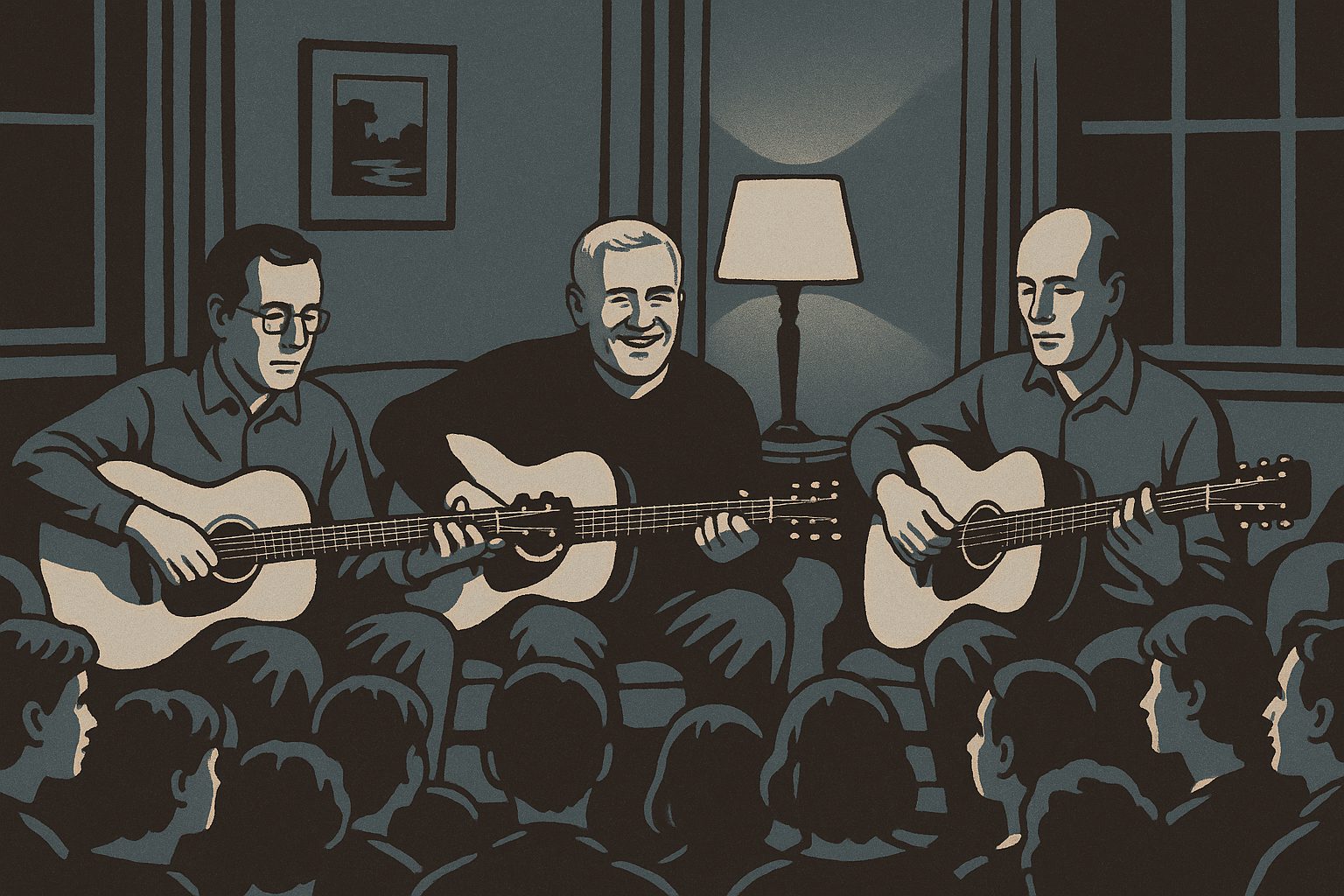 No stage, no scoreboard. The whole economy fits in one room.
The band’s seventh album, Ever The Optimist, their first in a decade, came out on July 31st, 2026, the day this essay first published. I planned none of that. Three days later John Douglas, who wrote much of their catalog and played on all seven of those records, died after a brief illness. I met him in that small room in Nashville.
One caution before I make that sound tidy. The fan funding ran through PledgeMusic, and PledgeMusic collapsed in 2019 owing artists an estimated nine and a half million dollars, with the administrator telling them not to expect any of it. Whether the band was among the burned, I couldn’t confirm, so I’m claiming nothing either way. The move (direct funding from the people who want the thing to exist) was right; the platform was a middleman wearing intimacy’s clothes, and intermediated intimacy is still intermediated. If the configuration has a first commandment, it’s that the line between the two people stays short. The band’s direct line runs through Patreon these days — yes, the same Patreon I filed under the brand economy at the top of this essay. At the scale of one band and the people who love it, it works more like a passed hat than a funnel, and the money moves as it’s given instead of pooling with a middleman.
Sojourn, trying to occupy it
The Trashcan Sinatras backed into the configuration because the industry left them nowhere else to stand. The more interesting question, at least to a builder, is whether you can aim for it on purpose. The clearest version I can point at is one I’m building, so take the usual discount for a maker describing his own work. Sojourn is a bedtime-story app, and almost every decision in it is an argument with the attention economy.
It’s read aloud. One person reads to another, in the dark. The listener never touches a screen, has no interface, no account, no profile. There are no streaks, no stats, nothing to share, no place to perform having used it. And the success metric, the thing the whole product is optimizing for, is the listener falling asleep, literally turning off their attention! It’s the only software I’ve ever built whose explicit goal is to get you to stop using it as fast as possible. Every growth playbook I know runs exactly backwards through it.
What’s left at the end of a season isn’t a usage graph. It’s a book, optionally a real one: if the stories were worth keeping, you can have them printed and mailed, a small physical keepsake of the nights two people spent reading them together, one that sits on a shelf long after the app is forgotten. The subscription doesn’t buy the stories. It buys the standing option to perform the ritual that makes them. The artifact is the point; the software is the loom.
 The artifact that outlives the subscription.
A fair reader will stop me here and ask why, if intimacy between two humans is the whole goal, there’s a machine anywhere near it. That’s the right question, and it has its own essay: Unlocked, Not Cheated makes the case for why a solo maker reaches for AI at all. The short version for our purposes is that the AI is what makes this configuration available to one person. A hundred bedtime stories at a consistent register is a career’s worth of craft I don’t have; the model supplies the craft so the ritual can exist. The intimacy is human. The scaffolding is not. Those are different floors of the same house.
But it goes deeper than that, and it has to do with someone who understands what makes a good story even if they don’t quite have the chops to craft every turn of prose. I’ve written millions of words as a tech author, nearly none fiction. But I love the art of storytelling in other mediums and I think I have at least passable taste for what is engaging and fun, if nothing else because I know what I’d want to read to my wife. There are some wild ideas in Sojourn: stories inspired by classics, weird songs, favorite movies, personal experiences, you name it. A bird in love with a whale, a llama on a cross-country trip in an ice cream truck, a telephone switchboard operator traveling across time and space. I’ll readily admit I couldn’t have done them full justice as a fiction writer. Rick Rubin isn’t a musician in any traditional sense, and on the records he shaped for the Beastie Boys and The Cult his contribution was the ear. I like to think I brought a much smaller version of the same thing to a bedtime-story app.
Skating already proved it works
The deepest reason I trust the configuration isn’t the product I’m building, and it isn’t even the band. It’s a fifty-year-old subculture that has run on it the whole time without a strategy deck.
Skateboarding has a gift economy, and it functions because it’s small enough that everyone in it has, at some point, been on both ends of every exchange: taught and been taught, filmed and been filmed, given a couch and slept on one, invited to a private ramp and built one. Nobody keeps score because everybody already knows the score is even over a long enough horizon.
The culture’s monuments are artifacts of that exchange. Burnside, probably the most storied skatepark in America, started in 1990 as rogue concrete troweled in under a bridge by locals who wanted somewhere dry to skate, until the city gave in and let it stand. Nobody sold tickets. Nobody owns it. It’s in Portland, incidentally; apparently the configuration likes it there. And the standard unit of skate fame isn’t a chart position or a follower count, it’s the video part: a few minutes of your best work, shot over years, usually by your friends, then given away. The culture’s whole archive got built person to person and handed over free.
The attention economy did eventually come for it. Skateboarding is in the Olympics now, with heats and judges and a medal table, and the community’s reaction has mostly been a shrug: nice for the kids, perhaps even more important for the parents, little to do with the thing itself. When the scoreboard finally arrived, fifty years of keeping no score turned out to be load-bearing. None of the engagement machinery ever got traction inside the culture, not because skaters are nobler than the rest of us, but because the conditions that hold the community together are the same conditions that starve those mechanics of oxygen.
It’s the cleanest proof I know that the intimacy economy isn’t a thought experiment. It predates the discourse by decades. I’ve written about one small instance of it elsewhere, in The Long Thank-You: a thank-you that took four years to arrive and was worth the wait.
The third lane
Step back and the bigger argument is about a blind spot in the whole AI conversation, which has, at the moment, exactly two settings.
One is the companion: the model becomes the relationship. The AI girlfriend, the character you text at midnight, the friend in the phone; by 2025, companionship and therapy had become the most common thing people do with generative AI. The other is the feed: the model becomes the engine that refines your attention and sells it back to you. Both are real and enormous, and both put the machine in the foreground, as either the partner or the predator.
Almost nobody is building the third thing, where the machine goes into the foundation so that two humans can reach each other better: software that disappears into the floorboards so a person can read to a person. That third lane is what the intimacy economy looks like once it has a business model, and the reason it’s so rarely named is that we don’t yet have the vocabulary for it. Our words, companion, feed, engagement, retention, reach, all belong to the two configurations that aren’t this one.
Why it’s hard, and not for everyone
I don’t want to sell this as utopia, because it isn’t, and the failure mode of essays like this is exactly that oversell.
It doesn’t scale, which I keep saying because it keeps being the catch. The economics are bounded by design. The temptation to wire in one little streak, one small leaderboard, one share button, is constant and comes from well-meaning people who are usually right about everything except this. The configuration is also nearly invisible from outside, because the instruments that would detect it aren’t the ones any platform puts on the dashboard: depth, the longevity of an artifact, retention measured as a relationship rather than a session. From the outside, work like this often looks like it’s failing, right up until you measure what it was actually built to do.
And small communities have their own diseases. They gatekeep, they curdle into in-groups, they mistake narrowness for taste. Intimacy at this scale is not automatically kind; it’s just intimate. Anyone selling you the small and the local as pure virtue is selling you the brochure.
Mostly, though, it asks for a particular temperament. The brand economy wants episodic performance to a large crowd. This wants sustained attention to a small one. Some people are built for that and feel relief the moment they find it. Many aren’t, and would be miserable, and should go run the t-shirt table with my blessing. The intimacy economy is not the answer to how every artist survives the AI era. It’s one configuration among several. The others already had names.
Where this lands
The t-shirt economy named a real tax: to make a living from creative work, you increasingly have to perform yourself on top of performing the work, which is a bill that falls hardest on exactly the introverts and weirdos who got into this to avoid it. The intimacy economy is where that tax doesn’t come due, because the work isn’t aimed at a public at all. It’s aimed at a specific person, and a specific person doesn’t need you to be a brand. They need you to be present, and to make a thing worth keeping.
That’s the whole pitch. It won’t make you famous, it won’t scale, and it will be illegible to anyone holding a dashboard. But it is real, it is available, the AI era makes it cheaper to attempt rather than harder, and almost nobody has bothered to give it a name. Naming the thing is the first step to being able to choose it.
Find your tribe, The T-Shirt Economy said, and know their shirt sizes. Here’s the other half. Find your one reader, and make them something they’ll keep.