The Long Thank-You
A story about giving away a domain name to a nonprofit and getting a four-year-late thank-you in the form of doubles on a vert ramp. The gift economy of skateboarding still works because both ends of it know how to operate without keeping score.
Years ago a friend and I built a small app that mapped skateparks. It started as the kind of thing you make for yourself and a few friends: where are the parks, what are they like, are they any good, is the one two towns over worth the drive. We named it The Skatepark Project, registered the domain, put real care into it, and shipped it the way you ship a thing you love instead of a thing you’re selling.
Some time later a foundation reached out. They were doing serious work in the skate world, the unglamorous, concrete-and-permits kind of work, helping to get skateparks built in towns that had nowhere for kids to go, and they wanted to operate under that exact name. And here was a clean domain already sitting on it. The foundation was Tony Hawk’s. They really just wanted the name, and we did a Zoom call with them where they explained their need: they had a new name for their org, we had the domain that matched it. My friend and I talked it over before the call, and decided to give them both the domain and the app, for free. There was a strange little pause on the call when I got to the free part, and then Tony said, “…well, these things never go like this.” You give a thing to people who are going to do good work with it, and then you go help them do the work.
We could have tried to sell it. People do; a clean name with a built app on it has a price, and the people on that call would have understood a number. But selling it would have turned a gift into a transaction, and a transaction ends at the sale. A gift starts something. I didn’t reason it out in those terms at the time. I just knew which one felt right, the way you watch a friend trying to land a trick on the fourteenth try, and you can see the one thing they’ve adjusted and you know this one is the make. It’s a thing your body has decided a half-second ahead of your mouth. We honestly saw it as two separate missions aligning, each strengthening the other.
For four years after that, the gift never came up. Not once, from either side. My friend and I wrote code for them, improving the app. We joined their board. We did the work. Nobody circled back to the domain, because in the world we come from, circling back would have been faintly off, like stopping someone mid-session to thank them for letting you drop in. It wasn’t a debt. There was no ledger. The whole point of the kind of giving I’d grown up around is that the giving and the keeping-track-of-giving are two different activities, and the second one ruins the first.
The ramp
On my fifty-fourth birthday, in August of 2024, I had the supreme luxury of skating Tony’s private vert ramp with a few friends. Two from home, one from The Skatepark Project who I had gotten to know due to our involvement. There was no expectation that Tony himself would skate with us. It was his ramp, we were grateful just to be standing on it, and at fifty-four, being grateful to be skating a vert ramp at all is a sound posture. That was already the whole gift as far as I was concerned.
What I didn’t know was that my friends suspected the day might turn into something, and had quietly arranged for Grant Brittain to be there to shoot it. If you skate, that name lands. If you don’t, it’s enough to know that Brittain is the photographer who took a great many of the images that taught the rest of us what skateboarding looks like, the ones burned into a generation’s memory from Transworld and Thrasher magazines, to name a few. My friends didn’t tell me he was coming. Telling me would have wrecked the exact thing they were hoping for, because the moment you know a camera is waiting on a moment, the moment stops being itself. They also, I’d learn later, picked him on purpose. If the day was going to be documented at all, it should be documented right.
There’s another reason skaters don’t advertise a photographer, even the legendary Grant Brittain: it adds pressure. A lot of pressure. We jokingly refer to a camera as a “bail gun” because the moment it comes out, you tend to tighten up, try a bit too hard, and start bailing. Not that skaters don’t take pictures and video, we do, a lot. But it’s ideally a casual thing to help keep that bail gun business to a minimum. It’s even common at times to try to sneak and take a photo or shoot a video without the skater seeing you do it. But with Grant that day, it became clear that he was there just to shoot us, and that became a uniquely challenging but fun pressure to work through.
So we do a pretty heavy session in unseasonably tough San Diego heat, and Grant documents it in a way only he can. What we didn’t know is that Tony was in his office, which has a window that looks out onto the ramp, half-keeping tabs on our session the way you keep an eye on people enjoying a thing you made. Then he came out. Not to skate, at first. He’d noticed me eyeing the gap.
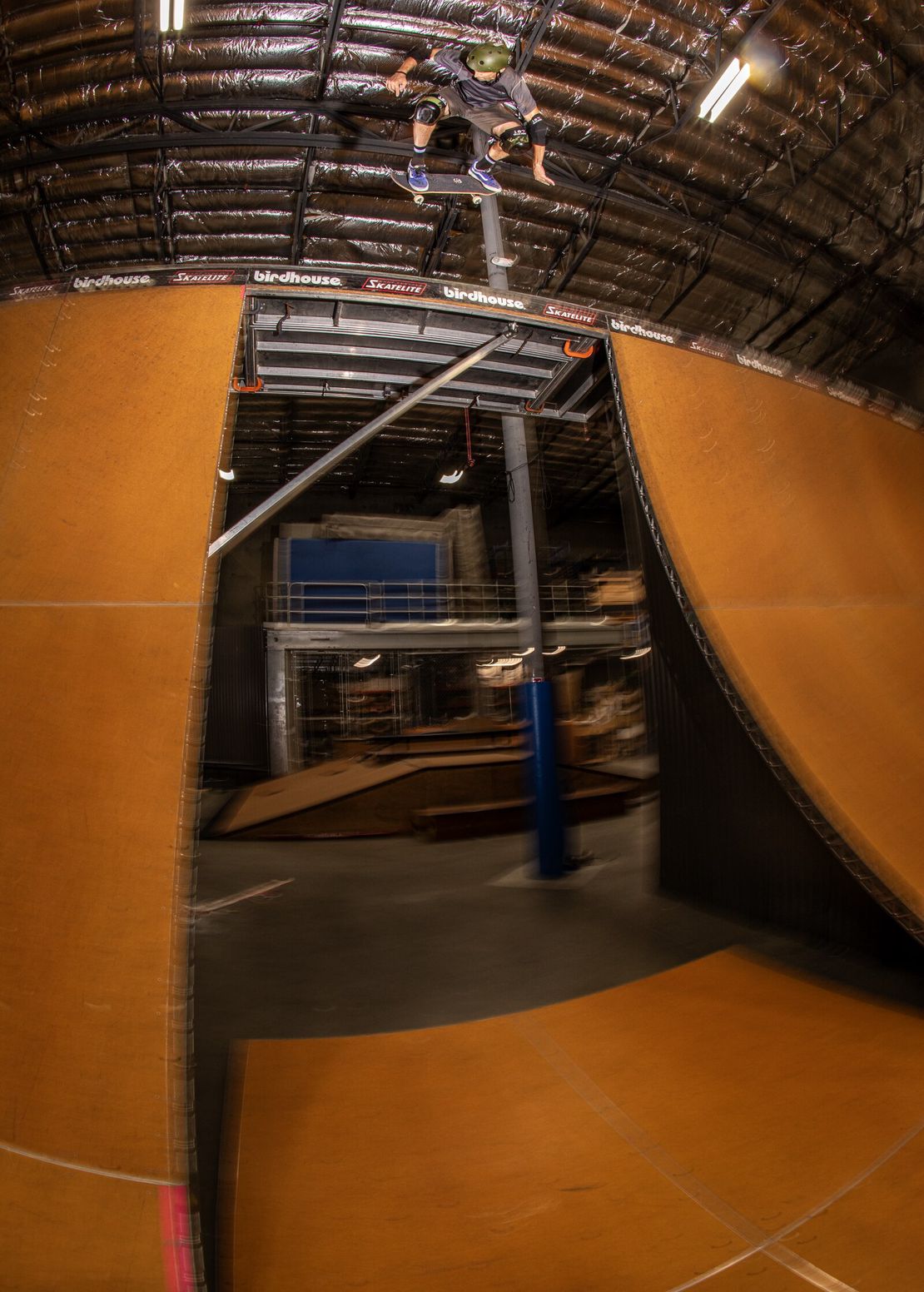
If you aren’t familiar with his ramp setup, it’s a 13.5 foot tall portable vert ramp, 70+ feet wide, and it dates back to when it traveled as part of his Boom-Boom Huck Jam action sports show. It had an 8’ wide opening engineered into it for a very specific purpose: to allow entry and exit from outside the ramp during those live shows, a need no other ramp ever had. The problem with the gap is that it goes from the vert to the flat, so there’s no cheating to get over it, and if you miss at all you’re dropping the full height of the ramp to concrete. It’s not so much that 8’ is unthinkable as a gap, locals at the ramp go over it casually, but it’s a gnarly feature on an already big and fast ramp, in all likelihood the best vert ramp in existence.
I knew I could do the gap. I had also never once actually done it, and those are very different kinds of knowing, separated by the precise distance between belief and the hard edge of that gap. Tony came out to give me pointers and a little push. Apparently he had seen enough to agree with my belief, and maybe felt like his job was to help close that belief/reality loop for me. We stood there and looked at the gap together for a few minutes, the way skaters look at a thing, mostly silent, running it in our heads. Then he said, “lemme grab my pads and show you.”
The make
So he skated with us a while, pretty chill, and we talked the line, and settled on a backside ollie as my best shot at it. If you don’t know skate tricks, a backside ollie is an air where you turn with your back to the ramp and you don’t grab the board. The not-grabbing part is technically harder than a grab air but it has the benefit of being a good air to carve and travel a distance with, and also a little easier to kick the board away and get out of trouble. First try, I bailed. Not close, not even in the conversation, just climbed back up the ramp with my heart going and told him I might need a different trick. “Nah,” he said. “You got it.” Dammit, Tony.
Second try was closer. I got over the gap, this time to a cleaner knee slide on the other side, and most of the fear drained out of it the way fear does after a thing has been survived. In skateboarding, learning the bail very often precedes learning the trick; it establishes your “safe” escape so that you can then lean in to pressing the actual thing. But the stress did not go anywhere, because the stress wasn’t really about the gap anymore. The stress was that Tony Hawk was standing there waiting on me, patient and unbothered, and that the trick needed a particular setup off the gap-facing wall to find the right line into it, which meant every attempt was a small public production with the most qualified audience on earth watching me assemble it. I’ve been in lots of skateboard contests over the years, so performance anxiety on the ramp isn’t a new thing. But there’s a specific flavor of pressure to being coached, gently, by the person who is better at the thing than anyone who has ever lived, while you fail at it in front of him.
Third try, I somehow landed it. The photo at the top of this is that, the gap cleared, a fifty-four-year-old’s very good birthday happening in real time.
Here’s my favorite part of all this, more than the landing, maybe even more than the serendipity of the situation. Nobody filmed it. My friends from home didn’t shoot video, didn’t pull out their phones, didn’t think to. My Skatepark Project friend didn’t even watch, he has a personal rule that he doesn’t like to watch gap first tries, so he was hiding in the office. There is no clip of it, no fifteen seconds being trimmed and captioned for an audience that wasn’t there. The only record of the entire afternoon is Brittain’s stills, and those exist only because a friend had quietly made sure a real photographer would be present if the day turned out to deserve one. The afternoon was not content. It was a day, lived, by people who still know the difference, and who treated the difference as obvious rather than as a stance.
Twenty years ago nobody would have filmed it either, and it would have meant nothing at all. Nobody carried a camera. The not-filming wasn’t a decision, it was just Thursday. What makes that afternoon legible now is that every person standing on that deck had a device in their pocket that would have captured the whole thing, in absurd quality, for nothing, and not one of them reached for it. The capture got free. The abstention got expensive. Most of us are still running the old etiquette on the new economics and haven’t opened the bill.
Doubles
I rode out the adrenaline of the gap, the giant slayed, that blessed endorphin bleed when the stress melts away because the thing is done. I was truly spent. I neglected to mention that Grant had treated me like a pro skater. At times when I squeaked out a make he’d hold up three fingers from the far deck. At first I was confused, then it dawned on me: he wants me to do three more because he’s playing with different shots. Dude, I barely made the one, and now you want three!? It’s mostly a blur now so I don’t recall how many of his shots he truly got, but I was smashed from the effort, the gap make the earned day-ender. That’s when Tony said, “you wanna do doubles?”
Well. Yeah.
The pressure dial was back at 11.
“What’s your best air?” he asked.
“I am NOT going over you,” I said. “I’m under guy on this one.”
He laughed, and said OK.
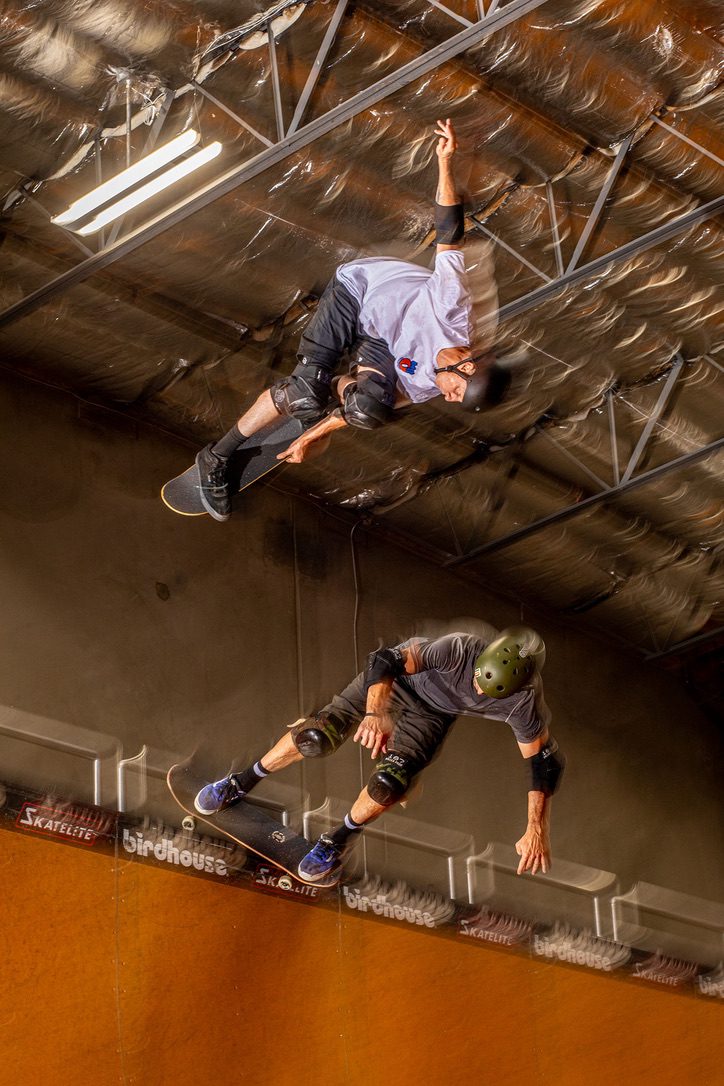 Doubles with Tony. Photo by Grant Brittain.
I was a nervous wreck, and he put me at ease in the way that good skaters put you at ease, which is mostly by being relaxed enough that their confidence somehow by osmosis transfers just a little to you. He’d adjust, he said, if I did anything crazy, which from him was both a reassurance and a quietly hilarious thing to be told. We made it several times. Brittain caught one of them. We thanked each other, got a group photo, and that was my surreal, entirely undeserved, perfectly earned fifty-fourth birthday at Tony’s ramp.
Two gifts
There were two gifts in that afternoon, and they were not the same kind, and the difference is the whole reason I’m telling it.
The gap was an earned gift. Tony came out unprompted, put on his pads, and coached a fellow geriatric skateboarder through a thing I could do in theory but had never actually pulled off, and then stood there through the bails saying you got it until it was true. That kind of thing, given with no audience and no plan to post it, is a specific cultural object. It only exists inside a small world where everyone has been on both ends of it, taught and been taught, held the camera and stood in front of it. You can’t manufacture it. You can only be inside the conditions where it happens.
Recently I stood on a strange vert ramp in Dallas in 101 degree heat and willed with every part of my being for a young girl I’d just met an hour earlier to summon the courage to stomp that first drop-in on vert. It took her the entire session, numerous agonizing steps up to the coping, leaning out over the edge, her body refusing. But eventually, through no assistance from me or anybody else, just a bunch of good vibes, she did it. She earned it all by herself. We all celebrated as if her win was ours, because in some small way it was.
Back to Tony, the doubles was a given gift, a different category than earned. It was spontaneous and unowed, just a thing that surfaced between two people who had spent the last hour skating the same 13.5 feet of Skatelite and steel. I don’t think it was a thank-you. It certainly wasn’t planned as one.
And the four years between the domain and that day is the frame around both. This is the part I’d ask you to sit with, if you sit with any of it. Tony thanked us on that Zoom call, and that was that. The birthday session at his ramp was something else. It was Tony being exactly who he is, doing the thing he does for skaters, on a day when I happened to be the skater standing in front of him looking at a gap with trepidation. It was the real thank-you, the kind that arrives on its own schedule or it isn’t one. It can’t be requested and it can’t be repaid, which is precisely what makes it worth more than the favor that occasioned it.
The principle worth stealing
I spent The Intimacy Economy arguing that there is a way of making and sharing things that runs on small communities and kept artifacts instead of audiences and scoreboards, and that it is nearly invisible to the metrics everyone watches. I had to argue it abstractly there, because the configuration is hard to point at. Here is me pointing at it. Skateboarding has been running on it for fifty years without a strategy deck, without a word for it, without ever once suspecting it needed one.
Look at everything that afternoon quietly refused. No posting plan. No filming the easy capture, the gap, which would have been the obvious clip. No scorekeeping. The gift economy of skating still works because everybody in it knows everybody has been on both ends, and nobody keeps a ledger of who owes whom. You cannot run a streak on people like that.
Fifty years is the part that should worry you, because for most of those fifty the discipline was free. You didn’t post the session because there was no posting. You didn’t run a streak because there was no streak available to run. The ethic and the equipment agreed, and nobody in that whole culture ever had to choose between them. Then the equipment switched sides. Every restraint that used to be structural became voluntary, somewhere around fifteen years ago, and voluntary restraint has a considerably worse track record than the structural kind. What I watched on that ramp was a fifty-year-old ethic being asked to hold on conviction alone, for the first time, with the cost of defecting sitting at zero and a camera in every pocket. It held. I don’t know whether that’s the most encouraging thing I’ve seen in a decade or a lagging indicator.
The friends-and-Brittain piece of the story is the one deliberate act in the whole afternoon, and it’s the part actually worth stealing. They did not film the day. But they did, on faith, arrange for someone great to be there in case the universe answered. They let the day be the day, and trusted that if it produced something worth keeping, there would be a way to keep it. That is the whole principle, and it’s the one I keep trying to build into everything I make now: let intimacy produce artifacts, but never let the producing of artifacts drive the intimacy. The afternoon did not exist in order to be photographed. The photographs exist because the afternoon was worth it. Reverse those two and you get the entire modern internet, and a worse day.
Sojourn and the other things I’m building are, underneath all the engineering, attempts to manufacture that condition on purpose, which is far harder than stumbling into it on a vert ramp on your birthday. You can’t decree a gift economy. You can only build the small, unscored, patient conditions where one might decide to show up. But the model is real, it predates all of this by a long way, and the proof of it is a four-year-late thank-you that never announced itself as one, from a guy who came outside because he saw an old friend of the sport looking at a gap and figured he’d help him over it.
Photos: Grant Brittain.