The Seal and the Net
A historian traced five thousand years of document verification and ended on a question: can we build the digital equivalent of the cylinder seal? We did, decades ago. It works exactly as well as the original, which is the part worth understanding.
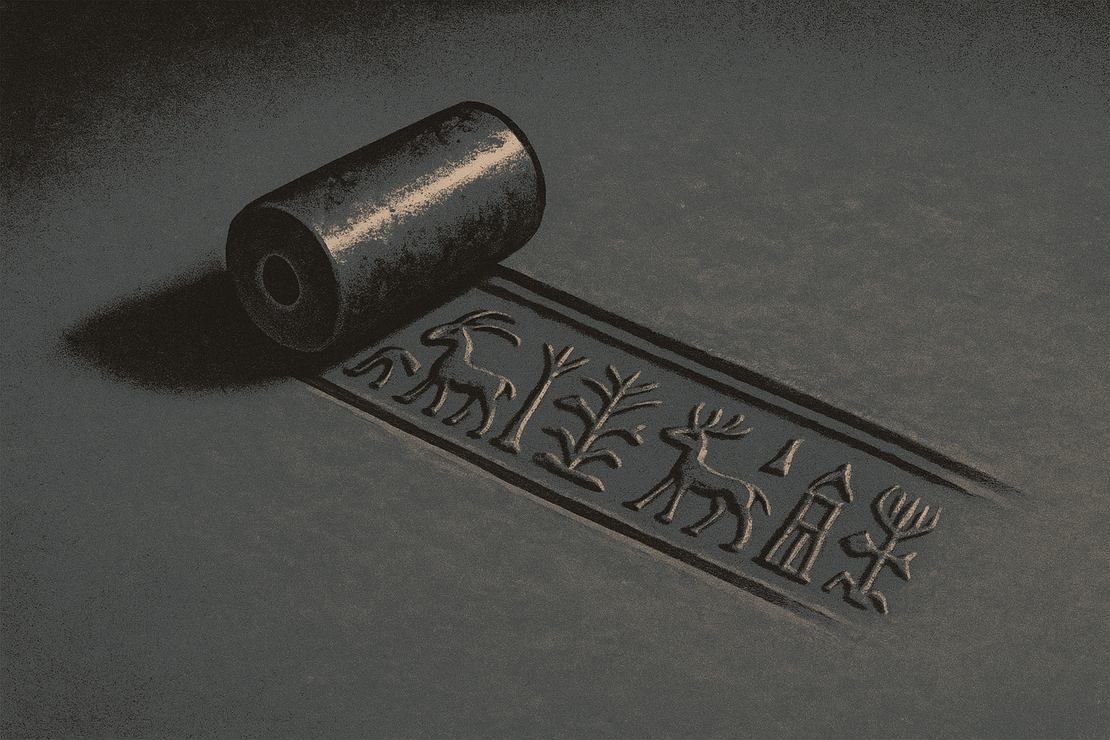
George Dillard writes history essays I read even when they’re far from anything I know, and a while back we traded comments under one of them, so I was primed to click when his piece on document verification came through my feed. In How Do You Know That Document Is Real? he walks five thousand years of the problem: Mesopotamian cylinder seals rolled into wet clay, wax pressed onto parchment tongues, medieval documents cut in half with wavy edges, the flowering of the signature, the calligraphic tughras of the Ottoman sultans. Then he stops at a door and, being a historian rather than a technologist, declines to walk through it. He ends on a question: “Can we build the digital equivalent of the cylinder seal? A lot is riding on the answer to that question.”
I’ve spent my working life on the other side of that door, writing software rather than securing it, but close enough to know where the plumbing runs. So I want to try to finish the thought.
Better math
The answer to the literal question is yes, and we already did, decades ago. A digital signature is a cylinder seal with better math. Every app on your phone was checked against a seal before the store would take it, so far upstream that you’ve never once seen the check fail. When your laptop warns you that an installer comes from an unidentified developer, that’s the same check, failing where you can see it. When your email provider quietly verifies that a message really came from the bank’s servers, that’s a seal. The camera industry is rolling out content credentials that sign a photo at the moment of capture, cryptographic wax pressed at the sensor. The padlock in your browser is a seal so routine you’d only notice its absence. Public-key cryptography gave us seals that are, by any mathematical measure, better than anything the Assyrians hung around their necks. Individuals have had one since 1991, when PGP shipped and handed anyone with a modem a seal the U.S. government classed as a munition. Dillard notes that his own kids don’t really have signatures, just logins, chips, and biometric scans, which is to say they grew up inside the digital cylinder seal without anyone pointing it out. Building it was never the hard part.
So why does his question still feel unanswered? Why does it feel, in 2026, like nobody can tell what’s real?
Reread his history asking who got caught, and something jumps out. In five thousand years, the seal never caught a single forger. People did.
That’s the mechanism hiding under the whole tour. A Mesopotamian seal could be stolen, and a stolen seal rolled exactly as well for the thief. Medieval forgers got good enough at faking wax that seals bled trust for centuries. Dillard reaches for the school permission slip, and anyone who ever hovered a pen over one understands the signature’s security model completely. Every regime he describes was forgeable, was in fact forged, and worked anyway, most of the time, for most people. It worked because it made honesty cheap and fraud expensive. Rolling your own seal took a moment; convincingly copying someone else’s took a craftsman, materials, and nerve, and if you got caught the merchant you defrauded knew where you lived. The seal was never a lock. It was a cheap way for honest parties to vouch, backed by the expensive machinery of reputation and reachability.
Seals and nets
Here’s the distinction I think his question is reaching for, and it needs two words instead of one. A seal is an instrument that serves the recipient. It answers: who stands behind this? It lets the honest vouch, and it can never catch anyone, because fraudsters simply decline to sign, and unsigned is the default state. A net is an instrument that serves an institution. It’s built to catch at scale: spam filters, fraud models, the AI-text watermarks now being mandated into chatbots. Nets have a history of their own. For decades, color printers have laid invisible yellow dots across every page, encoding the printer’s serial number and a timestamp, a net strung for currency counterfeiters; in 2017 the dots on a leaked NSA document told anyone who looked the date, the minute, and the serial number of the printer it came out of. A net catches. What a net can never do is vouch, and what a seal can never do is catch, and nearly all of the current confusion about “verification” comes from asking one instrument to do the other’s work. Dillard’s own opening lists them side by side, watermarks for AI video and badges for human-typed posts, as if they were one kind of tool. They’re the two kinds. Watermarks will not tell your readers you’re trustworthy. Content credentials will not stop the flood of machine slop, because slop doesn’t sign.
My mother ran the same net, twenty years before I’d heard of the yellow dots. Report cards then were a single card that followed you through the year: it went home every grading period for a parent’s signature and came back to school. My brother, in junior high, lifted a stack of blanks from the school office and ran two cards for the better part of a year. The real one he kept, forging her signature on it each period and turning it back in. The fake one, grades improved, existed only to be shown to our parents. He had the seal. What he didn’t know was that she had been suspicious for a while and had put a small dot, somewhere nobody would think to look, on the card she had been signing. Nobody in the family remembers what tipped her off, but she was an amateur detective when it came to my brother’s hijinks. At some point the display card had to be rebuilt from another blank, and he rebuilt it carefully. It came home without the dot, and he was busted. His report card caper was serious in the moment, and over the decades it became the story he told better than anyone in the family. The dot did what nets do: it caught, once, and only because somebody had decided ahead of time to be suspicious. The stolen blank did what seals do, which is vouch for whoever is holding it.
 The catch is real. So is everything the net never touched.
The indented cut
Dillard’s loveliest artifact makes the deeper point, the one his question walks right up to. The medieval chirograph: a contract written out twice on one sheet, a word inscribed across the middle, then cut apart along a deliberately irregular line, one half per party. Match the halves later and you’ve proven the copies are genuine counterparts. The jagged edge was called an indented cut, which is where the word “indenture” comes from. It is a hash check, seven hundred years early, and it shares a property with every other instrument in his tour. It verifies that the two documents match. It is perfectly, structurally silent on whether what they say is true.
That silence is where the analogy between his tour and our moment breaks, and it breaks in an instructive place. Every technology in his history answers one of two questions: who sealed this (identity) or is this the same document (integrity). Our present anxiety is about two different questions: did a person actually make this (origin) and should I believe it (merit). That’s four questions, and “real” has been the one word doing duty for all of them. No seal in five thousand years touched the second pair. The sultan’s tughra authenticated decrees that lied. A notarized contract can notarize a swindle. I’ve written before about why a check is only worth its independence from the thing it’s checking, and origin and merit are precisely the properties a mark on the outside of a document cannot reach. Whether a human’s judgment survived inside a piece of work turns out to depend on how the work was made, and no stamp on the artifact records that. The verification tools we’re nostalgic for were never doing the thing we miss. We miss something we never had.
So my full answer to his question runs like this. Yes, we can and in fact did build the digital cylinder seal; the engineering is the finished part. What broad adoption would buy us is what seals bought the Mesopotamians, and it’s worth having: cheap vouching for the honest, a cost jump for impersonators, a base level of accountability. Missing from that list is the thing his opening paragraphs mourn, the ability to look at an arbitrary artifact and know whether it’s real, because “real” was always those four questions wearing one word. And where the eye can’t tell the difference, history says somebody will manufacture the distinction and sell it back to us as a certificate. Some of those certificates will even be worth buying. None of them will be a truth machine.
The other half
The seal was only ever half the instrument. The other half was the reputation and reachability behind it, and there is one place where that half still exists as a job. A notary is less than most people assume. In most American states the requirements are a pulse, a clean record, and a small fee; about thirty states add a bond, and the exam, where there is one, covers procedure. Nobody tests whether you’re honest or can spot a forgery. The bond sounds like the deterrent and isn’t. It’s five or ten thousand dollars in most of the states that require one, and the notary doesn’t even post it; a surety company does, for a premium of about fifty dollars. What the public gets for that is a company that pays the victim and then comes looking for the notary if something goes wrong. The stamp costs almost nothing. What the state sells is a promise that the stamp can be traced to a person, by someone paid to do the tracing. (Most of Europe went the other way and made the notary a trained lawyer. Both versions work, which tells you the expertise was never the part holding the weight.) When the job moved online, the human came along on a video call. When the industry tried to automate it, the services a decade ago that stamped a document’s hash into Bitcoin’s ledger and called themselves notaries, we got a notary that can prove a document existed on a Tuesday and can’t be found by anyone on Wednesday.
The industry’s one famous attempt to build the human half by hand was PGP’s. Its answer to “who stands behind this key” was other people: you signed a stranger’s key to vouch that it belonged to the person it claimed, they signed yours, and the vouching spread outward in what Phil Zimmermann called a web of trust. The way it actually spread was the key-signing party. Engineers met in a hotel conference room, read each other’s driver’s licenses, and signed each other’s keys one at a time. Picture that, because it’s the most honest thing the industry ever did about this problem: a room full of people who understood the math better than anyone alive, standing in line to look at each other’s faces. It worked as far as the room. Thirty-five years later, almost nobody signs their email.
Which brings us, of all places, to wearables. Dillard’s history opens with Lady Layard wearing ancient seals as jewelry, and I think the image is better than decoration: the seal was always jewelry plus a person. A neck is what a seal hangs on: a person who can be found, and made to pay, and who has only one reputation to spend. The carving mattered because it hung on somebody findable, in a walkable city. The notary is the neck, licensed as a profession and nothing else. The key-signing party was the neck rebuilt by hand, in one room, for an afternoon. Today’s high-tech seals have better math and no necks.
So here is the question I’d hand back across the door to our historian friend. He asked whether the seal could be rebuilt; it can, and it was. What I can’t see from my side is how the neck was built. Every seal in his five thousand years was attached to a person somebody could walk to. What did people do when the city got too big to walk, when the sealer lived three days’ ride away and there was nobody to send for him? The notary is one answer, and it’s older than most of the countries that license one; its ancestor is standing in his first exhibit, where a Mesopotamian contract carried the seals of both parties and a witness, a third neck whose only job was to have been in the room. I suspect there are others, and that some of them were strange. Medieval custom had a seal’s die defaced or destroyed when its owner died, so the mark could never outlive the person it answered for: a reputation spent exactly once, enforced with a hammer. I’d like to know what the rest were, and which of them survived the loss of the walkable city, because that’s where we live now, and my side has been trying, mostly failing, to solve it with math for thirty-five years.