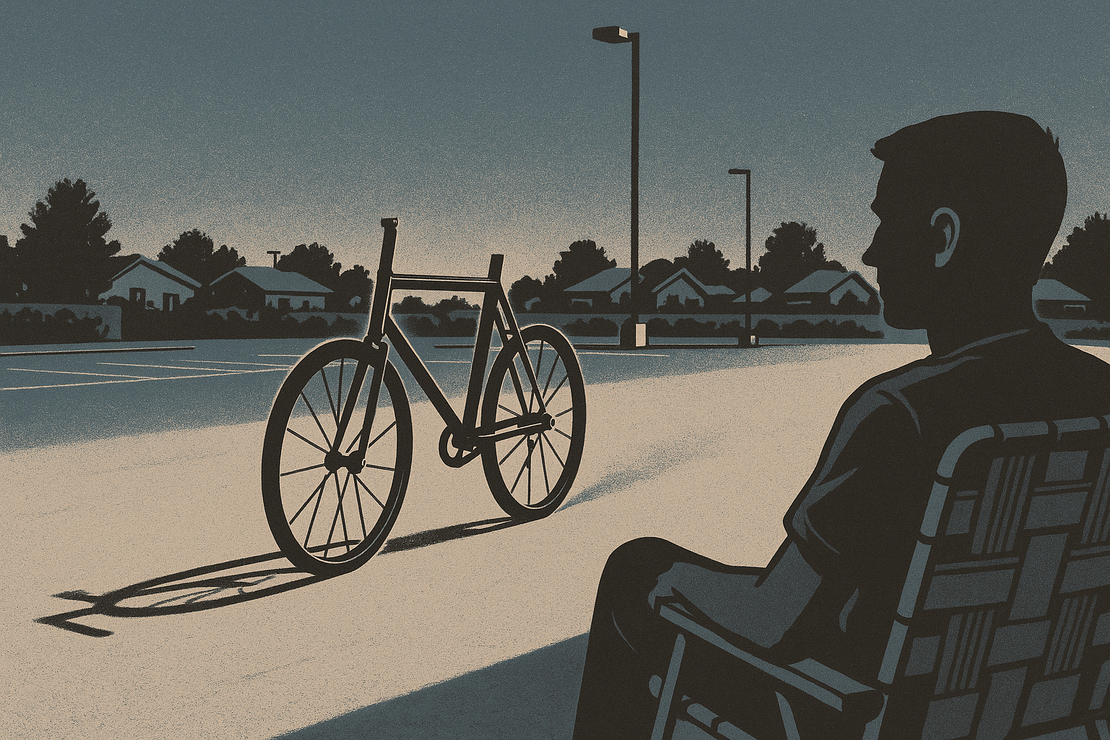
The Self-Riding Bicycle
A joke about a product that frees you from the one thing you actually wanted to do. Convenience has a default direction, and nobody votes on it.
Picture the launch. The lighting is good, the founder is in the nice plain t-shirt, and the thing under the cloth is a bicycle. The GhostRider™, he calls it. We asked a simple question, he says. What if riding a bicycle could be effortless? The bicycle, it turns out, rides itself: sensors, a gyroscope, a motor where the crank used to be. It balances, it steers, it accelerates, it leans through the corners. We removed the seat, he adds. And the pedals. What would you do with them? Not to mention the handlebar. Nobody’s there to hold on! It takes a clean lap around the stage, riderless, to applause.
And it is genuinely impressive, so sit in the applause for a second before the obvious thing arrives, which is: you’re not on the bicycle. You’re watching. The bicycle is riding itself across the stage and you’re across the room from it, clapping, a spectator at the experience you were ostensibly there to buy.
This isn’t entirely hypothetical. Engineers have actually built bicycles that balance and ride themselves, as a flex, and it’s a real piece of work. I’m not dunking on the engineering. I’m dunking on the pitch — the part that sells it as a product that frees you from something. A self-balancing bike that helps you stay up is one thing: an assist, training wheels for grown-ups, fine. A bike that rides itself, with nobody on it, is a different kind of object, and the kind is “a solution that ate its own problem on the way to the stage.” That part is hypothetical but worth imagining, because it’s less ridiculous than it sounds.
The category error
A bicycle has exactly one part you can’t remove, and it’s you. Pedaling isn’t the regrettable cost of getting somewhere — you are the thing getting somewhere. And yes, in a dense city a bike is also the best transport there is, faster and saner than a car, which is why half of Amsterdam commutes on two wheels. But even then you’re on it; the getting-there includes you. The self-riding bicycle removes the rider, and that breaks both versions at once. If you came for the ride — the wind, the effort, the small animal competence of staying upright and turning your own body into forward motion — it automates away the exact thing you came for. If you came to get somewhere, it delivers the bicycle to your destination and leaves you standing in the driveway. You were never the friction in the picture. You were the cargo.
It doesn’t save labor; it deletes the purpose. The bike gets there. You stayed home and got nothing. The benefit has no recipient.
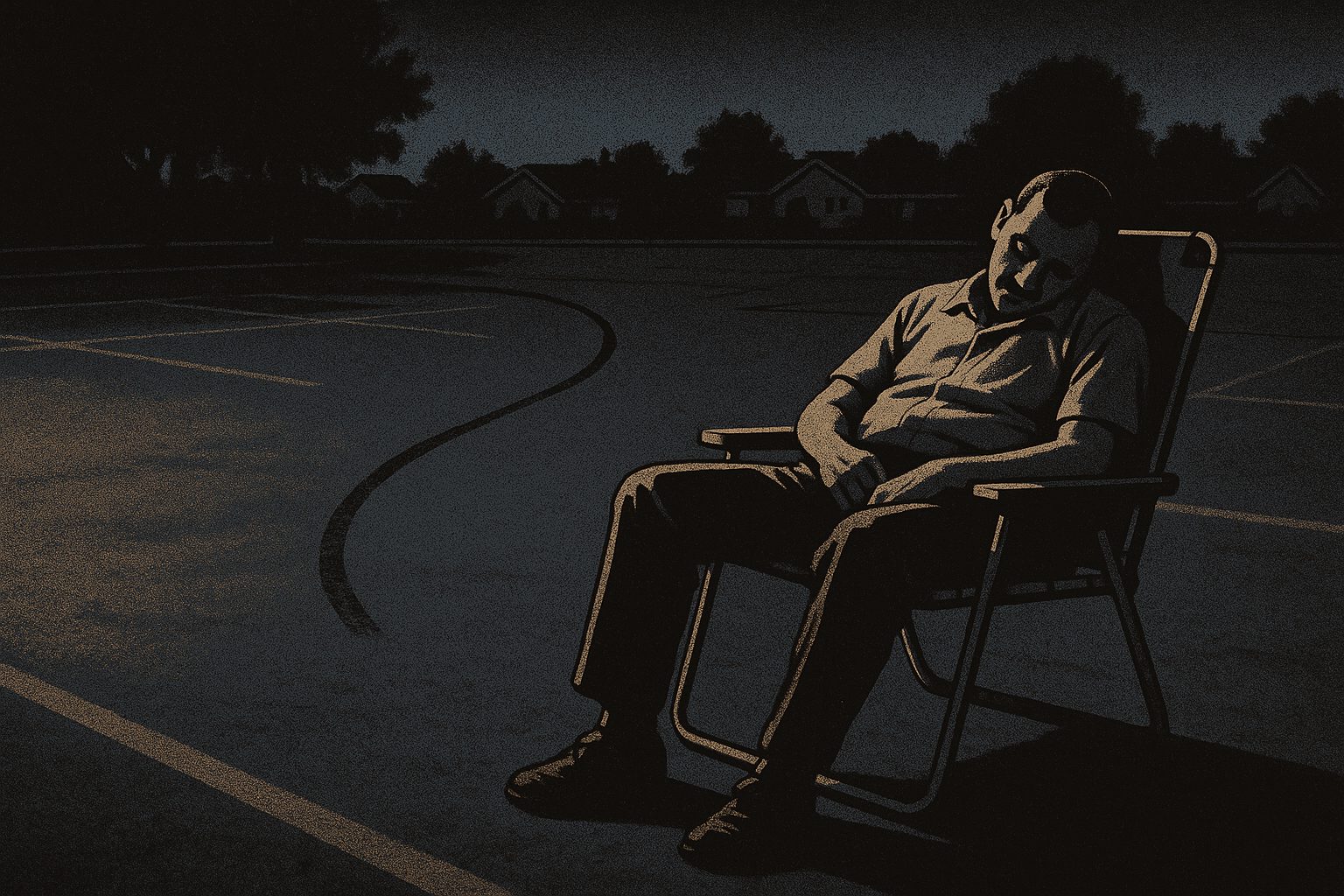 The ride happened. He slept through it.
Means and ends
There’s a real distinction under the joke, and it makes the joke almost worth the absurdity, because it travels. Some activities are means: you do them to get an outcome, and if a machine can hand you the outcome and skip the doing, that’s pure gain. I do not want to wash dishes; I want clean dishes; the dishwasher is a small miracle and I have never once mourned the suds. Most of what we’re automating right now is means, and good riddance.
But some activities are ends: the doing is the outcome, the experience is the product, and there’s nothing left to hand you if you skip it. The bike ride. The meal you cooked for someone you love. The song you play yourself. The long conversation. The hike, as opposed to the arrival at the top of it. The self-riding bicycle is funny because it runs means-logic on an end. It treats riding a bike like dishwashing — a chore to be optimized — when riding a bike is the rarer thing where the chore was the point. Run that confusion at scale and you get a strange kind of progress: a world of flawlessly delivered outcomes that nobody is actually there for. I follow that nobody out to the empty grandstand it implies, from the watcher’s seat, in The Unwatchable Race.
The default direction
Here’s the part that’s less funny and more worth your attention. Almost nobody decides, in cold blood, to automate away a joy. You wouldn’t actually buy the self-riding bike. The joke only works because the error is so obvious when it’s a bicycle.
The trouble is that the error is almost never obvious. Delegation has a default direction — toward more of it, always — because each individual step is reasonable and convenient and saves a little something real. And ends rarely announce themselves as ends; they wear the costume of chores. Cooking looks like a chore until the night you realize you haven’t made anything with your hands for anyone in a year. Writing the thing yourself looks like a chore until the part of your mind that used to do it goes quiet and you notice the quiet. My handwriting sucks, it didn’t used to, and I hate that. The self-riding bicycle is loud and stupid and easy to refuse. The version that actually gets you is silent: a hundred small, sensible handoffs, not one of them obviously the one that mattered, until you look up and find you’ve optimized the doing out of a life and kept only the having.
That non-recognition is the real subject. It’s the thing I keep circling, in the abstract: we automate away things we didn’t know we were keeping. The self-riding bicycle is what that looks like drawn with a crayon.
Where “it relocates upward” runs out
Those of us who build with AI tools have a comforting line we tell ourselves: the effort doesn’t vanish, it relocates upward. Hand the grunt work to the machine and your attention moves to higher-value judgment. I believe that. I’ll argue it repeatedly, because for means it’s true and it’s liberating.
It also has a floor, and the floor is exactly at the self-riding bicycle. There are activities with no higher altitude to relocate to, because they were never a stepping-stone to anything above them. The bike ride doesn’t ascend into some purer essence of cycling when you automate the pedaling. It just stops happening. The joy doesn’t move up a level. It evaporates. Comparative advantage is a wonderful instrument and it bottoms out precisely on the things that were ends. And forgetting that is how careful, well-meaning people automate their own lives hollow with the best intentions.
The chairs are the wrong scare
You already know the cartoon version: the people in the floating chairs, fed through straws, gone soft, gliding through a world that does everything for them. It’s a tidy image and it lets us all off the hook, because nobody pictures themselves in the WALL-E chair. Of course you’d never let it come to that.
But the chair is the wrong thing to be afraid of. Nobody chose the chair. They each chose a hundred reasonable conveniences, every one defensible on the day, and the chair is just where a road paved entirely with reasonable conveniences happens to end. The dystopia isn’t a decision; it’s an accumulation. That’s scarier than laziness, because laziness you can resolve to fix, but accumulation only asks you to keep saying yes to things that are, one at a time, completely fine.
Not an argument against tools
I want to be careful here, because it would be easy to read all this as anti-tool, and it isn’t. I use the latest tools, every day, on purpose; most of the other essays here are about doing exactly that and why it’s worth the cost. I am not telling you to pedal to the office on principle, or to scrub by hand what a machine scrubs better. The line is means-versus-ends, not more-versus-less, and the whole skill is noticing which one you’re holding before you hand it off. Automate every means you can reach. Guard the ends, because the ends are the part of the life that was ever actually yours.
And which activities are ends is yours to decide, not mine. For somebody, cycling really is pure transport and the self-riding bike would be a gift, assuming it comes with a sidecar you can ride in. For somebody else the commute is the best twenty minutes of the day. I can’t hand you the list, and I wouldn’t if I could — that was the whole point of Becoming Gnarly. All I’m claiming is that the list exists, that it’s shorter than the marketing would like, and that it’s worth drawing on purpose, in your own hand, before the default direction draws it for you.
That’s one cut. The next essay, Standing on Surfaces That Move, makes the companion one — taste from craft, the judgment a machine can execute for but never supply — and the rest of these essays run on both.
The test
So here’s the test I’ve started using. It’s cheap and it works. When a tool offers to do something for you, ask whether you wanted the outcome or the doing. If it’s the outcome — clean dishes, a faster route across town, a draft of the boring memo — take the help and don’t look back. But if it’s the doing, if the doing was the thing you were actually there for, then what the tool is offering, very politely, is to be you at the one moment you most wanted to be yourself.
A bicycle that rides itself is not a better bicycle. It’s a very expensive way to not go on a bike ride.