The Tax of Mastery
Why a competent adult would choose to be bad at things on purpose. Two kinds of starting over — the joyful reset and the dragon you've spent a life avoiding — and a dusty inherited guitar I decided to make mean something.
At thirty I took up ice hockey, which is a deranged thing for a grown adult to do. I’d skateboarded most of my life, well enough that my body had a deep, wordless fluency with a board. Skilled enough to think about style on top of the muscle memory. None of it transferred. Ice is not wood or Skatelite or concrete, a hockey stop is nothing like a skateboard’s, and there is a specific humility in being genuinely good at one thing and then standing on a surface that takes all of it away. I described it at the time as trying to learn to play basketball without knowing how to run. I spent a season getting the puck poked off my stick by ten-year-olds. And I loved it.
That last part is the part worth explaining, because on its face it makes no sense. I had a thing I was good at. Why pay money to be bad at a new one, in public, heckled by children? Don’t know if you know this but kids can be brutal.
The tax
The easy answer is humility. True as far as it goes, and also the boring answer, the one that makes me sound kinda noble. What took me longer to see: mastery levies a tax. When you’re new at something, the learning is steep and total: every session you are awful. But you’re also visibly, measurably less of an idiot than the one before, and that gradient is about the best feeling a human nervous system makes. Then you get good, and the gradient flattens. Mastery is mostly maintenance and small increments, a long plateau where you defend a level you already reached and occasionally nudge it higher at great effort. That’s not a complaint; the plateau is where real work gets done, and most things worth doing live up there. But the freshness is gone, and for a certain kind of person — the kind who is, underneath everything, in it for the progression — the flat part quietly costs something the achievement never pays back.
Starting over somewhere new refunds it. You buy back the steep part of the curve. You get to be bad again, which is the only way to be a fast learner again, because fast learning and being bad are the same condition seen from two sides. Seems weird holding both at once but that’s how it works.
It isn’t free, and that’s important to know. The price is an ego hit, and the size of the hit depends on who’s watching. I took up beekeeping the same decade — another beginner’s slope, an entire craft I had to start from the vocabulary up — and that one barely cost me anything on the ego front, because beekeeping happens in the back corner of a yard with nobody around but the bees, who have strong opinions but don’t keep score or talk trash. Bee stings hurt, but they spare the ego. Hockey was the opposite: a public arena, actual spectators, a version of myself that had been competent for decades getting dismantled by ruthless middle-schoolers where people could see. Same refund, very different price. Most people, offered the steep part of the curve at the cost of looking foolish in front of others, quietly decline and stay on the plateau. I fully understand that choice. I just think they’re leaving the best part on the table.
Choosing to be a beginner is a luxury. It takes time, money, and a life stable enough that you can afford to be bad at something on purpose. Hardship that forces you back to zero — a layoff, an injury that ends the thing you were good at, a life that detonates and has to be rebuilt from nothing — is not this, and anyone living it is facing a very different challenge. The whole value here is in the choosing. This is about volunteering for the bottom of a curve, not being thrown down it against your will.
The easy dragon and the real one
But hockey, for all the bruises, was an easy beginning, and it took me a while to admit why. Nothing was at stake. I was already an athlete; hockey was a new facet of an old skill set, and being bad at it threatened nothing about who I thought I was. It takes quite a while to figure out a wrist shot, even longer to develop the finesse of a proper slap shot, but those were mechanics I could grasp. It was the steep curve with the safety on because somewhere innately I knew it was just a matter of time until competence arrived.
There’s another kind of beginning with less certainty, and it’s the one this essay is actually about. It’s the beginning you’ve avoided — the thing you’ve spent a life quietly arranging not to find out whether you can do, because being bad at it would cost more than pride. Not a new facet. A dragon.
Mine is music. I was born and raised in Nashville — Music City, the place where music is the literal industry and the background radiation both — and I have been intimidated by it my entire life. Not uninterested. Intimidated. There’s a specific weight to being a non-musician from there, a sense that you, of all people, should already know this, that the not-knowing is a small ongoing failure you’ve trained yourself to walk past. Even worse, I had no excuse. I grew up around it, my late grandmother had a DIY music studio in her house for as long as I can remember. I sat on her warm tube amps as a child, listened to endless demo songs on the phone with her mostly against my will, and still, as an adult, couldn’t tell a Stratocaster from a Telecaster. Yeah, embarrassing. Turns out it’s very easy to never start the thing you’re most afraid of being bad at; you simply keep finding that it isn’t the right time, for decades, and call that normal.
I did make music, once. In the mid-eighties I had a brief run as a teenage rapper and DJ, and I want to be precise about the production values: a crappy cassette deck, a Radio Shack mixer, a toy Casio keyboard, a garbage turntable, a Dr. Rhythm drum machine, and not one unit of actual music knowledge. I lifted hooks off other people’s records, thumbed primitive melodies on the Casio, and mixed overdubbed live tracks on the cassette recorder until the overdub quality said I was done, usually three passes. It was, to the modern ear and in all likelihood every ear, objectively bad. The dragon would have pitied me. I made it anyway, and I loved making it.
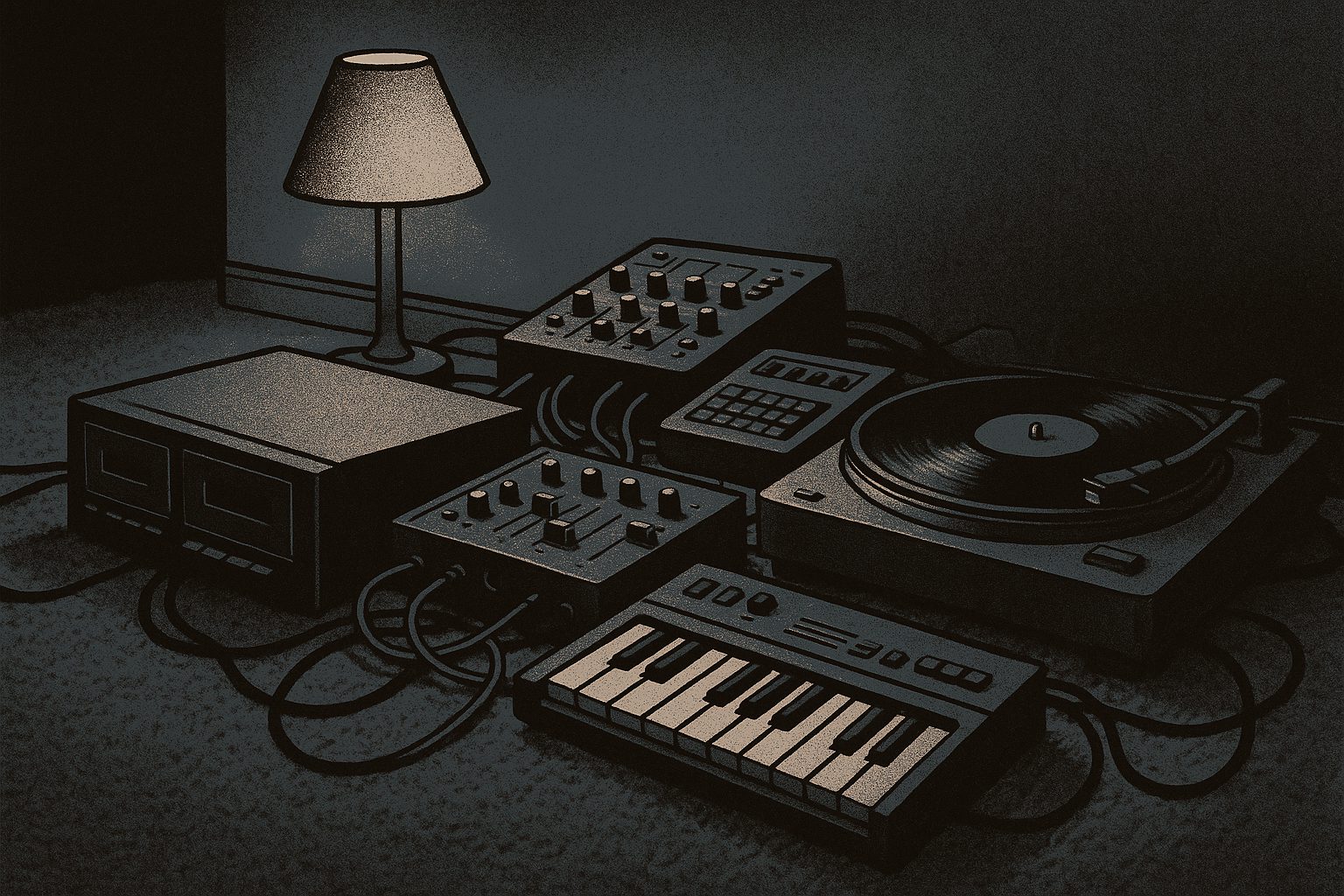 The rig: a cassette deck, a Radio Shack mixer, a toy Casio, and not one unit of music knowledge.
Which sounds like the opposite of a man who avoided music his whole life, and it’s actually the most careful avoidance in the whole story. Early hip hop was the one door into music a non-musician could walk through without ever meeting the dragon — no theory, no instrument, no telling a Strat from a Tele, no need to be any good. You didn’t have to understand a chord progression or practice a scale, you could just program a drum track, steal a sample from an old record, and you’re in business. I got to create, I got to scratch the itch, I even carried my grandmother’s thing forward in my own bent and lo-fi way, all without once standing in the room with the fear. It wasn’t facing the dragon. It was finding the one hallway in the castle the dragon didn’t guard. That clunky kid’s studio was the first time I reached for a tool to make something I hadn’t earned the craft to make. The taste to do it well took decades longer; the reaching never changed.
What changed isn’t a story about destiny. My grandmother was a very serious aspiring country musician, the Nashville kind, more aspiration than career. She was obsessed with it her entire life, and actually paid with her own money to have records pressed, even had some of her songs recorded by others. She died years ago. She had a shiny red Fender guitar, a real one, and after she died it did what many heirlooms do: it went into a closet and stayed there, dusty, unremarkable to everyone around it. It surfaced when my parents moved and did the triage a move forces. They didn’t think much of it. I did. I remembered it from childhood, sitting in her studio. And I remembered it in the artist photo she paid to have shot in Nashville’s Centennial Park in the 1970s, her in that purple dress. I hadn’t known it still existed.
Nobody handed it to me as a torch. There was no deathbed scene, no note, no chosen heir. Only the recognition in recent years that she and I are more alike than I ever realized growing up: the relentless obsession with whatever you’re doing, driving everyone around you a little nutty with your singular focus. We definitely share that. But she died never knowing I had one iota of music interest. Her guitar was a thing nobody else especially valued that I happened to recognize, and the meaning it carries is meaning I decided to give it. That distinction matters to me, because the sappy version — she passed it down so I could carry the music forward — is false, and what actually happened is better: a forgotten object I chose to treat as a doorway. The nudge didn’t come from beyond. I supplied the nudge. The guitar just sat there being exactly the right guitar.
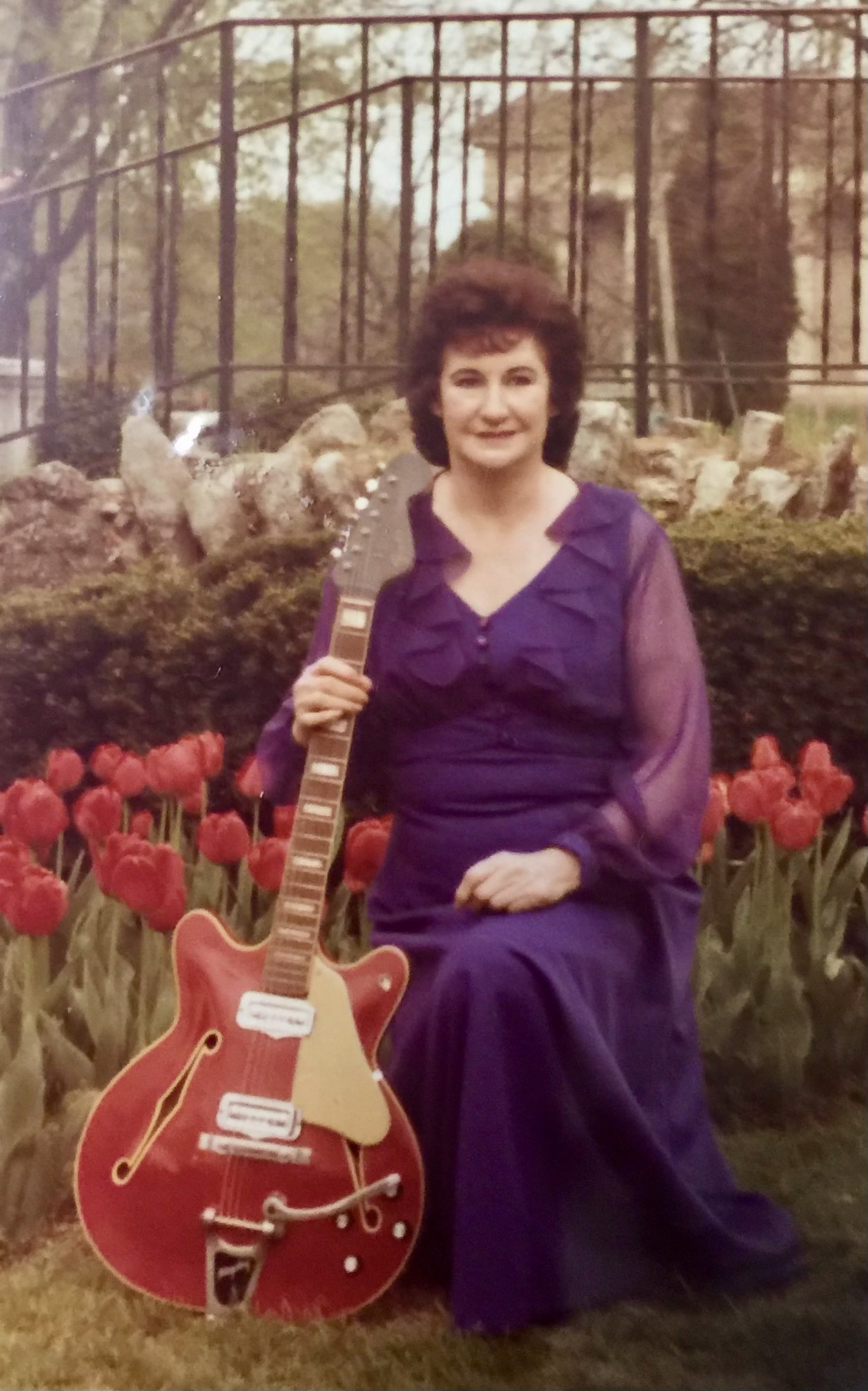 My grandmother with the same guitar, sometime in the 1970s.
So I started learning, on her guitar, and it is a completely different experience from hockey, because the ego doesn’t get bruised in the fun way; it gets threatened in an older, deeper way. Every clumsy chord change is also a small confirmation of the thing I’d feared and dodged: that I’m starting embarrassingly late, that I might find the floor of my own ability and discover it’s lower than I’d hoped. Hockey couldn’t touch any of that, because I never believed I was supposed to be a hockey player, and never thought for a second I couldn’t be one. The guitar carries real baggage, because somewhere underneath I’ve always believed I was supposed to be able to do this — and avoiding it was easier than testing it.
And — for whatever it’s worth, and it might be worth a great deal — I think I can. I have a stubborn, unproven conviction that there’s a capacity in there I never spent, that the intimidation was always bigger than the actual obstacle. As of this writing that capacity remains exactly that: unspent. I am not good. I’m a beginner with a beautiful red guitar and a lot of road to cover, and the honest report is that the dragon is very much alive and I am, at last, in the room with it. Not a midlife crisis, for the record, though it is, I’ll admit, a very sexy red guitar.
A fun wrinkle emerged once I’d spent some time with my grandmother’s guitar, which by now has earned a name: Berenice, after her middle name. I realized the guitar might be a path rather than a destination, and that the path ran backward, toward that goofy teenager scratching records. What I was doing back in the mid-eighties with the drum machine and the Casio keyboard was assembling hooks and rhythms. It dawned on me that there’s a guitar for that, a bass guitar, and that it might actually be the instrument for me. So I bought a bass and started learning it alongside the red Fender. I’ll continue to learn both but I suspect I’m a bass guy. We’ll see. For now I’m just bad at two instruments instead of one.
The borrowed instrument
That backward look goes further than the bass. The clunky kid’s studio and the AI tools I build with now are the same instinct forty years apart: find a way to make the thing without first becoming the person with the craft to make it. I’ve spent a whole run of these essays defending that instinct, sincerely, because for most of what I make it’s the right call. Not being an illustrator or graphic artist, I lean on AI to help create images I’d probably otherwise just not have. I have tons of story ideas and a legit feel for what works, but I use AI to scaffold complete stories where I don’t have the chops to write fiction from scratch. There are even times when I have the craft and reach for the machine anyway, to take it somewhere I couldn’t get on my own: I’m a decent critical thinker, but arguing ideas with AI pressure-tests them in a way I never could alone.
The guitar is the one place I’m refusing my own argument on purpose, and I nearly gave myself credit for turning down something nobody offered. Nothing on the market makes your hands play guitar. But there is a machine that makes music, and I could have a song by dinner: type a description, name a genre, get back three minutes with a hook and a bridge, a wicked guitar solo, and a clean fade-out, better than anything I made in 1986 and better than anything I’ll play this year, or next. That option is real and cheap and sitting right there. It’s useless to me.
The reason is the whole essay. With the images and the stories I wanted the thing to exist, the craft was in the way, so I went around it to get the output, and I’ll do it again tomorrow. With the guitar I don’t want a song. I want to be someone who can play a song, and nothing generates that. My absence of craft isn’t the obstacle here; it’s the entire point. Some difficulty is the work. Not all friction is formative. Telling those two apart is the only thing I’ve really been writing about this whole time.
Which means the choice was never whether to use the tool. It was whether to keep wanting the output, and wanting the output is exactly how I dodged this in 1986 and every year since. The hallway I found in the castle is still there. The machine has made it wider than it has ever been. The guitar is me finally taking my own distinction seriously enough to let it cost me.
There’s a word for something you use and don’t own: rent. It’s the right word for all of it, and that’s the part I’d left sitting under the argument all along. Route around a craft and you don’t acquire the ability, you rent it: output by the month, for exactly as long as the terms hold. Most of what I build now, I build on a borrowed instrument, rented from a handful of companies that can raise the price or change those terms whenever they like. But learn a craft and it’s yours, essentially forever. Nobody can reprice a G chord once your hands know it, any more than they could reprice a wrist shot.
The rented tool is only the near end of it. The far end is reach. Everything I make still has to find somebody or it may as well not exist, and that road was never mine either. For thirty years that was a fine trade: whoever hired me owned the road, I owned the making, and the making was the part they couldn’t do without me. The things that were mine start to finish, the ones I’d win or lose on alone, I could never get in front of anybody at all. People still pay me for the making, and every year it gets harder to say why they should. Which leaves the road as the only part worth owning, and the road is the one I never learned to build. But I’m working on it.
Nobody stands at either end of the guitar. Nobody rents me the instrument, and nobody has to find it or buy it for it to do its whole job. It’s the back corner of the yard again, except this time the only one keeping score is me, and I’m harsher than the ten-year-olds ever were. It figures that the one instrument I own free and clear is the one I can barely play.
Becoming, unfinished
That’s where I have to leave it. The hockey story has an ending: I tried it, I loved it, I can tell you how it turned out. The guitar story may never get a clean one. I don’t get to describe the slain dragon’s body. I only get to tell you I finally walked in, and that it was still standing when I did.
There’s a word I keep coming back to for this whole disposition — becoming — and the guitar is where it stops being a tidy idea and turns into an unresolved thing in my actual hands. Two ways in, and they don’t cost the same.
The first is the refund. It’s easy to claim, because it’s already owed to you: the tax you paid getting good at something is sitting right there, and most Saturdays you can go collect it by being a happy idiot at something new.
The second is the dragon. The dragon refunds nothing: no tax coming back, no gradient promised, and nobody’s handing you this one. You go because the avoiding was costing more than the failing ever could.
I’m sure of the first. I’m in the middle of finding out about the second.