The Unwatchable Race
A driverless racing series would be a flawless spectacle with no reason on earth to watch it. The two things optimization can't fake are a clock and a rival.
I had no use for motor racing. Loud, repetitive, a parade of billboards doing two hundred. Then a friend recommended Drive to Survive and I lost a weekend, and what hooked me had almost nothing to do with cars. It was the people. Who they were, who they couldn’t stand, which garages were quietly at war, the engineering trickery, how a tenth of a second in Bahrain rearranged a championship by December. In the early seasons, Guenther Steiner dropped lovable f-bombs left and right, and made you dread that post-race call to Gene Haas, the owner, along with him. The speed was the occasion. The story was the reason.
Watch long enough and you learn the grammar. The grid, undercuts, overcuts, clean air…and which drivers to pull for or against. A teenage prodigy like Kimi Antonelli, a perfectly assembled champion like Lewis Hamilton, or another champion like Max Verstappen, who at times has been undoubtedly the best driver in the field but sometimes hard to love. So in any given season you may lean harder toward the guy you love or the guy you most certainly don’t, and in the latter case the grandstand flips. You stop cheering for a man and start cheering for the field, for anyone, please, to take him down. The sport gets better for it. That’s the tell. We don’t even need a hero. We’ll build the poles out of whatever the season hands us, including a champion we decide to resent, because the one thing the watching cannot survive is having no one to be for or against.
The driverless grid
Now take the people out.
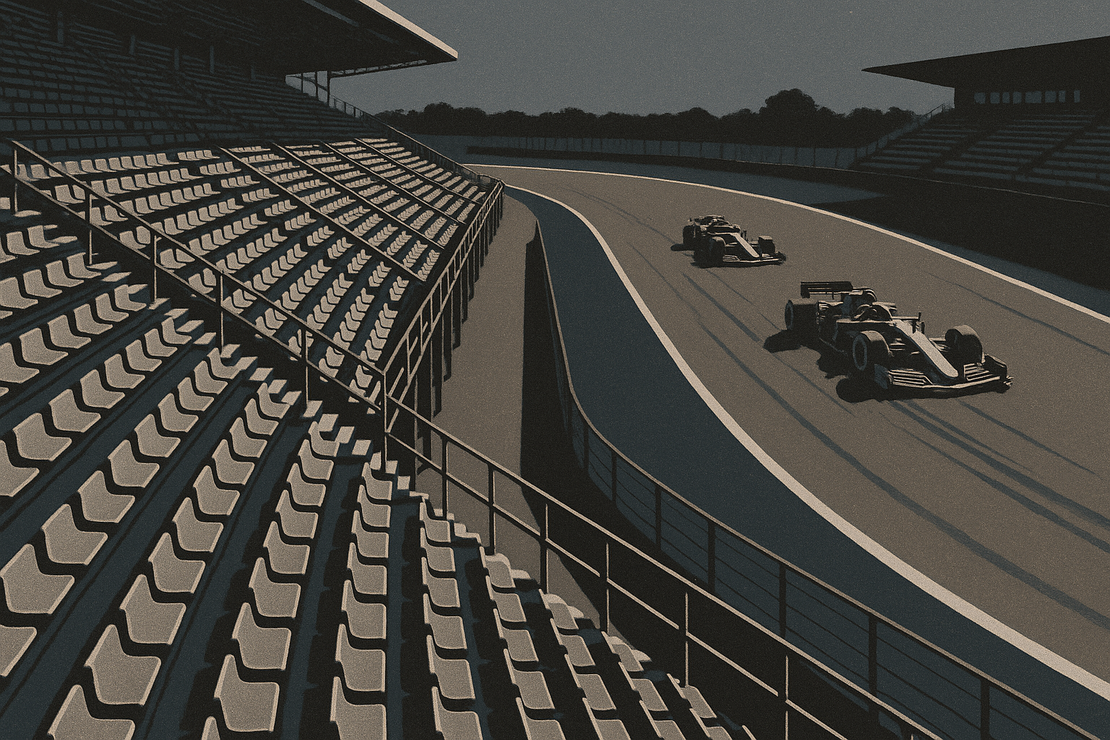
Picture the same circuits, same speeds, the same engineering living on the ragged edge of physics, and not one human in any of the cars. Let’s call it G1. This is the age of AI so of course the cars are driverless. Pure optimization, twenty ghosts trading the perfect line, the lap times would be incredible. It would be a genuine technical marvel, and you would glance at it the way you glance at a benchmark score, and you would not come back next Sunday. Nobody fills a grandstand to watch a forklift outlift a man.
You could object that plenty of human races are already boring, and you’d be right. The Hungaroring, outside Budapest, is tight and narrow and close to impossible to pass on; it reliably produces processions, twenty cars finishing about where they started, the thing effectively settled on Saturday. Not full-on Monaco, but close. And we watch anyway. A championship is riding on it. The year your guy finally turns things around. Somebody’s seat for next season is on the line. A dull race between people is still a race between people, and the boredom is a bad afternoon rather than a broken sport. G1 breaks the sport, and it could manage it on an afternoon when the driving is spectacular.
The biosphere
And we have already run half of this experiment, on this exact sport. In 2020 Formula One restarted inside what former F1 team boss Ross Brawn called a biosphere: the paddock sealed into a bubble of isolation, everyone swabbed every other day, a whole season of testing for a resulting positive rate around a tenth of a percent. The season went off. The cars ran. The grandstands stood empty, race after race, and stayed that way. And unlike some other major sports leagues, F1 figured engine noise was loud enough to not need to pipe in artificial crowd noise.
Notice which component was saved in the COVID year. Given a pandemic and a choice, the sport let the seats in the stands sit vacant and spent a fortune keeping the seats in the cars filled. Nobody in that emergency ever proposed the obvious efficiency: run the season driverless and skip the swabs entirely. Empty stands were a wound it could survive. The thing it would not give up, at nearly any price, is precisely the thing G1 proposes to delete.
Which is the same joke I’ve told before, wearing a different coat. I once wrote about a bicycle that rides itself and called it a very expensive way to skip a bike ride. That was the doer’s seat: automate the thing whose whole point was the doing, and you’ve eaten your own afternoon. G1 is that joke moved to the watcher’s seat. Pull the driver and of course the driver loses the sport they gave everything to. But that’s the obvious theft, the one the bicycle already showed us. The quieter, bigger one is the grandstand: eighty thousand people who came to watch a person do something with their one and only nervous system on the line.
The control condition
So what are those people in the stands there for? The lazy answer is effort: we like to see someone strain. It doesn’t hold up on its own. The engine strains at least as hard as the driver, and nobody buys a ticket to watch the engine. Strain is certainly part of it, who doesn’t love a triple-overtime NHL playoff game? But we watch humans for something effort alone can’t explain, and the cleanest proof I know is a documentary about grown men playing Donkey Kong.
The King of Kong should not work. The stakes are a high score on a 1981 arcade cabinet. There is no athletic prestige left to credit, no money worth the name, nothing your brain can mistake for importance. And it is riveting, because it has the two poles and nothing else: Steve Wiebe, the earnest, recently-laid-off everyman, chasing the record on a camcorder in his garage, breaking off mid-run when his young son hollers from the bathroom to have his bottom wiped. Up against Billy Mitchell, a hot-sauce mogul with a mullet and an American-flag tie who appears to have been cast by the universe specifically to be rooted against. Strip away every reason to care except the human one and the human one still fills the screen. That’s the control condition. Not the effort, not the arena — just the two men.
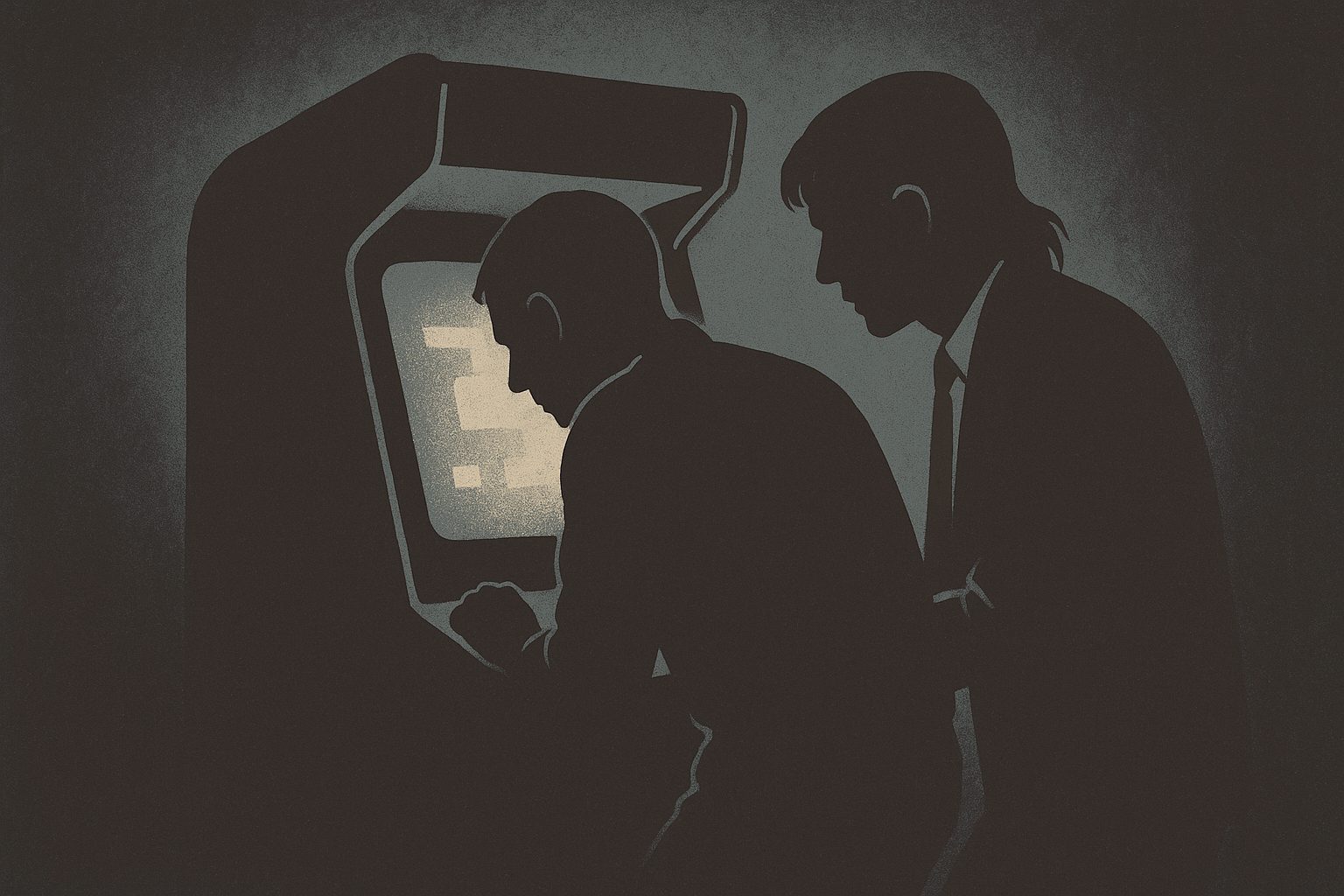 A high score on a 1981 cabinet, and two men who genuinely cannot stand each other. That was always enough.
What we couldn’t forgive
Here’s the other control, and this one implicates us.
For most of a decade I watched a cancer survivor win the Tour de France seven times, and so did much of the planet, and the watts that carried Lance Armstrong up those climbs were chemically inflated, and we kinda knew it, and we cheered anyway. That’s the part worth sitting with. The output was, in the most literal sense, fake. Not metaphorically enhanced. Doped. And the era was the most compelling thing in the sport, because the story was real even when the numbers weren’t. He had Jan Ullrich as his foil: not a villain, a legitimate rival, good enough to make winning mean something, which is its own kind of necessary. Without a credible challenger, dominance just flattens into a stat line. Ullrich made the climbs a contest. The contest made the myth.
And when it came apart, watch what we actually couldn’t forgive. It wasn’t the doping. Most of the peloton was dirty; everyone with a pulse suspected it. What finished him was the lying, the years of it, the lawsuits aimed at people who were telling the truth, the hostility and vengefulness toward honesty itself. He broke the relationship, and that we don’t forgive, even though we’d quietly absorbed the cheating for a decade. Which tells you what the relationship was made of the entire time. We were never buying the watts with a straight face, not entirely. We were buying the man, and we kept buying through the fall, because the fall was the next chapter of the same story we’d been reading. (Pete Rose got there a different way, on the same road: the gambling, sure, but really the denial that outlasted everyone’s patience for it, with an attitude to boot.)
I have ridden Alpe d’Huez. Twenty-one hairpins, each one signed with the name of a rider who won a stage here, counting down as you climb. The pros do it in about forty minutes. I did it in an hour and seven. I barely registered the names. I was overwhelmed just to be on the climb, and it took a few turns to settle in and trust I was allowed to enjoy it. Armstrong’s name was up there in the early bends, bolted to the mountain: the wins annulled, the palmarès blanked, the sign left where it was. It’s not there anymore — it took a few years, but they finally took it down. Which is the tell. They can annul a result and they can unbolt a sign. They cannot vacate the fact that we watched.
Put the two controls together and you’ve isolated the active ingredient. Make the arena trivial — Donkey Kong — and the narrative still holds. Make the performance fraudulent — Armstrong — and the narrative still holds. The only thing present in both is a person, with a story, unspooling in front of us in real time.
What the machine can’t give
A machine can’t give you either of the things that story runs on.
It can’t give you a clock. Jordan had an era. Tiger had an ascent. The Armstrong years were years, same as Schumacher in F1, a human span burning down once, and the reason you’d drop everything to witness the run was the knowledge that it would not come again: that you were present for a thing that would outlive the watching of it. A driverless car has no career. It does not peak at twenty-six and fade at thirty-five. It will reset the lap record on a wet Tuesday and again on a dry one and there is no last dance in it, because there is nothing in it that ends.
And it can’t give you a rival. Two G1 cars racing aren’t enemies. Neither wants to win. Neither resents the other, neither earns anything by beating it, neither can be the worthy Ullrich or the punchable Mitchell, because a foil has to be a self with something at stake against another self. The crowd would strain to invent a story and find nothing to hang it on. You cannot root against a thing that has nothing to lose.
A clock and a rival. The grandstand needs both, and the machine has neither.
I notice this is the same mechanism that decides whether you trust a piece of writing now. One race tells you little about a driver; a season reveals him, it unspools his story. One post tells you little about a writer; a couple hundred reveal whether there’s a continuous someone on the other side, with the fixations and the bad days and the metaphors they overuse. Drive to Survive and a body of essays are the same instrument pointed at different lives. Both run on a persisting, mortal person you get to watch become themselves. That’s the part the optimization can’t fake, on the track or on the page. Copy the artifact perfectly and you’ve still copied nothing that mattered, because what mattered was the witness behind it.
What I let the app eat
I can prove how much I believe the watching is the relationship, because I built something to defend it. A few years into a fantasy F1 league run entirely in a group chat — standings tallied by hand (mine!), disputes settled in the scroll-back, somebody always forgetting to lock their picks — I got annoyed enough to make us a stripped-down app to do the sums. Open Wheelers. A deliberately simple thing that grew into a real app, and notice what I let it eat: the scorekeeping, the pure friction, the means. It never touches the race. It never touches the Sunday group chat that was the entire point. I built a machine to hold the spreadsheet so the friendship could keep its hands free. Which is the whole quarrel with G1 in one breath: one automates the clerical work around the watching, the other automates the human out of the thing being watched, and telling those two apart was always the only question.
I haven’t watched a full Tour since Armstrong, or much basketball since Jordan. Not because the stories stopped. There are plenty worth the time. Those particular ones just used me up, and that’s the most honest thing I can tell you about what the watching was for. It was never information. It was the chance to say I saw it while it was happening. Build G1, and it will break every record we have, faster and cleaner than any of these flawed and mortal people ever managed, and there will be no one in the stands — in the only sense that ever mattered — to have been there when it did.