The Violinist and the Commodore 64
In 1982 a musicians' union voted to ban the synthesizer, and they were right about what it would cost them. The gains arrived forty years later, from a toy.
I believe it was 1984 when I upgraded from a TI 99/4A computer to a Commodore 64, which would become the single best-selling desktop computer of all time. Those were early days for desktop computers, and the C64 was an affordable entry point, introducing many of us to the BASIC programming language, early online communities, and software piracy. A few of us even leveled up to learning 6502 Assembly Language, which was no-joke challenging for that era, likely for any era. I used my Commodore for tinkering with programming, playing games, and eventually running a Bulletin Board System (BBS) on a shockingly slow dial-up connection…mostly to download more games.
Although I knew about it, I personally didn’t spend all that much time noodling with the C64’s SID (Sound Interface Device) chip, which we would later realize was low-key revolutionary — an advanced three-voice music synthesizer. Not a toy. Three oscillators, a filter, and envelope generators. The architecture of a legit digital musical instrument. An engineer named Bob Yannes led the small team that designed that chip, four of them, in five months in the latter half of 1981, and then he left the company and co-founded a synthesizer manufacturer called Ensoniq the following year. He put a synth in a few million kids’ bedrooms and then went off to build them for adults.
None of us really knew what he had done or what it meant. If I had announced that I wanted to learn music on the Commodore, I would’ve been quickly redirected to a piano, and not the digital kind. In 1984 the machine that could convincingly imitate a grand piano was a Kurzweil that cost more than ten thousand dollars.
Two years before I ever touched a Commodore, a branch of the Musicians’ Union in London voted to ban the synthesizer. They voted to ban the thing that would ship inside it three months later.
The motion passed on May 23rd, 1982, and it called for an outright ban on synthesizers, drum machines, and any electronic device “capable of recreating the sounds of conventional musical instruments.” It was a union rule for members, the equivalent of a carpentry union insisting on real hammers over nail guns, and it had teeth wherever the union’s contracts reached, in the studios and the theatre pits.
The vote fell on Bob Moog’s birthday, which is a fun little coincidence. Bob Moog (pronounced as if rhyming with vogue) was an American engineer and electronic music pioneer who invented the Moog synthesizer. We’ll come back to that.
The NME (New Musical Express), a legendary British music journalism magazine, called the Musicians’ Union loonies for the decision. Synth players formed a rival organization with the magnificent name Union of Sound Synthesists. Told this way it’s a story about people being silly in the past, and that’s how I first heard it.
Things got real when Barry Manilow played the Royal Albert Hall in January of 1982 without a live string section, synthesizers standing in for the strings. Those two nights were recorded and released as Barry Live in Britain, which went to number one in the UK. Manilow was huge in that era, with songs like “Copacabana (At the Copa)” and the very meta “I Write the Songs”…which he didn’t write! Bruce Johnston of the Beach Boys did. If you aren’t familiar with Manilow, picture Michael Bublé’s catalog with Taylor Swift’s fans. His are called Fanilows, a name they didn’t pick and eventually embraced. So him not using a live string section with real players was a big deal, and the record of him not doing it was now the country’s best-selling album.
The players who would have been on that stage were now gone. Through the decade that followed, session work contracted, musicians moved to multitrack and covered whole ensembles alone, and the theatre pits thinned out. A room full of people looked at an instrument and said this is going to take our members’ work, and indeed it took their members’ work. Sometimes when you think the sky is falling, it actually falls.
So they were right. Nobody mentions that part.
Here is the other thing that was happening while that synth vote was being taken.
The band Rush had spent years building something that didn’t have a name yet. Geddy Lee sang lead and played bass, and at the same time played Moog Taurus pedals with his feet. He also played keyboards, live, in front of people, in a band whose whole reputation rested on how hard its music was to play. Rush in 1982 had no string section to send home, so his synthesizer never stood in for anyone. It demanded more from the one who stayed.
To honor him, in March of 2025 Moog released a signature Minimoog Model D with Geddy Lee’s name on it. Satin red with metallic flecks, a nod to the Grace Under Pressure stage rig, a Rush starman badge on the case, a certificate hand-signed by Lee, a little over five thousand dollars.
Forty-three years after a room of working musicians voted to ban the instrument, the instrument gets stamped with the name of a musician revered for musicianship.
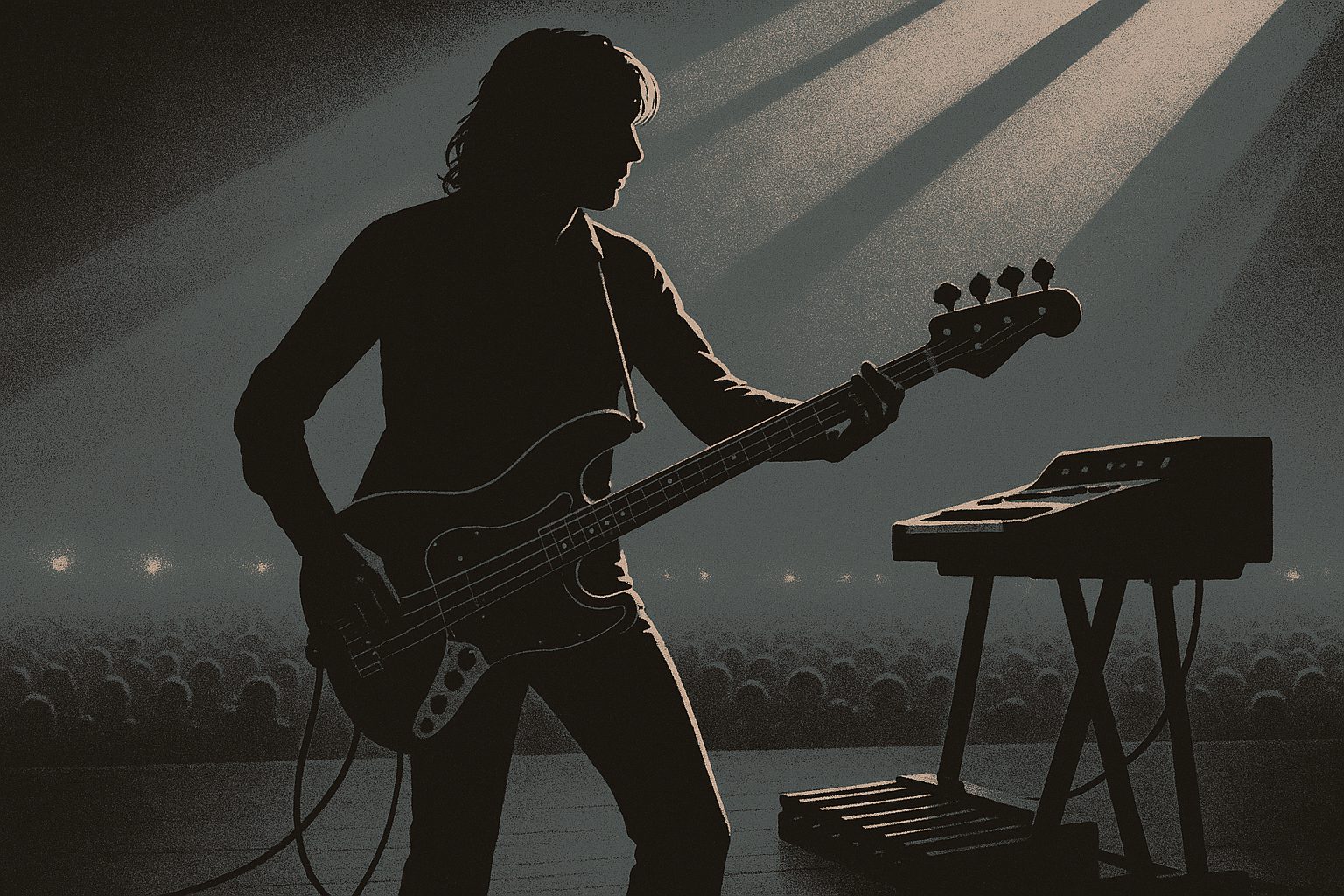 The synthesizer in that band never stood in for anyone. It demanded more from the one who stayed.
Let’s now pause and not take the obvious next step, which is to say Geddy Lee is a rebuttal to the string players. He’s not.
Nobody could have brought him into that meeting as evidence of the bright future of synth. What he was doing had no name, no category, and no second practitioner. By the time it had all three, it did not hire a single person who had lost an orchestral session. Lee was already a virtuoso bassist before he touched a keyboard. The form he invented had no chair in it for a violinist whose phone stopped ringing. Both of those are true at once, and any telling that keeps one and buries the other is suspect.
So here’s the shape, and I think it generalizes.
When a technology removes a cost, the losses can be counted right away and the gains cannot, because the gains are forms nobody has invented yet. You can list the players who stopped getting called. You cannot list a thing that does not exist yet. Every argument about a new instrument gets conducted with half a ledger, and it is always the same half that’s missing. At the time of the weird synthesizer ban, you could see the laid off string players. You couldn’t quite yet see Geddy Lee.
That isn’t a claim that the people counting losses are wrong. They are counting real things, accurately, in the present tense. It’s a claim about which evidence is available while the argument is happening.
Then I went looking for where the string players actually went, because I wanted to know whether the story I was telling myself would survive contact.
Some of it did. Session work moved into machines, and sample libraries have improved to the point where listeners without training can’t reliably tell a library from a room full of people.
And some of it has nothing to do with machines at all.
Film and game scoring still hires live orchestras, constantly, in large numbers. It hires them in Prague and Budapest. David Lynch recorded Lost Highway and Mulholland Drive with Prague players; the City of Prague Philharmonic plays more than two hundred and fifty recording sessions a year and exists largely to record other people’s films. A Prague player costs a production a small fraction of what a London or American player does.
The hourly rate isn’t even the main draw. The players sign buyout clauses, so the production owns the royalties outright and forever. What got moved wasn’t only the session. It was every payment that would have followed it.
Some real share of what looks like the synth replaced the string section is a wage difference wearing the synth’s clothes. The London player lost the work and a Czech player got it, and no machine took part in that transaction.
I don’t know the ratio. I doubt anyone does. What it means is that the ledger was wrong in a second direction nobody was watching: a column of losses charged to a machine that a wage difference actually caused. That error is available to every displacement story ever told, including the ones being told this week.
The orchestras themselves went somewhere, and it’s stranger than dying.
They became subsidized. Pittsburgh takes about a quarter of its revenue from ticket sales and better than half from donations. Boston’s ticket and performance revenue covers roughly thirty-eight percent of what the orchestra costs to run. Across American orchestras, as of the last full accounting, something like forty-three cents of every dollar arrived as a contribution, and that fraction has been climbing for years, because expenses rise and ticket prices can’t chase them.
An orchestra is now a thing people keep alive on purpose. The tickets stopped covering it a long time ago.
I didn’t have to go looking for an example. I live in Nashville, and on September 28th the Nashville Symphony announced it had run out of cash, declared a financial emergency, and suspended the rest of its season, with a ten-million-dollar hole in the operating budget and all seventy-seven musicians headed for furlough. Six days later Oracle, which is building a headquarters across the river, handed the orchestra a ten-million-dollar gift and the season was back on. Music City kept its orchestra because a software company decided it should. Whether that’s a rescue or a reprieve is one more column nobody can fill in yet.
And then the column nobody could count started filling in, in the same domain, forty years late.
Live orchestral concerts of film, television, and video game scores: somewhere around ten or fifteen shows a year worldwide in 2010, by the count of a promoter whose company now runs six hundred of them a year. His current estimate is roughly two thousand, across fifty to seventy-five franchises, and it’s one man’s estimate, so hold it loosely. The game share of that is real on its own. One Final Fantasy concert tour has played more than two hundred and fifty sold-out shows since it started in Sweden in 2007, and it was the first game-music production to fill the Royal Albert Hall, and later Carnegie Hall. Film scores performed live to picture are the same phenomenon.
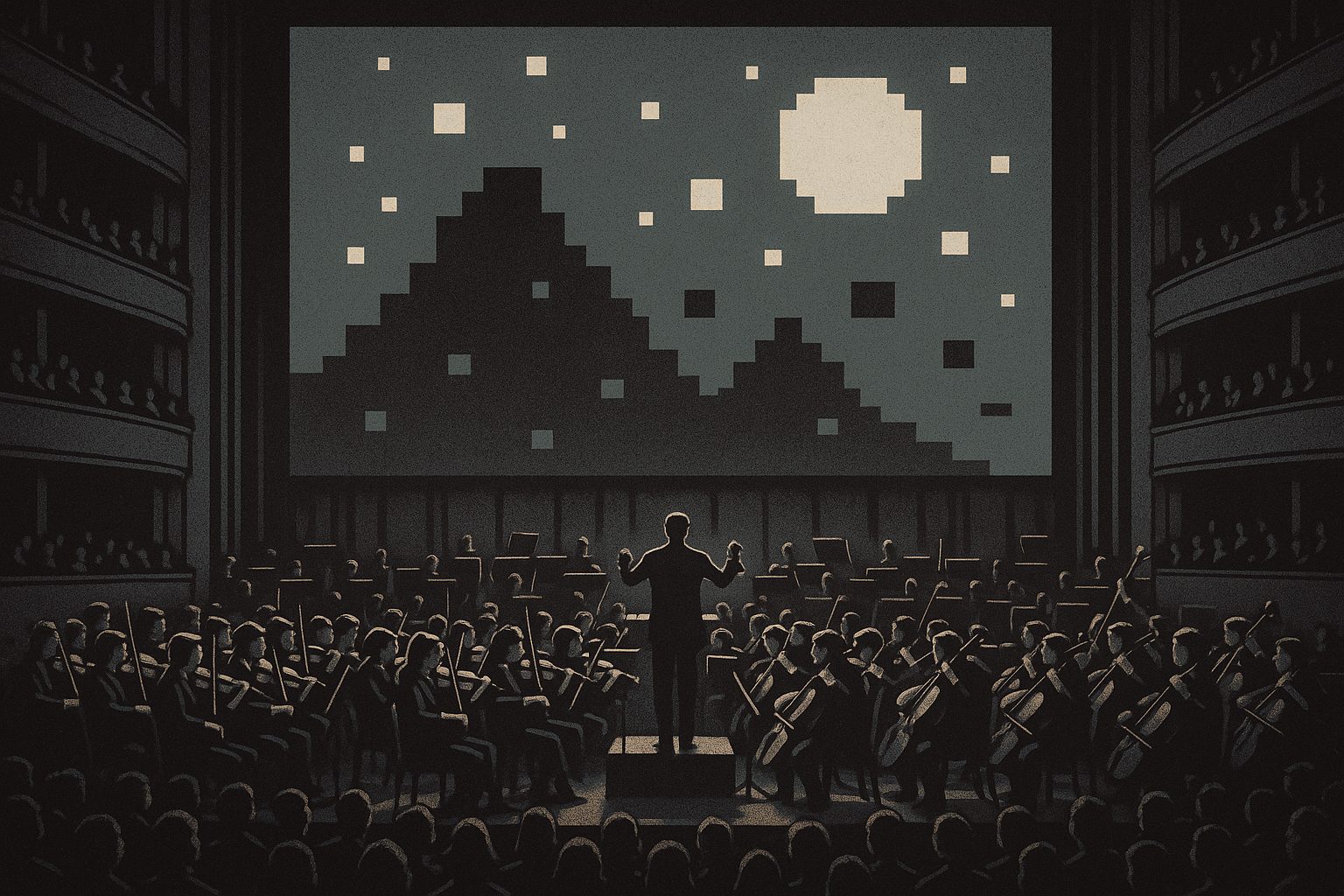 The column nobody could count, filling in forty years late.
Now think about where that music came from.
It came from children making noise on machines their parents had classified as toys. Rob Hubbard. Martin Galway. Tim Follin. Jeroen Tel. The composers who turned that Commodore chip into a music school nobody accredited, for students nobody enrolled. Their descendants score games, and those scores fill halls, and filling a hall means hiring an orchestra.
The kid at the game machine grew up and started paying string players.
Nobody in that London meeting room could have counted this. Not because they weren’t smart, and not because they weren’t paying attention. It required a form of music that didn’t exist yet, made by children on equipment the adults had correctly identified as a toy, arriving as orchestral employment four decades later. There was no line on the form for it.
The ledger still doesn’t balance. Nobody has counted the audition pool directly, but two people who modeled it separately landed in the same place: at any given moment somewhere between twenty and twenty-five thousand trained musicians competing at auditions, against roughly a hundred and thirty net new orchestral hires a year, a number that comes from reading twelve seasons of orchestra rosters name by name. The right column filled in. It filled in slower than the left one emptied, and it did not pay the people who lost. A violinist whose session calls stopped in 1986 was not made whole by a symphony hall full of game music in 2019.
I’d like to stand outside all of this. I don’t get to. I’ve spent a working life on judgment that a machine now does a passable imitation of, and I have no idea how long I’m employed or in what capacity. I might soon be searching for a synth of my own to ban.
What I notice is that I can’t count either column. Not the one that’s emptying, which I’m standing in, and not the one holding the next Geddy Lee we can’t yet see. Neither can anyone who’s certain, in either direction, and the certainty is running well ahead of the arithmetic on both sides.
Somewhere right now there’s a kid doing something with a machine that everyone around her has correctly identified as not serious. She isn’t in anybody’s ledger. She won’t be for about forty years.