The Wait Was the Review
Some processes were never held together by discipline. They were held together by the wait, a delay doing gate-work nobody assigned it. Nobody misses a checkpoint that was never on the org chart.
Over twenty years ago Nashville, my hometown, got its first real concrete skatepark, out at Two Rivers, and those of us in the local scene checked on the construction constantly. I’ve built dozens of wooden ramps over the years, maybe hundreds. Wood has no clock in it. You can take all the time you want, and when you get it wrong you back the screws out and cut another piece. Years after finishing my own ramp I tore off the entire skating surface and rebuilt it. The one thing I couldn’t rebuild was the concrete pool coping, which stayed exactly as it had been set.
Shaping concrete is a delicate art with exactly one take, and I have never done it. That’s precisely why it intimidates me, and precisely why I couldn’t stop watching this park go in.
I went out for the day they shot the over-vert capsule in the flow bowl, where the concrete has to curve back over itself and defy gravity like the overhang on a climbing wall. They spray it on, the same way pools with vertical walls get built. That day was hotter than anyone had planned for, even by middle-Tennessee summer standards, and the concrete was setting up too fast. We’d hung around Wally Hollyday plenty during that build, the legendary park builder running the job, but we steered clear of him that afternoon. He was fuming, spritzing water across the capsule to slow the cure just enough to work it, watching a critical feature go wrong in real time. There are no checkpoints in that. You get it right on the way past, or you live with it.
A few years later I was my own general contractor on a house. I pulled the permit myself and learned a piece of every trade by standing next to it. I hired subs who mostly did great work and occasionally didn’t, and the whole of my job was being there to notice, and to jump in and wing it when something was off. It wasn’t a skill. It was a presence.
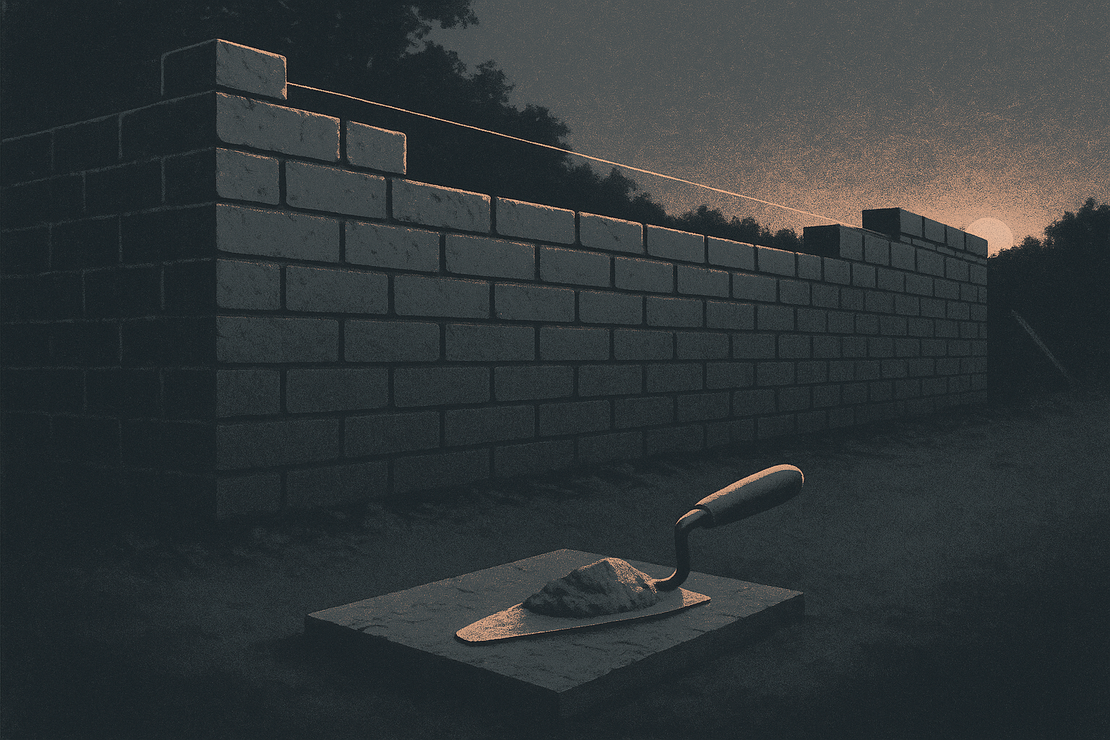
Brick is the opposite of shotcrete. A skilled mason lays them shockingly fast, but it’s still one at a time, twenty thousand of them, and it cannot all happen in a day. The work has ends of days in it.
One evening after the crew had gone I noticed the surround on a back stairwell had run three courses too high, enough to throw the entry off badly. I had never laid a brick in my life, but I was fairly certain I could unlay one. I found a trowel and took all three rows down before the mortar set.
Nobody scheduled that inspection. It wasn’t on any plan. It happened because bricklaying has the end of a workday built into it, and there was nothing to do with the gap but look. The wait was the review.
Then the wait went away. Most of what I make now, I make at the speed of shotcrete.
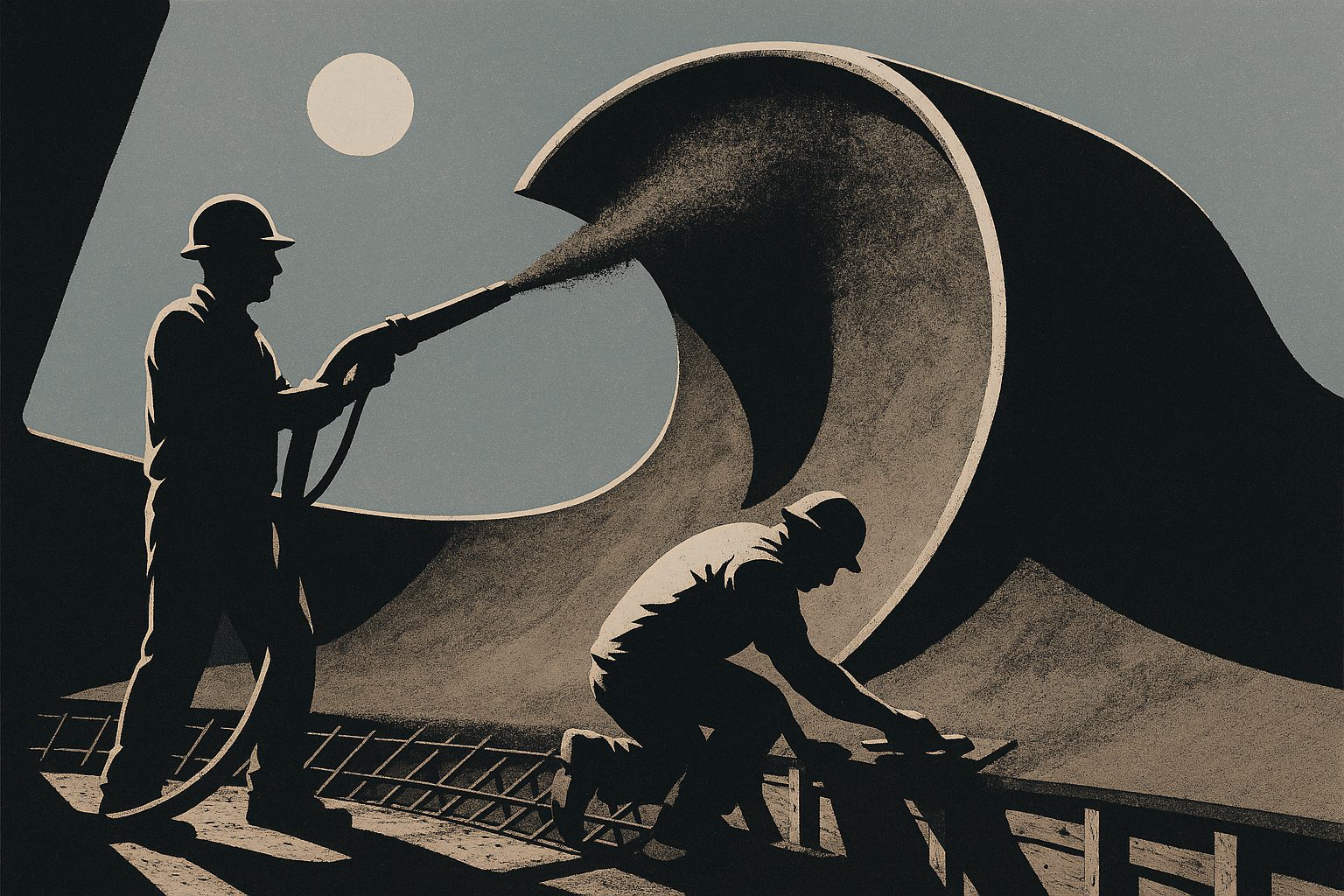 Shotcrete going up on the over-vert: one pass, no checkpoints, get it right on the way past.
Load-bearing by accident
Some processes are held together by discipline. Somebody designed a checkpoint, named it, wrote it down, and the work stops there on purpose. But a lot of processes — more than anyone wants to admit — are held together by latency instead. The gap between draft and feedback. The two days it took the research to come back. The end of the bricklayer’s day. Nobody designed those stops. The delay was simply there, and reviews accumulated in it the way silt accumulates in slow water.
The trouble with a checkpoint nobody designed is that it fails differently than a designed one. Skip a designed checkpoint and it leaves a trace: a missed sign-off, an empty field on the form, a reviewer asking where their copy went. Delete an accidental one and it leaves nothing at all — no missed meeting, because there was never a meeting, just a wait that used to be there and now isn’t. The failure is invisible by construction. Which is why this keeps happening to competent, careful people: you can’t mourn a stop you never knew you were making.
Load-bearing structure nobody documented, because nobody knew it was structural. And speed is the thing that finds it, the way an earthquake finds which walls were holding the roof up, by removing them.
The chapter I stopped loving
I lived a version of this for years without the vocabulary for it. Writing tech books, a finished chapter went off to review and came back two or three weeks later. I resented every day of that turnaround. It was the slowest thing about the job and I complained about it to anyone who would listen.
But somewhere in that gap a thing reliably happened that I never once credited to the gap: I stopped loving the chapter. The affection wore off on its own schedule, and the writer who reread those pages against the reviewer’s notes was a colder, better editor than the one who’d sent them out. Nobody assigned that. It came free with the delay.
Compress the turnaround to an hour, which is roughly what modern tools have done to every turnaround I have, and the review still happens. The falling out of love doesn’t. You’re editing something you’re still infatuated with, and infatuation has never once caught a weak claim.
I’m not the only one who has filed this report. When Hank Green caught heat over AI-assisted research on his channel, the internet had the fight it wanted to have: labor, authenticity, whether the tool belongs in the work at all. Read what the man actually said, though, and he wasn’t defending any of that ground. He said he’d been relying too heavily on AI as a research aid, that the words were still his, and then the sentence nobody claimed: I’ve been moving so fast that my own process isn’t actually clear to me.
That’s not a labor complaint or an authenticity complaint. It’s a process-collapse report, volunteered by the collapsed. And I’d bet the mechanism was the same one that saved my stairwell. A research request that used to cost days now costs seconds. The days were never the point — but the days were where the doubt lived. Time to reread your outline against what you asked for, notice the claim leaning crooked, cut the segment before anyone saw it. The tool didn’t remove his judgment. It removed the wait his judgment had been quietly living in, and no alarm went off, because the checkpoint had never had a name. He deserved gentler treatment than he got: a man who diagnosed himself correctly, out loud, while everyone argued about something else.
What the friction was actually doing
I have to narrow the claim now, because I’ve run the experiment on myself and the simple version fails it.
Researching an essay I’m still drafting, an AI assistant handed me both of my anchor examples in seconds, retrieval that would once have cost me hours scouring the internet. By the logic above I’d just lost my review window, and the crooked claim should have sailed straight through. It didn’t. One of the two was the Che-as-dorm-poster case, and it arrived looking a little too tidy, so I pushed on it right there: isn’t he a muddier figure than the posters let on? That push surfaced contested death-toll numbers and a piece of history routinely pinned on him that doesn’t survive a close look, both of which would have embarrassed me in print. The checkpoint held at full speed. No wait required.
So the honest mechanism is narrower than “speed eats the review,” and sharper: the friction never did the checking. It manufactured the doubt that made checking occur to you. Material that arrives instantly arrives looking finished, and finished-looking things repel scrutiny; a two-day-old Che reference has had two days for your skepticism to accumulate against it. Someone already suspicious of whatever lands in front of them doesn’t need the gap, and I happened to be carrying that doubt about Che already, the tidy-rebel version never having sat right. Someone who isn’t suspicious won’t use the gap they have. That’s why this failure hits competent people so unevenly — the delay was never protecting everyone, just the people who’d been coasting on it without knowing. Speed doesn’t make you careless. It reveals whether your care was yours, or the schedule’s.
Not a virtue
Friction is not a virtue. It was an accident that happened to carry load. The two-day turnaround was not wise, and the mason’s pace was not my mentor; they were costs, and the review work they did was unpaid, unaimed, and lucky. If the takeaway you’re reaching for is “slow down, good things take time,” put it back where it came from. Every process improvement that ever worked is a counterexample, and I would not willfully return to that two-week chapter turnaround.
The prescription is to rebuild the checkpoint deliberately, with a name, at the places the failures actually happen. And the failures are knowably asymmetric, which is what makes this actionable instead of a vague call for care. The machine’s characteristic failure is that it under-reports the null: where an honest human researcher comes back empty-handed and says so, a model tends to fill the gap with something plausibly shaped, so what you verify on its side is existence and warrant. Does the source exist, does it say what’s claimed, is the confidence proportional to what’s actually settled. The human’s characteristic failure runs the other way: breadth, recency, the discipline of looking past the first satisfying answer, so what you verify on your own side is coverage. What didn’t get searched because the first result felt good enough. Neither party defers to the other; each one checks for exactly the failure the other is prone to. That’s the gate the delay was only ever approximating — badly, by luck, and without a name. The rebuilt version is better than the accident, because a named checkpoint can be audited and an accidental one can only be mourned.
I can report the rebuilt kind works, because one caught me this month, and the catch is funnier than I’d like. Reshuffling my own publishing schedule, I moved four essays onto new dates in a single pass. One of them opens with the line I contradicted myself in public six weeks ago. The move turned six weeks into four, and that essay’s first sentence became false while I was busy looking at something else. What caught it wasn’t a wait. It was a note I’d filed four days earlier recording why that date mattered, sitting exactly where the change would trip over it — the planning document for this essay, as it happens. The piece about rebuilt checkpoints was the checkpoint.
The other rebuilt checkpoint is the one you’re reading. This essay was finished on August 22 and I sat on it, on purpose, for twenty-five days. This morning, publication day, I read it the way a stranger would and cut and moved things the writer who finished it would have defended. Longer than the chapter turnaround I said I’d never go back to, and the opposite thing: nobody imposed it, it had a date on the calendar, and I knew what it was for.
One boundary, so the idea stays the right size. A named gate is not a colleague: a counterparty who can push back supplies judgment, and friction only ever supplied time. Those are different missing pieces: an author alone with a slow tool still gets the accidental review; an author with a fast, honest counterparty still gets the pushback. This essay is only about the time.
And a limit, because I’ve tested that too. A rebuilt checkpoint is eliminative, not generative. The gates I’ve built into my own work are good at killing things — claims, drafts, whole essay ideas that deserved it — and they have never once found anything. Every discovery still comes from the undisciplined parts: conversation, detours, the wrong question asked at the right moment. That’s no strike against the gate; nothing in the two-day wait ever generated an idea either. It only made room to distrust one. A filter’s output is bounded by its input, so beware anyone selling you a review process as a source of insight.
So: not slower. Nobody sane is going back, and the machine’s research reach is the best thing to happen to my work in years. The wait it deleted was mostly waste, and I said goodbye to the waste gladly. But the waste had a stowaway. The belief that removing a delay removes only the delay is the quietest lie in every efficiency story. Before you delete the wait, stand in it one last time and figure out what it was holding up. Then build that, on purpose, with a name, and let the wait go.