
Unlocked, Not Cheated
Why use AI at all? I have three answers, and only one of them is about speed.
Standing on Surfaces That Move opened with part of an argument and stopped short of finishing it. It said where the value in creative work has moved: out of producing the work and into the judgment that steers it. It did not say why you’d hand any of the producing to a machine in the first place. You can accept everything in that essay, and everything in the ones that follow — that taste outlasts the tools, that format dictates discipline, that small and intimate beats big and optimized — and still stop me at the door with one question.
Fine. You have taste. You have craft somewhere in you, at the design layer or the engineering layer or the editorial layer. You’re not a beginner. You have chops. So why run the work through a model at all? Why work this hard to pull something real out of something artificial when you could just make the thing yourself? It’s one thing to question the person with no chops who is counting on AI to reliably thread the skill needle for them, it’s quite another for the person with legit experience to choose the artificial route.
It’s a fair question, and most of the answers on offer are bad. One is a shrug: it’s faster. The other is a sermon: the future is here, get on board. Perhaps the most common is: you’re a fraud. None of these are true to what the tool actually does for the work I’m doing. The honest answer has three parts, and they don’t substitute for each other. They stack.
Three doors, not one
The reason “why AI” feels like it has a single, weak answer is that the three real answers usually arrive fused together, and fused together they collapse into “AI saves time,” which is the least interesting of them and the easiest to dismiss. Pull them apart and each one is a separate door. Each opens onto work that wasn’t reachable before, and each fails the skeptic’s objection on different grounds, which is exactly why separating them matters.
The first door is craft you don’t have. The second is time you don’t have. The third is impossible work no number of humans could do at all. I’ll take them in that order, because that’s the order of how much they change what’s possible. The third is the one the AI conversation almost never names cleanly.
The first unlock: craft you don’t have
Here is the situation the first unlock addresses. A maker has taste — real opinions about what’s good, reliable intuitions about when something works and when it’s a few degrees off — but lacks the accumulated craft the work requires. The prose. The illustration. The music. The systems design. Their taste is real and it’s trapped, because shipping anything at all means first mastering the half they never built.
That’s me with fiction. Take Sojourn, my bedtime-story project. I know exactly what bedtime register should feel like: the unhurried voice of a Peter Falk reading to a kid, the warmth under Big Fish, a little Twain in the joints. I have firm opinions about when a bedtime story condescends, when it strains, and when it lands. I have tons of story ideas too.
There’s even a more personal motivation at play for Sojourn in particular. I want to read bedtime stories to my wife, and admittedly the concept of bedtime stories tuned to adult sensibilities is a bit niche. There are options, they’re just not great in my opinion. And there are classics, but they’re often weird. Seriously, a witch who’s trying to bake kids in her oven!? Don’t get me wrong, there are wonderful stories out there, but I have ideas I want to explore of my own. Or in some cases riffing on the seeds of ideas from others, like the concept of a little bird in love with a whale, both knowing they can only be together for brief moments. That’s a cool story, and I have the taste to guide and edit it into something worth reading to my wife, carefully walking the line between child-like wonder and adult lived experience.
What I don’t have is the craft of someone who has written a hundred bedtime stories at that register and held the quality across all hundred. Before AI, that gap was a closed door with two options. Spend years becoming that writer, high-five Malcolm Gladwell at the 10,000 hour mark, effectively crowding out everything else I want to make. Or don’t make the thing. Those were the options, and taste didn’t get a vote.
With AI the door isn’t closed. The model doesn’t supply the taste; that part stays mine and stays the hard part. It supplies enough of the craft layer that the taste can reach the work without my first becoming the writer who has it. The model drafts in the register. I’m the one who knows whether it actually lands, and which draft to keep. The taste I bring; the craft the model fills in.
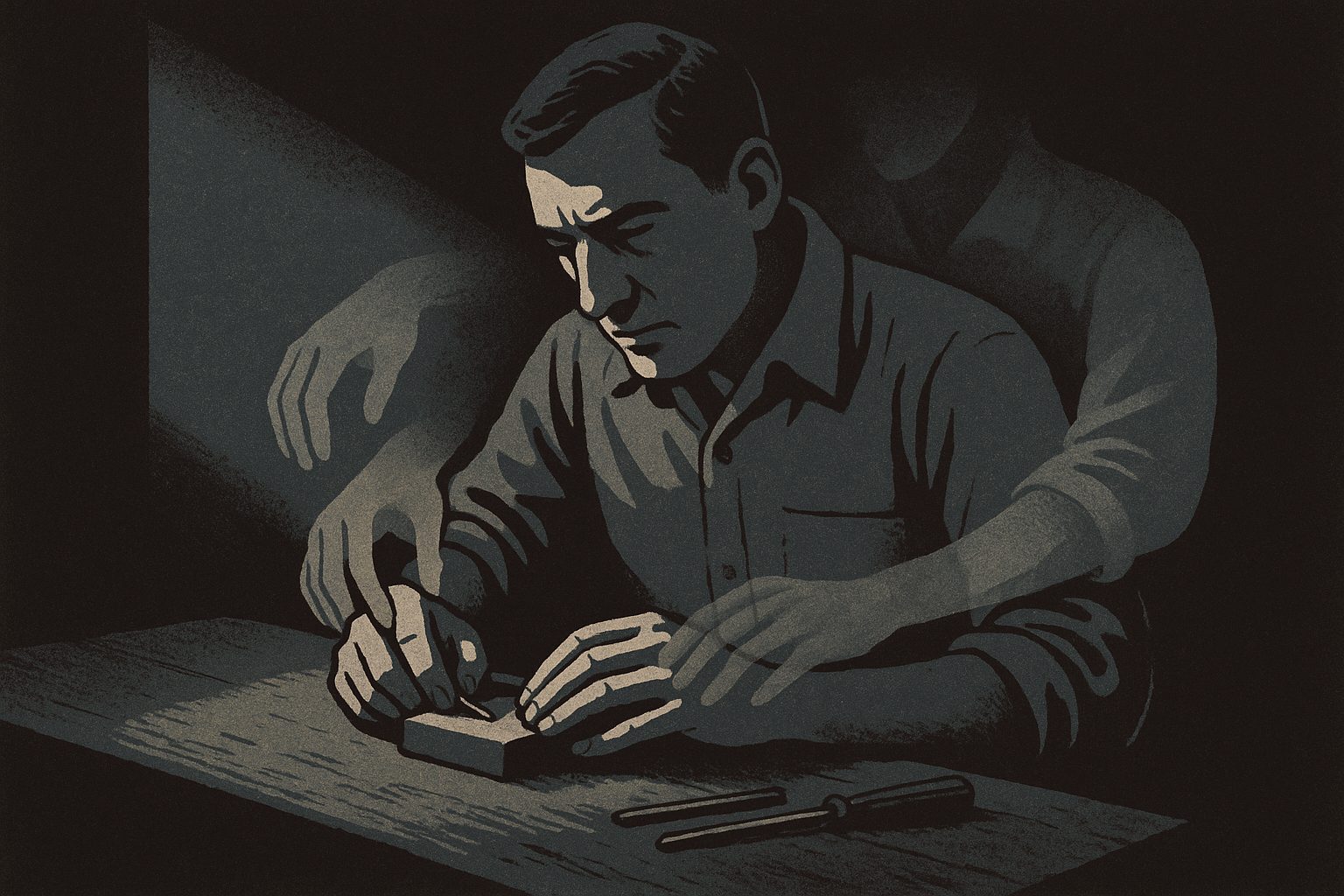 The assist supplies the craft, never the taste.
One sharpening, because this unlock gets oversold the second you let it. It’s asymmetric. AI lifts the taste-rich and craft-poor. It does nothing for the taste-poor and craft-rich, and it actively drags down work where the maker brings neither. Those are the people producing the median slop everyone rightly complains about. The unlock is conditional. It only fires when you bring something the model can be steered by. That’s kinda the definition of a tool.
The second unlock: time you don’t have
The second unlock has nothing to do with capability and everything to do with the calendar. A maker can have the full craft and the full taste and still own a finite number of hours. Ambitions that run past the hours get compressed into lower quality, or distributed across other hands until they lose their authorial coherence, or quietly abandoned.
“Productivity” is the wrong frame for this, and the wrong frame is what makes the unlock sound trivial. Productivity counts outputs per hour and asks you to ship more of the same. This is a different measurement. It asks which projects get to exist at all. A 2x speedup does not make a fifteen-year project fit inside a working life. A real unlock does, by moving the wall.
The lone maker has always been boxed in by calendar arithmetic. Long novels, long series, multi-product studios, an app you’ve spent 10+ years flailing away at (yeah it’s mine and it’s called Muster), anything published on a sustained cadence: these have been institutional formats, not because individuals lacked the talent but because no individual could sustain them across the years available. Stalefish Labs runs numerous products and a writing slate — the Groundwise apps, Citizen’s Daily Brief, Sojourn, The Wayward Herald, the essays — which is structurally a small team’s charter, and I’m one person. By hand, sequencing all of that across a career means most of it never ships; the calendar quietly decides which projects die. Wayward alone needs a publishing cadence that without AI would require a salaried newsroom or a frequency low enough to kill the format. With AI the wall moves out far enough that the studio shape becomes available to an individual at all. It doesn’t add hours to the day. It changes what a given number of hours can reach.
The honest caveat: this unlock has a real competitor, and that competitor is hiring people. A team is a perfectly good answer to “not enough hours” in plenty of domains. The case for AI over a team here is narrower than it first looks. It’s about authorial coherence, the way a lone maker keeps the work of one mind where a team tends to blur it, and about economic viability for projects that can’t carry a payroll. Citizen’s Daily Brief is entirely free and likely will stay that way — nobody could afford to pay a staff of journalists to produce it. The wall that moved is still a wall. Push far enough out and you hit the diffuse-attention problem the last essay ended on, plus coordination drag and editorial fatigue. AI moves the calendar wall. It does not knock it down.
The third unlock: work no number of humans could do
The first two unlocks make hard work reachable. The third makes impossible work reachable, and it’s the one that finally kills the “you could just hire people” objection, because some work just can’t be done by faster humans at all. It’s work whose shape requires a substrate humans can’t be. It comes in two forms, and the objection fails against each for a different reason.
The first form is latency and per-input customization. The work has to read a state it’s never seen, generate a response, and return it faster than a human could, customized to an input the maker never anticipated. Wayward takes a reader’s prompt and hands back a custom story crafted as a comedic skit (Edgar Allan Poe attempts to assemble IKEA furniture, Evel Knievel crashes a gender reveal party) in seconds. A thousand writers on staff couldn’t do that, and not because they’re slow. The format needs sub-minute latency on a unique request, and the space of possible requests is open-ended, so there’s nothing to pre-write. The work is shaped by the substrate, not sped up by it.
The second form is the one I think is genuinely the strongest single argument in this whole essay, and it almost never gets named: breadth with a controllable bias profile. The work requires aggregating across more sources than a person can hold, separating signal from noise across editorial perspectives that any human team would each individually slant, and running it through a pipeline whose biases you can set on purpose and lay open for inspection, in a way a human team’s accumulated slant never is.
Citizen’s Daily Brief is the clean case. It reads thirty-four news feeds spanning the full editorial spectrum — wire services, public media, broadcast, left and right, business, international, government primary sources, domain specialists, aggregators — and weights each story by how many distinct perspectives cover it rather than by raw volume, so four viewpoints on one story outrank five outlets parroting a single wire report. It does that every morning. It even detects syndication, so the same AP copy republished twelve times doesn’t fake independence. I chose AI for the assessment work not despite its bias but because of a property of that bias. As I put it in the Stalefish piece on the project, even the most well-intentioned “I read everything” reader can’t actually aggregate that breadth by hand, let alone weight it by perspective on top. This is one of the few places AI has a real structural advantage over a human doing the same job.
Here’s why that’s a feature and not a workaround. Every human editorial team carries slant. The most disciplined newsroom committed to balance still compounds individual opinion across thirty-four sources at daily cadence, and a newsroom small enough for one person to run inherits that one person’s slant whole. AI’s bias is not zero, and there are parts of it I can’t control. The model itself inevitably carries a slant I didn’t set and can’t fully see — what it treats as a perspective, what it foregrounds when it summarizes, baked in upstream by people who aren’t me. What I can design and lay open is everything around it: the source list, the perspective tags, the weighting logic, the syndication detection. That scaffolding is published and checkable. A newsroom’s slant is neither — it isn’t designed, it’s accumulated, and it never appears on the page. So I’d never claim the machine is unbiased, or transparent. The honest claim is narrower: the system around the machine can be made more inspectable than a human team’s compounded judgment ever is, and for a product whose whole pitch is apolitical synthesis, that was the property worth having.
That second form is why “just hire a team” loses on the merits. Against the latency work, more humans can’t hit the timescale. Against the breadth work, more humans is the problem: every body you add adds slant, disagreement, and delay to the exact property you were trying to control.
The unlocks stack
None of my projects runs on a single unlock. They compound, and the stacking is the actual point.
Sojourn is prose craft I don’t have, plus the scope to produce a whole catalog of choice-branching bedtime stories solo. Wayward is multi-reporter voice range plus a sustained cadence plus custom stories at request latency. Citizen’s Daily Brief is the heaviest stack: analytical craft I don’t have as a non-journalist, a daily-plus-weekly cadence run solo, and the breadth-with-a-designable-bias-profile that the AI conversation rarely names. Groundwise leans almost entirely on the second unlock: a precipitation engine tuned against more edge cases than a lone developer’s hours could reach, powering a family of trail-, field-, and garden-condition apps that don’t even use AI at runtime.
The skeptic’s “why bother” almost always argues against one unlock at a time, which is why it keeps feeling answerable and keeps being wrong. Knock down “AI saves time” and the breadth argument is still standing. Knock down the breadth argument and the craft-gap is still standing. Remove any one unlock from CDB and either a worse product ships or none does.
What AI doesn’t unlock
The cheat-code charge deserves a straight answer, so here it is: AI doesn’t unlock any of the things that decide whether the work is good.
It doesn’t unlock taste. Median output is the default. The model runs to the center of how everything tends to get said; it is a machine for the perfectly adequate, and left to itself it will hand you the most forgettable possible version of whatever you asked, on time and instantly skippable. Pulling the work off the median is entirely the maker’s job: insisting on the specific, doing the editorial pass, choosing what not to ship. It doesn’t unlock the studio’s stance, the set of principles that say classification over interpretation, ambient over declarative, names that don’t announce themselves. The model will happily produce attention-economy work all day; refusing it is a choice you bring. It doesn’t unlock the relationship at the center of the intimacy economy. You still have to invest in specific people and specific communities, and the model can’t pick the reader you’re writing for. And it doesn’t unlock the discipline to not make a thing just because making it got cheap. That temptation runs the other way, and resisting it is all maker.
Take the relationship one. It isn’t abstract in my house. My wife and I quit buying each other cards years ago; instead we write each other rhymes, built from the cards of a rhyming game I’ve worked on for ages and still haven’t finished. Birthdays, Valentine’s, no occasion at all. The running joke is to accuse each other of having AI write them. Neither of us ever has. Not because a model would do it worse — we both know it would often do it better — but because the whole worth of the thing is the time you spent thinking about the other person, eight clumsy lines that are unmistakably yours. Hand that off and the rhyme might improve. The gift evaporates. On an artifact that small, what you’re giving was never the verse.
The cheat-code framing assumes AI hands you an outcome you didn’t earn. It doesn’t. It hands you an outcome whose quality is set entirely by the taste and discipline and choices you bring to it. Bring none and it produces median work, plausibly and fast. Bring them and it produces work that no quantity of hours could have reached. Sojourn isn’t easier to build because of AI. It’s possible to build because of AI. That’s a different claim, and the difference is the whole essay.
Where the cheating actually is
There’s a version of AI writing that really is cheating, and naming it precisely is the fastest way to see why mine isn’t. A kid has a model write their book report. That’s cheating, and not because a machine was involved. It’s cheating because the book report was never the point. The assignment was the practice: the slow, awkward work of turning a read book into an argument, which is the only way the judgment behind it ever gets built. The output was disposable. Producing it was the entire event. AI hands the kid the artifact and quietly removes the one thing the exercise existed to grow.
That’s the real line, and it has nothing to do with professional versus amateur. It’s whether the work being delegated was the work that forms you. Craft practice is the forge of taste. You do not arrive at judgment by reading about it or wanting it badly. You get there by doing the craft, millions of words of it, badly and then less badly, until the doing has quietly rebuilt how you see. So the thing you can never hand off is not the execution. It’s the practice that makes the taste, because the moment you delegate that, there is no one left who knows what good looks like.
Which is exactly why my case runs the other way. I already stood at that forge: call it the better part of six million words across forty-seven books, a decade and change of paragraphs nobody would reread now, all of it building the only thing that survived, a sense of when a sentence is true and when it’s faking. The practice is done. Delegating the execution now doesn’t rob me of a formation I already have. It spends it.
And here’s where the first unlock stops sounding like its own contradiction. Craft you don’t have — using a model to write fiction I never trained to write — looks like the opposite of earn it first. It isn’t, because the thing you have to earn was never the craft. It was the taste. Craft is how taste gets built, but once built, taste travels; judgment projects across gaps, which is most of what Standing on Surfaces That Move was about. The bedtime register I can recognize on contact but couldn’t produce, I learned from a lifetime of being read to and reading aloud, not from writing a hundred bedtime stories. So I bring earned taste to a craft I never practiced, and the model supplies the execution. That is not the kid’s move. The kid has no taste yet to bring, and no style, which is just taste transmitted through enough practice to leave a signature. A model can only project a signature that already exists: give it a developed style and it carries yours; give it a blank slate and it hands back the median. The maker with earned judgment gets amplified; the beginner gets overwritten, on time and instantly skippable.
So the rule that holds all of it together, without diminishing the craft that does the real work: you may delegate craft, whether you earned it or never had it, but only if you bring taste you paid for somewhere — and taste is the one thing the practice exists to build, and the one thing you must never hand off. Delegate the forging and you haven’t saved yourself the hard part. You’ve skipped the only part that was ever going to be you.
The “not really yours” part
There’s a sharper version of the objection: if the model wrote the prose, the book isn’t really yours. That one has a real answer, and it’s large enough to get its own essay, so I’ll keep it short here.
The work is mine at every layer where my choices bind. The premise. The character architecture. The ground rules of the world. The prose discipline, the named rules a project’s prose has to hold. The editorial pass. The decision to ship this version and not the seventeen others the model offered. The brand stance that refuses certain moves on principle. None of that is the model’s, and none of it is keystrokes. Where authorship actually lives once the typing stops being the work is a question worth taking apart on its own terms, and I do. For now it’s enough to say the obvious thing: the choosing is the authorship, and the choosing was mine.
The honest accounting
This essay is not claiming AI is neutral, not morally, not environmentally, not culturally. It isn’t. Taking these three unlocks means accepting a real bill. The models I use were trained on a vast amount of human work pulled in without consent and largely without payment, including creative work by people who’d perhaps object to exactly what I’m doing with it. I’m a party to one of the settlements that fight produced, so none of this is an abstraction to me. There’s the energy and water the systems burn. And there’s displacement landing right now on illustrators, writers, translators — people doing work I’m adjacent to, not safely distant from. None of it is small, and none of it is conveniently somebody else’s problem. My claim is only this: the bill is worth paying for some makers on some projects, with eyes open — and anyone who tells you it’s zero is selling something.
It also means the maker’s responsibility goes up, not down. Taking the unlocks comes with an obligation to spend them on work worth making. Producing slop with them is a choice. Shipping the seventeenth competent-stranger version of something we already have is a choice. The discipline the rest of these essays keep insisting on is exactly what makes the unlocks defensible in the first place. Without it, the cheat-code critics are simply right.
The alternative isn’t doing it by hand
The skeptic’s question — why AI at all — smuggles in an assumption: that the alternative is the same work, done without AI. For most of what I’m building, that’s not the alternative. Sojourn isn’t a kind of bedtime storytelling that happens to be easier with a model; without the model it doesn’t exist. A daily brief that weighs thirty-four feeds by perspective, run by one person, doesn’t exist without the breadth unlock. A continuously published, reader-responsive satirical paper run by one person doesn’t exist without the substrate. The choice was never between an AI-assisted version and a hand-made version of the same thing. The choice was between the thing existing and not existing.
So the arc that follows assumes you’ve made the call I made, that bringing the work into the world is worth more than the principled refusal that would keep it out. Plenty of reasonable people land the other way, and this isn’t an argument that everyone should take the offer. It’s an account of what becomes reachable if you do, and what it costs to do it without embarrassing yourself.
Unlocked, not cheated. The maker is still doing the only part that was ever hard. The unlock is just the part that didn’t used to be on the table.