With Malice Toward None
Lincoln’s sentence is a rule book for winners: be generous to the people you beat, and still hold whoever did wrong to what they did. Grant let the losers keep their horses, Reconstruction forgot who the fight was for, and a few hundred Nashville students kept both halves of it at once.
On the afternoon of April 9, 1865, in the parlor of Wilmer McLean’s house at Appomattox Court House, Virginia, Robert E. Lee asked Ulysses S. Grant for a favor.
The terms of the Confederate surrender were already on the table in Grant’s handwriting, and they were more generous than Lee had reason to expect. His men would be paroled, not imprisoned. Officers would keep their sidearms. As long as they kept their word and honored the end of hostilities, no one would be disturbed by federal authorities. But there was something the document didn’t cover. In the Confederate army, the cavalrymen and artillerymen often owned their own horses and mules. Would they be allowed to keep them?
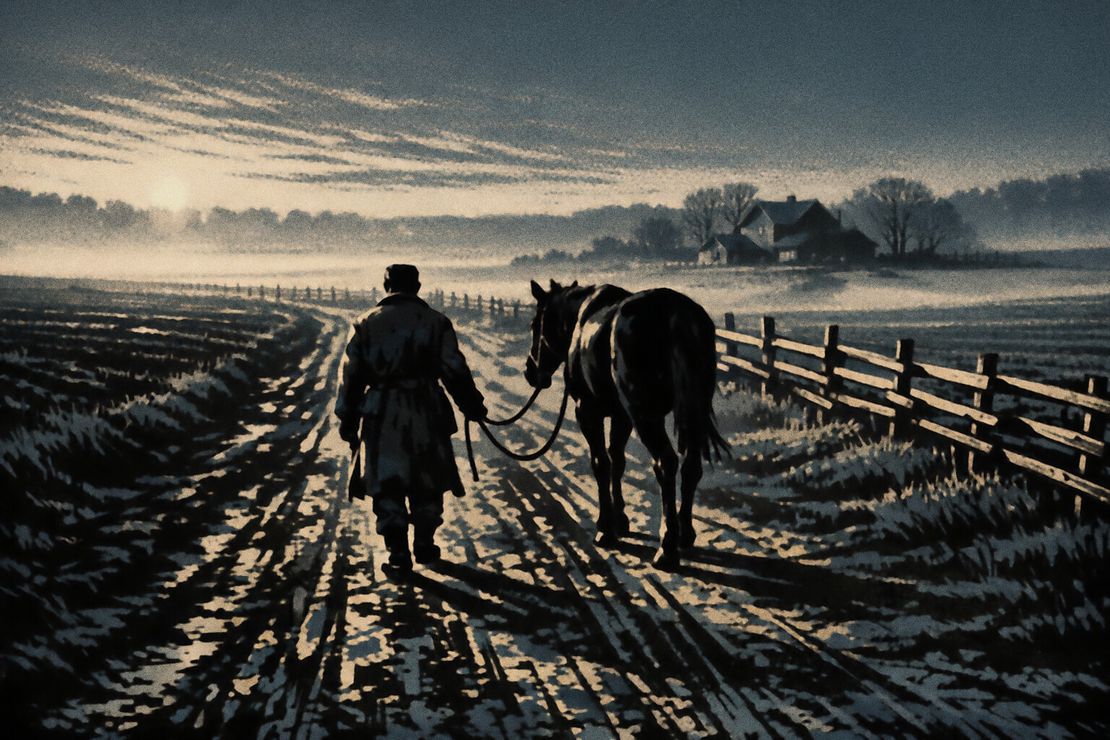
Grant didn’t rewrite the formal terms, but he said he would instruct his officers to let any man who claimed a horse or mule take it home. Most of these men, he reasoned, were small farmers, and it was already April. A man who walked home to a ruined farm without a horse or mule couldn’t plow a crop, and a family without a crop might not make it through the winter.
Then Lee mentioned that his army had been living on next to nothing for days. Grant sent over rations for about twenty-five thousand men. To his defeated enemy.
As word of the surrender spread through the Union lines, the artillery started a celebratory hundred-gun salute. Grant had it stopped. “The Confederates were now our prisoners,” he wrote years later, “and we did not want to exult over their downfall.” His aide Horace Porter wrote down the order itself: the war is over, and the rebels are our countrymen again.
Since the election this month, I’ve been thinking a lot about Grant’s handling of that victory, and his rationale for it. Four years of war. Roughly seven hundred thousand dead, more than the American dead of World War I and World War II combined. And at the very moment he’d earned the right to celebrate, the winning general decided that his army’s joy would not be fired over the heads of the men it had beaten.
Five weeks earlier, at his second inauguration, Abraham Lincoln had already set the tone. With the war all but won, he closed with a single sentence:
With malice toward none, with charity for all, with firmness in the right, as God gives us to see the right, let us strive on to finish the work we are in, to bind up the nation’s wounds…
It may be the most quoted sentence about reconciliation in American history. It’s also one of the most misremembered, because people tend to stop after the first two phrases. Read all the way through, it’s a rule book for winners, and it comes to this: be generous to the people you beat, hold whoever did wrong to what they did, and don’t lose track of who got hurt. The hard part is keeping all of it at once. I learned that from my own corner of the world, where we kept some of Lincoln’s words and dropped the others, and I’m writing it down because I can feel how easy they are to get wrong.
I was born in Nashville and have lived just south in Franklin since I was a young teenager. You can’t get hot chicken in downtown Franklin without walking past a cannon, and I live only a few miles from the field where five of the bloodiest hours of the Civil War played out. Remnants of that war are everywhere here, and some of them are pretty odd given the stakes of the conflict. Just down the street from where I live is a neighborhood called Battlewood. Some of the street names: General J B Hood Dr, Jeb Stuart Dr, and General N B Forrest Dr. Remember that last guy, we’ll come back to him. At my high school, we were the Franklin Rebels. The thing is, when you grow up in an area steeped in history, your day-to-day life tends to normalize it and just kinda tune it out.
Yet it still matters, and I should say how. An election is not a surrender. Nobody stacked rifles this month, nobody is anybody’s prisoner, and whoever won will be on the losing end again soon enough. No election I’ve voted in weighs what that war weighed. What carries from 1865 to an ordinary November is smaller: the moment after a fight when one half of a country has the upper hand, and has to decide what the other half is to them now.
I’ve never belonged to a political party, and I don’t vote for one. I vote for ideas, as held by people, one race at a time. Plenty of my friends and family vote in ways that cancel mine out. This month most of the people I voted for won, except here at home, where the people I vote for usually lose. So I’ve spent November on both ends of a win, and at each end, people I know and love are standing at the other. That’s fine. The temptation I’m about to warn against isn’t a party’s. It’s a winner’s.
I know what the losing end sounds like. Two years ago, on an election night that went the other way, a family illness put me in a hospital with people I love, none of whom had voted the way I did. I was there to help, and I wanted to be. Sometime that night I heard one of them, out of what they thought was earshot, call me one of “them.” It wasn’t gloating. It was sorting, about the person who’d come to sit with them, and it had nothing to do with anything I’d done that night. I expect I’d have heard the same word if their people had lost. That’s what sorting is: a verdict on what kind of person you are, passed without reference to anything you did. Everybody does it, on winning nights and losing ones. Winning is when it starts to matter, because the winner is the one in a position to act on it.
I’ve thought about that remark more than I’d like, so here is an honest accounting of what I’ve carried since. Not an appetite for gloating; I’ve never had much of one. I do keep a list, of sorts. Whoever you voted for, I’d guess you have one too, so the particulars of mine don’t matter here. Mine isn’t written down, and what’s on it is things that were done, things I think somebody should have to answer for in a court of law. I notice how good it feels to want that. I notice, too, that the entries don’t stay things. Left alone, an act turns into the people who did it, and then into people like them, and by then it’s my own “them.” I know what that feeling built, right here, once it got to run things. I’ll get to it.
Malice toward none, charity for all
Three days after the surrender, on April 12, the Confederate infantry marched in to lay down their rifles. Joshua Chamberlain, the Maine college professor who had held Little Round Top at Gettysburg, commanded the Union troops lining the road. As John B. Gordon led the first gray column past, Chamberlain had a bugle sound, and his men shifted their rifles from “order arms” to “carry arms,” the marching salute. Gordon had been riding with his head down. He heard the rifles move, understood what they meant, wheeled his horse, dropped the point of his sword to his boot, and ordered his own men to answer in kind. Chamberlain called it honor answering honor.
Chamberlain’s fullest account of it came fifty years later, and historians still argue over how much of it is polish. Either way, it’s the picture the country chose to remember.
What Grant and Chamberlain understood is that the way you win decides whether the fight is actually over. Humiliate a beaten man and you’ve only sown the seeds of the next fight. Europe learned that at Versailles in 1919, when the winners made Germany accept the blame for the whole war in writing, handed it the bill, and got about twenty years of peace for the trouble. Let him keep his horse and feed his men, and you’ve given him a reason to go home and plant.
There’s a plainer reason too. I’ve never understood what the endgame of sorting is supposed to be. In every version I can picture, the other half is still here in the morning, in the next pew and the next hospital room. Secession was the one time half of us tried for a version where they weren’t, and it took four years of war to settle that we don’t get that option. So when the winner called the losers countrymen again, it was a plain description before it was a kindness.
None of the generosity was a verdict on the cause. In the same chapter of his memoirs where he stops the salute, Grant calls what those men fought for “one of the worst for which a people ever fought, and one for which there was the least excuse.” He fed them anyway. The judgment stayed on the cause, and he took it off the men.
That’s malice toward none and charity for all. It’s the part of Lincoln’s sentence everybody remembers. It’s also the part that turned out easy to keep, as long as it stayed between white men. Letting a beaten man keep his horse cost the winner nothing he wanted.
Firmness in the right
The whole sentence didn’t last. Five days after Appomattox, Lincoln was shot at Ford’s Theatre. The man who wrote the sentence never got to carry it out.
There were people in the North who wanted the accounting I want, and didn’t stop where I stop: hang the generals, make them all pay for the tragedy they caused. Lincoln had held them off. What actually happened over the next twelve years was stranger. Malice came back, but aimed at the newly freed people, while charity flowed easily between the white men who’d fought each other. The Confederate farmer walked home with his mule. The freedman on the Carolina and Georgia coast, promised forty acres of his own by a field order that January, had the land taken back by autumn.
The fighting didn’t end. It moved, from the battlefields to ballot boxes, courthouses and back roads after dark. And it started here in my home state. In the months after the surrender, six Confederate veterans met in a law office in Pulaski, Tennessee, about an hour south of where I’m sitting, and started a secret club. They called it the Ku Klux Klan. By 1867, Nathan Bedford Forrest, a Memphis slave trader turned cavalry general, had become its first Grand Wizard. That’s the Forrest on the street sign down the road from me. The matching white robes and the burning crosses came later, with the 1915 revival, but the work was the same from the start: within a year the club was a campaign of terror against freed people and anyone who stood with them. Atrocities against countrymen, done from behind a mask.
Now go back to John B. Gordon, the Confederate general who answered Chamberlain’s salute on that Virginia stage road. After the war he was generally acknowledged as the head of the Klan in Georgia. Called before Congress in 1871, he denied it, admitting only to membership in a secret “peace police.” By 1877, as a United States senator, he was one of the architects of the deal that settled a disputed presidential election by pulling federal troops away from the last two Southern statehouses they were still protecting. That bargain left four million freed people and their children to the night riders, and then to Jim Crow, for most of the next century.
I don’t think that makes the salute a lie. I think it shows what honor meant to Gordon: a debt owed to other white soldiers, never to the people they had held in bondage. Charity can be sorted by kind as easily as blame can.
North and South did reconcile, after a fashion. By the turn of the century, white veterans in blue and gray were shaking hands at reunions on the old battlefields. The historian David Blight has shown what that reunion cost: it was bought by quietly writing the freed people out of the story. White North and white South extended charity to each other, and paid for it with the people the war had been fought over.
That’s the failure Lincoln’s third phrase guards against. Firmness in the right doesn’t take back the charity. It’s aimed at something else. Be as generous as you like to the people you beat, but never to the cruelty itself, and never at the expense of the people it hurt.
From the outside, firmness and malice look alike, but there’s a way to tell them apart. Firmness goes after an act. It starts with a thing that was done, follows it to the person who did it, and uses the laws that were on the books before the thing was done, in the courts that were already there. Malice goes after a kind of person. No old law covers being the wrong kind, so malice has to write new ones for the occasion. That’s what Versailles did, with a whole nation as the defendant. And in a country that votes every two years, a law written for the occasion gets handed to whoever wins next. Malice has a quieter form too: start with a person and go looking for something to charge them with. That one uses the old laws and the old courts, and it’s still malice, with better paperwork.
The test doesn’t flatter my own story. Treason was a crime long before the war, and in June 1865 a federal grand jury in Norfolk indicted Lee for it. Grant insisted the parole he’d written at Appomattox covered Lee too, and said later that he would have resigned his command before arresting him. The case went no further. By my own test, a trial for Lee, by name, under a law older than the war, would have been firmness. “Make them all pay” was the malice. The country did neither. I think Grant was right to keep his word, and I think it’s fair to ask what that cost.
I ran my own list through the test too. Most of it passes: things that were done, under old laws, in old courts, crimes that were crimes before anybody voted. I’m keeping that part. Wanting someone to answer, by name, for a thing they did isn’t malice, however good it feels. What doesn’t pass is the place where the list had stopped being about acts and started being about my neighbors. I’d like some of them to own what they’ve said, and there’s no law for that, and there shouldn’t be. I can tell a neighbor to their face that I think they were wrong, they can tell me the same, and that’s where it ends.
Firmness and malice are two things a winner can do with a win. Forgetting is another, and it’s quieter than either. By 1877 the laws that protected the freed people were already written: three amendments and the Enforcement Acts that put night riders in federal court. The country stopped using them, and the courts narrowed what was left. Only then did the Southern statehouses start writing new laws for the occasion, and the one usually counted first came out of Tennessee, in 1881. They were laws about a kind of person, and about nothing any of those people had done. This is the thing I said I’d get to: a “them” with a legislature. That was Jim Crow: malice, with forgetting as its permission slip. The reconciliation kept the charity and let go of the firmness. And charity without firmness isn’t grace. It’s forgetting.
Both at once
Nearly a century later, in Nashville, a group of college students showed what it looks like to keep all of Lincoln’s sentence at once.
Starting in February 1960, students from Fisk, Tennessee A&I, American Baptist and Meharry sat down at downtown lunch counters, asked to be served, and were refused, cursed, beaten and arrested. They’d trained for it in workshops run by James Lawson, a young minister who taught that nonviolence wasn’t the same thing as being passive, and that the aim was to bring your opponent around rather than to beat him.
At about 5:30 on the morning of April 19, someone threw dynamite at the North Nashville home of Z. Alexander Looby, the Black attorney defending the arrested students and a Republican member of the city council. The blast wrecked the house and blew out windows across the street at Meharry Medical College. Looby and his wife, Grafta, came out of it unhurt. Nobody was ever charged.
By that afternoon, about three thousand people were marching downtown to confront Mayor Ben West. They marched in silence. The way the story has been told ever since, all you could hear was shoe leather. West came out to meet them on the courthouse steps. He was already arguing with one of the ministers when a young Fisk student named Diane Nash cut in with a question:
Mayor West, do you feel that it’s wrong to discriminate against a person solely on the basis of his race or color?
West said yes. Years later he said the question had been put to him as a man, and “it was a moral question and it was one that a man has to answer and not a politician.” Three weeks later, on May 10, six downtown stores served Black customers at their lunch counters for the first time. Nashville became the first major city in the South where a sit-in campaign won.
Look at what Nash didn’t do. She didn’t demand that he admit defeat, or apologize, or resign. She asked him a question and left him room to answer it honestly. Notice what the march didn’t ask for, either. Whoever threw the dynamite was never caught, though they should have been, and the three thousand who walked downtown that afternoon didn’t make catching them the price of the counters. They asked for the counters.
The firmness never wavered. The sit-ins had gone on for months, through beatings and a bombing, and they would have gone on as long as it took. The question carried that firmness too. It was about an act, asked in front of three thousand people, and it didn’t let him off. The charity was in the same question: she put it to a man she assumed could still answer. Neither cost her any of the other. She had every reason to call him one of “them.” She asked him instead. That’s the whole thing I’m trying to say, and a twenty-one-year-old in 1960 said it better on some courthouse steps.
 They asked for the counters.
As a teenager in the eighties I spent afternoons a few blocks up the hill from those steps, at Legislative Plaza, which had the best stairs in the city for a skateboard. The lunch counters were a block away. In school we’d certainly learned about slavery and the Civil War. We learned precious little about the struggle that had happened down the street, only about twenty-five years earlier, within the memory of most of my teachers. Nobody mentioned it, and we didn’t ask. That’s forgetting from the inside. It doesn’t feel like anything.
Today the plaza at the foot of the courthouse steps is named for her.
Close to home
Twenty miles south, in Franklin, Lincoln’s whole sentence is laid out in brick and bronze, and you can walk it in an afternoon.
On November 30, 1864, the Confederate Army of Tennessee threw itself at Union lines dug in around the town. In about five hours, roughly 9,500 men were killed, wounded, captured or missing. Carnton, the McGavock family’s plantation house at the edge of the field, became the largest field hospital. The bodies of four Confederate generals were laid out on its back porch. The bloodstains are still on the floors.
Carrie McGavock, the lady of the house, helped tend the wounded for months. They were Confederates, her own army. In 1866, she and her husband gave two acres beside their family graveyard for nearly 1,500 Confederate dead, and she kept that cemetery and its record book until she died in 1905. It was mercy, and it was real. It was also mercy for her own, which is the kind that came easiest to everyone in this story.
Carrie McGavock was also a slaveholder. On the night of the battle, it was the people she enslaved who were ordered to help with the wounded. After emancipation, Black workers helped her keep the cemetery for the rest of her life, and Mariah Reddick, a woman she had owned since girlhood, never lived at Carnton after the war but nursed the McGavocks for the rest of their lives. Mercy and the cause it served, under one roof. Both are things she did, and neither settles what kind of person she was. If you want to know how decent people hold indefensible things, Carnton is the building.
In 2017, after the violence in Charlottesville, three Franklin pastors, Chris Williamson, Kevin Riggs and Hewitt Sawyers, began meeting with Eric Jacobson, a historian with the Battle of Franklin Trust, about the Confederate soldier who stands atop the monument in our town square. Locals call the statue Chip, after the piece of hat it lost when it was hoisted up in 1899. Not everyone found it cute. The pastors came in wanting it gone. They chose a different path. Instead of taking anything away, they would add what was missing. In 2019, five markers went up around the square telling the history the monument left out: the enslaved people once sold within sight of that spot, the Black soldiers who fought for the Union, the violence that met freedmen afterward. In 2021, a bronze statue of a United States Colored Troops soldier went up on the square, facing the old one.
It wasn’t frictionless. It took a lawsuit to settle who owned the square, but the aldermen approved the markers unanimously, and it got done. Sawyers, who grew up under Jim Crow and had kept away from the square most of his life because of the statue, said after the unveiling that “now downtown belongs to me too.”
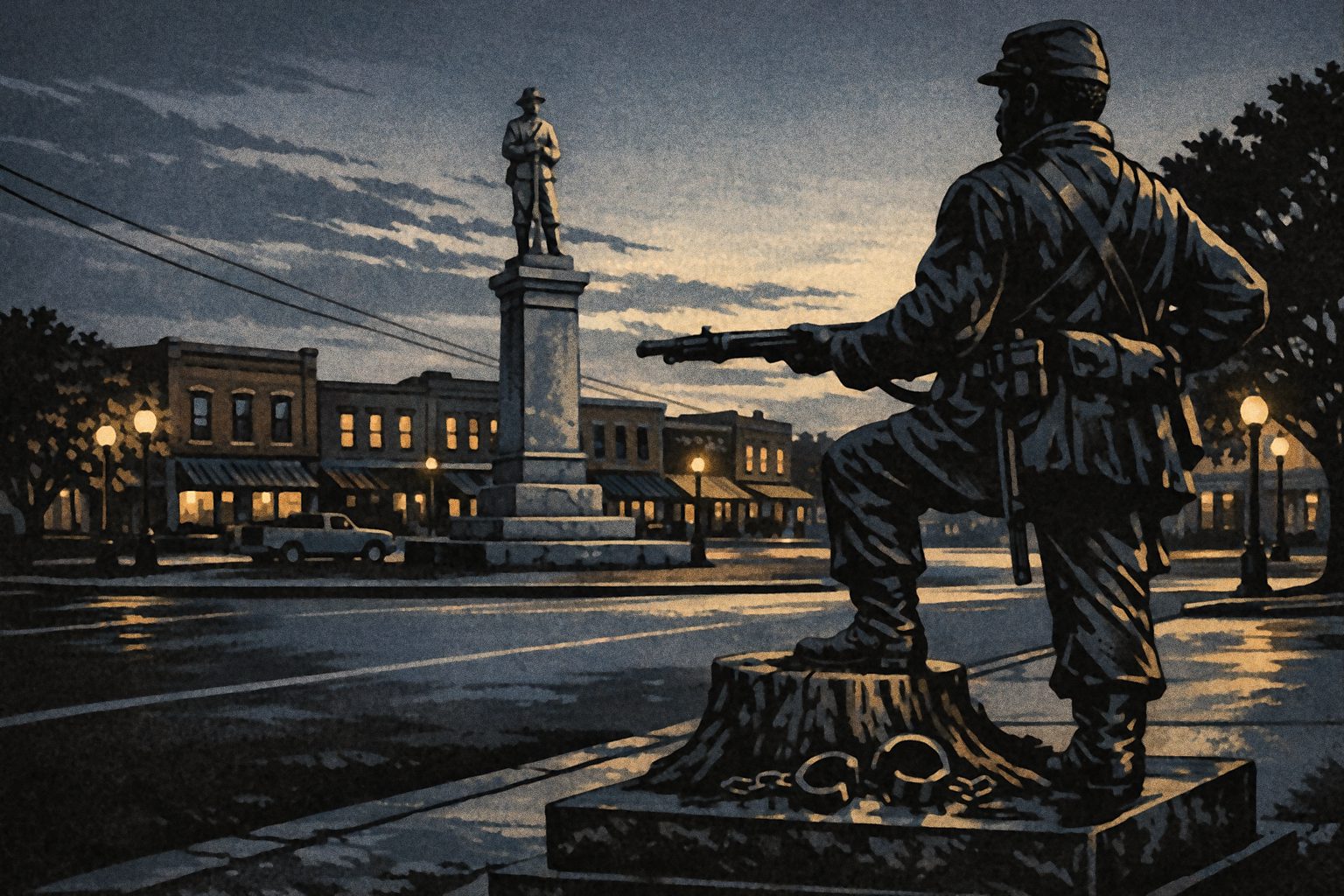 Nothing taken away. The missing part added.
Nobody is punished by those markers. Everyone they describe is long dead, and much of what they describe was legal when it happened. That’s the firmness left when there’s nobody to try: the record. Say what happened, in plain words, where people have to walk past it. The markers record acts. People were sold here.
Nobody’s ancestors were erased. Nobody’s suffering was left out. Two soldiers stand across the street from each other in my town, and between them they carry the first three parts of Lincoln’s sentence. The North wrote that sentence. In Nashville and in Franklin, the South showed how to live it. Eventually.
As God gives us to see the right
The fourth phrase is the one winners skip.
As God gives us to see the right. Lincoln said it at the moment he’d been proven right in the most terrible way imaginable. And he chose that moment to admit that he could see the right only as far as he’d been given to see it.
Earlier in the same speech, he said something even harder. Both sides, he said, “read the same Bible and pray to the same God, and each invokes His aid against the other.” And then: “let us judge not, that we be not judged.” He wasn’t saying both sides were equally right. He had just spent four years, his entire presidency, saying otherwise. He was saying that being right doesn’t make you righteous, and that the winners are the ones most likely to confuse the two. I’ve been right about things and insufferable about them in the same afternoon.
I don’t share Lincoln’s faith, as I’ve said elsewhere, and I’ve leaned on his sentence anyway. You don’t need his God to keep his humility. Whatever we credit for our sense of right, whether it’s scripture or conscience or the way we were raised, we can still be wrong about part of it. Three pastors in my town walked into a meeting sure the statue had to come down, and what they built instead was better than what they came for. Nobody needs a win to forget that, though whoever just won is the most tempted. I was on the receiving end of that certainty in a hospital two years ago, and I’ve caught my own list sliding from acts to a “them” since. That’s why the test sends my list to a court and not to me. A court is how someone who might be wrong still gets to be firm. Holding conviction and doubt at once is the hardest thing in the sentence, and Lincoln didn’t pretend otherwise. His verb was strive.
To finish the work we are in
Lincoln’s sentence doesn’t stop at seeing the right. It goes on to the work: bind up the nation’s wounds, and care for “him who shall have borne the battle,” and for his widow and his orphan. It turns to the people the fight cost.
That answers the thing I confessed up top. The wanting I described looks back, at what was done and who did it. Lincoln’s sentence looks somewhere else, at the people who bore the cost. Reconstruction didn’t fail because too few generals hanged. It failed because the people the war had been fought over were left alone with the men who’d lost it. Nashville’s marchers knew the difference. They asked for the lunch counters. The first question for a winner is who you’re going to protect. How hard to hit comes second.
So a win leaves three sets of people in front of you. The ones who voted the other way keep their horses. They’re countrymen, they did nothing a court would recognize, and what you owe them is what you think was wrong, said to their faces. They owe you the same. The ones who did things answer for them, by name, under the old laws, and they’re countrymen before and after. What no law reaches still goes on the record, the way five markers on a town square put it there. First come the ones the things were done to. The measure of the win is whether they’re better off a year from now, and only after that whether anything on your list has been answered for.
Some of the people who lost will call any accounting vengeance, however it’s done. Appomattox didn’t buy Gordon’s consent either. The sentence was never addressed to the losers. It was addressed to the winners, and this month that’s me in most of the country and my neighbors here at home.
Nothing in this story stayed won by itself. Not the surrender, not the amendments, not the counters. Every one of them had to be kept by somebody the year after, and the years nobody did are when it came apart.
The last thing the sentence asks for is “a just and lasting peace among ourselves.” It takes both words. The bargain of 1877 lasted most of a century, and it wasn’t just. Versailles called itself just, and lasted twenty years. Firmness is how a peace gets to be just, charity is how it gets to last, and neither can do the other’s job.
So if the people you voted for just won, whoever they were: let the people who lost keep their horses, even the ones who called you “them.” Hold people to what they did, by name, and never to what kind of people they are. Know who your win was for, and look in on them after the celebrating stops. And remember that you might be wrong.
In the spring of 1865, thousands of men in gray walked home from Virginia leading horses they’d been allowed to keep. Most of them were farmers. That same spring, along the Carolina and Georgia coast, freed families were working land they’d been promised, and most would not be allowed to keep it. It was April. There was still time to plant.
This is the first piece of a longer project, Bless Our Hearts, about the South, my hometown, and the kind of character my great-grandfather meant when he said he voted for the man, not the party. Bless our hearts.