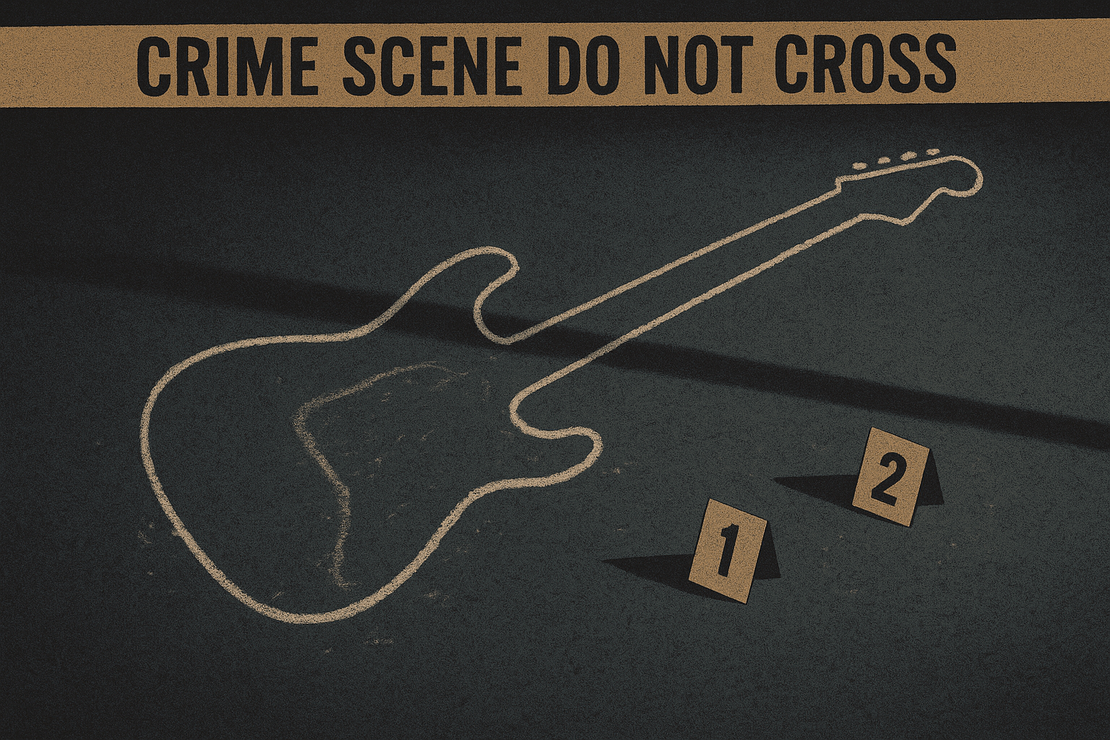
You Can't Police a Groove
Music spent a decade trying to legally police influence, in a medium where the units are unusually legible. It went badly, in ways worth knowing before we try the same thing on everything at once.
In 2023 Ed Sheeran stood outside a Manhattan courthouse, having just won, and said that if the verdict had gone the other way he would have quit music for good. He had spent years and a reported fortune defending a four-chord progression and a backbeat against the estate of Marvin Gaye. Not a stolen melody, not a lifted lyric, not even Marvin’s 1964 passport. At issue was a chord pattern that sits under a thousand songs and predates copyright (and Marvin Gaye) by centuries. The man was, in effect, on trial for four chords and the rhythm that connects them. How did we build a world where you can be hauled into federal court over a sequence older than recorded sound?
The answer is that we decided to put a fence around inspiration, and we built the first one in music. The experiment is worth studying, because music is the easy case, each song an equation of sorts. It has discrete, countable units, notes and chords and bars, and centuries of doctrine for handling them. If a clean line between influence and infringement could be drawn anywhere, it could be drawn here. Yet it couldn’t. And that should worry anyone who wants to draw the same line around artificial intelligence.
A word on why a software developer who builds AI-assisted creative tools is the one telling you about music lawsuits. I’m not a musicologist or an entertainment lawyer. But I’m not a stranger to intellectual property either: I worked through the patent and copyright questions firsthand to bring two tabletop games to market, so I’ve seen from the inside how this machinery treats the makers it claims to protect. And my own work is now sitting in the middle of the current fight: I have forty-seven books in the training data and a claim filed in the settlement over it, and right now there is a serious push, in courtrooms and in legislatures, to make the training of an AI model on copyrighted work an act of infringement in itself. That is the live question, the one that decides whether the tools I and a lot of other people build remain legal to make. So I went looking for what actually happens when the law tries to police influence rather than copying, and found I didn’t have to guess or hypothesize. We’ve been here before. Music already ran the experiment, in public, over more than a decade, and reached a verdict.
This is the companion to an earlier piece about the ethics of borrowing, which asked whether AI-assisted work is honestly yours. This one is about the law, and a blunter claim: when you try to police borrowing, you in fact don’t protect creators. You terrify them. Music is the proof, and it’s worth thinking about before we aim the same machinery at everything.
The overreach
The case that opened the door was Blurred Lines. In 2015 a jury found that Pharrell Williams and Robin Thicke owed the Marvin Gaye estate millions, and in 2018 the Ninth Circuit affirmed it, 2 to 1, for a final figure around $5.3 million. Read the complaint carefully and notice what the infringement was not. It was not a copied melody or a borrowed lyric. The two songs share no such thing. What “Blurred Lines” took from Gaye’s “Got to Give It Up” was the feel: the cowbell, the falsetto, the party-in-the-background vibe, the era. That feel is amazing but Marvin never had a unique claim to cowbell or background party.
Judge Jacqueline Nguyen said so in dissent, and her words are the whole argument in one sentence. The majority, she wrote, “allows the Gayes to accomplish what no one has done before: copyright a musical style.” She called it “a devastating blow to future musicians and composers everywhere.” That is the move to watch, because it is the move everyone repeats. Policing influence means policing groove, era, vibe, the exact layer copyright was always built to leave free. The melody you can own. The feeling of summer is supposed to belong to everyone.
When fear prices itself in
Here is the thing about a bad precedent: the courts don’t have to keep ruling for the damage to spread. The risk alone does it. That’s really the whole idea of how legal precedents work.
Olivia Rodrigo did not lose a lawsuit. She gave her songs away preemptively. After fans noticed that “good 4 u” rhymed structurally with Paramore’s “Misery Business,” she added Hayley Williams and Josh Farro to the writing credits. After others heard her “deja vu” leaning on Taylor Swift’s “Cruel Summer,” she added Swift, Jack Antonoff, and St. Vincent. No suit was filed in either case. She handed over a share of two hit songs to avoid the possibility of one. Retroactive credit-sharing is now ordinary defensive practice across pop, lawyers stapling names to songs the way you’d buy insurance.
Sam Smith handed Tom Petty a writing credit on “Stay With Me” after its chorus turned out to echo “I Won’t Back Down,” a song Smith said he had never knowingly heard. Once “I don’t think I copied this” stops working as a defense, the tax isn’t really about theft anymore.
It is worth being precise about what that is, because it can look like justice. It isn’t. It is fear pricing itself in. Artists now formally credit, as theft, the kind of absorption an earlier generation would have called influence and been proud of, because the line between the two stopped being predictable enough to risk. The same Rodrigo who, in the other essay, got a gracious shrug from Elvis Costello when she borrowed his riff is, on her own records, paying tribute at gunpoint. That is what a chilling effect actually looks like from the inside. Not a ban. A tax on inspiration, collected in advance.
The system tried to correct itself
To be fair, this story is not all alarm. The same courts partly walked it back, and conceding that is what keeps this honest.
In 2020 the Ninth Circuit, sitting en banc, cleared Led Zeppelin’s “Stairway to Heaven” against the claim that it lifted its opening from Spirit’s instrumental “Taurus.” In doing so the court killed a doctrine called the inverse-ratio rule: the idea that the more clearly you could prove an artist had access to a work, the less similarity you needed to show to prove they copied it. Notice what got hauled in. “Stairway to Heaven” is about the most-played rock song in the history of FM radio, the riff so overfamiliar that Wayne’s World gave a guitar shop a sign reading “NO STAIRWAY TO HEAVEN.” If the song everyone has heard a thousand times can be dragged into federal court as a possible theft, nobody is safe. Now sit with how that rule maps onto AI. A model has maximal access; it has, in some sense, heard everything. Under an inverse-ratio logic, exposure alone starts to look like guilt, and a system that has read the whole library is guilty of everything by default. It is the jurisprudence of the kid standing nearest the broken lamp. Burying that rule was a quiet act of sanity. Thank you, Ninth Circuit.
The courts then leaned on Stairway to throw out the $2.8 million verdict against Katy Perry’s “Dark Horse,” on the ground that the disputed little repeating figure was a commonplace building block, not protectable expression. Two principles came out of that stretch and they are good ones: you cannot own the basic vocabulary, and access is not the same as guilt. The system, eventually, found its way back toward something workable. But notice the cost of getting there. A decade of litigation. Verdicts that swung on the makeup of a jury and which side’s musicologist was more persuasive on the day. Careers spent in deposition instead of in the studio. We’re all the poorer for that.
The easy case we still failed
Step back and total it up. In music, with its finite and legible units and its centuries of precedent, with everything stacked in favor of drawing a clean line, we still could not reliably tell influence from infringement. The same chord progression was a crime in one courtroom and common property in another. If the line is unworkable there, it is hopeless for prose, where the units are softer, and for images, softer still, and it is simply incoherent for training, which is influence with no discrete copied unit at all, just statistical residue spread across millions of works.
This is the part people get backwards. “Music is different,” someone always says, “it has countable units, it’s the easy case, your analogy fails.” Exactly backwards. It being the easy case is the entire point. We had the best possible conditions to build this fence well, and it still fell on the people it was meant to protect. That is not a reason to expect it would go better with harder materials. It is a warning.
And to be clear about what I’m not saying: I am not saying infringement never happens, or that every one of these plaintiffs was acting in bad faith. Some surely had a real grievance. Vanilla Ice built “Ice Ice Baby” on the actual bassline of Queen and Bowie’s “Under Pressure,” a real and recognizable unit lifted whole, and it resolved the way clean cases do: a quiet settlement and a credit, no decade in court. That is the tell. The lifts you can name get handled; the trials and the chilling verdicts come from the cases where there was never a copied unit to point at, only a feel. The failure isn’t that the suits existed. It’s that the standard became unpredictable enough to chill the innocent, and a rule that frightens the honest while the well-funded litigate their way through is a broken rule even when some individual plaintiff deserved to win.
The road not taken
There is a functioning version of this ecosystem, and the other essay is built around it: Costello handing out the receipts for his own borrowing and calling it the job, two generations of debt acknowledged without a lawyer in the room. Stand-up comedy runs on the same honor system with even less legal backing: a comic will break mid-joke to say “to steal a bit from Birbiglia,” and that spoken credit does the policing no court ever could. An entire profession keeps itself honest on reputation alone. A culture that treats influence as the engine out-creates one that treats it as a tort, every time. That is the road we keep choosing not to take, and it costs us nothing to take it except the comfort of pretending our own work came from nowhere.
 Chuck Berry to Dylan to Costello to Rodrigo — two generations of acknowledged debt, and no original at the bottom.
The same fence, around everything
Which brings us to the live proposal, the one to make AI training itself an act of infringement. Strip away the framing and look at the mechanism, because the mechanism is the thing music already tested. It is the Blurred Lines instinct at planetary scale: police influence rather than copying, presume guilt from access, and let whoever can afford the better lawyer set the terms for everyone else. It would chill creation far more than it protected, and it would manufacture the same defensive-crediting absurdity Rodrigo is already living, except metastasized across the entire corpus of human expression. Every model output would arrive trailing the legal equivalent of a paternity test.
None of this means the artists’ grievance is imaginary. It isn’t. The companion essay argued that a human absorbing a sitcom and a model trained on ten thousand novels don’t differ in kind — both absorb and recombine — and I stand by that where authorship is concerned. But kind isn’t the only axis. AI removes a friction that used to keep borrowing fair, the natural limits of human speed and scale, and on that axis the difference in degree is enormous enough to matter. It settles nothing about whether the work is authored. It settles a lot about whether compensation is owed. That loss is real and worth answering. But the answer has to be a mechanism that actually fits the problem: compensation routed back to the people whose work fed the models, and ideally public or commons infrastructure so the value isn’t simply enclosed by whoever trained fastest. The answer is not the one weapon we have already watched misfire in the one domain where we had the cleanest possible shot at aiming it.
We tried to put a fence around inspiration. We built it in the place we had the best tools to build it well, and it still fell on the people it was supposed to protect. Doing it again, around everything, is not a plan. It is the same mistake with a much bigger blast radius.