You Can't Relic a Life
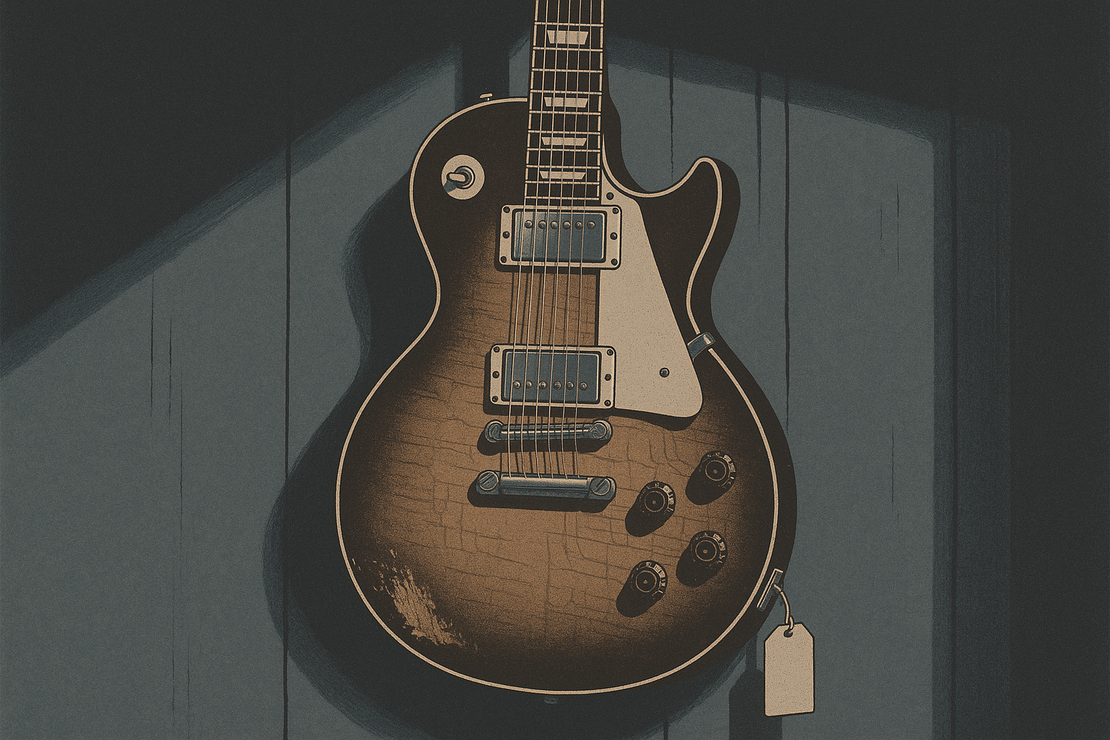
A brand-new guitar, factory-aged to look like it survived forty years of gigs. You can buy the wear. You can't buy the years that earned it, and I'm no longer certain anyone still checks.
There’s a kind of Les Paul guitar that looks like somebody played the life out of it. Sunburst, the finish checked into a thousand hairline cracks the way old nitro lacquer goes after enough cold nights. A worn patch on the back of the neck shaped like a hand. The gold on the hardware dulled to a tarnished green. Around the back, a belt buckle has rubbed a soft crater through the lacquer, down to bare wood, the kind of wear you only get from a few thousand nights standing up with the thing slung low.
None of it ever happened. Gibson builds them like that brand new, distressed to order, and I’ve struggled with it the same way I’ve struggled with AI.
A luthier named Tom Murphy got famous doing this on purpose. The aging work he pioneered at Gibson is good enough to have its own name on the price tag, and people line up to pay a premium for a guitar that shows up pre-haunted: checked, worn, buckle-rashed, dinged in exactly the places a real life would have dinged it. None of this is a sneer. The work is genuinely beautiful, Murphy is an artist, and the people who do this kind of aging are some of the most skilled hands in the building. I own guitars I haven’t come close to earning. I’m a beginner, and I know it.
But stand in front of one long enough and the strangeness gets under your skin. Every mark on it is a memory of something that never happened. The buckle crater vouches for shows it never played. The hand-shaped patch on the neck remembers a hand that was never there. You’re looking at the receipt for a life the instrument never lived, printed at the factory and sold to you as the look of having been somewhere. A forger can buy genuinely old paint and still get caught, because the one thing he can’t fake is the age of the act itself. Same here. You can buy the wear. The years that put it there were never for sale.
Effort was never it
I keep getting the next part wrong, and I think most of the people arguing about AI get it wrong the same way. We assume the thing worth protecting is the labor. The hours. Time served. The sheer human work the machine skips when it returns in four seconds what would have cost me a weekend, or in the case of the Les Paul a few decades of playing. That’s the e-bike thing, the veteran rider watching somebody float up the climb he’s been bleeding on for years, now with a motor. I feel it in my chest as much as anyone. It seems obvious that the value is the effort.
Then I think about “Yesterday.”
Paul McCartney woke up one morning with the whole melody already in his head. He’s told the story plenty of times: it arrived in a dream, fully formed, and he was so sure he’d accidentally stolen it from someone that he spent weeks playing it for people, asking if they recognized it. The working lyric was scrambled eggs, oh my baby how I love your legs. The most-covered song in the history of recorded music cost its writer roughly the effort of a long yawn.
So the labor isn’t the thing. If value tracked sweat, “Yesterday” would be essentially worthless, and instead it’s worth the catalog. Whatever we’re actually paying for, it slept in and wrote it down before breakfast.
Two different wells
The next reflex is to say it’s skill. Craft. The forty years of practice stacked under the one easy minute, the taste that lets a master throw something out fast because he already knows. I’ve made that argument myself, more than once. Taste is real, and most of what I write circles how you earn it.
But it still isn’t the whole story.
You do not have to be a virtuoso to write a song that takes the floor out from under a person. Some of the most gutting records ever made came from people who could barely play, but they had three chords and one unbearable thing that had happened to them. And a great deal of immaculate, conservatory-grade music slides right off you, flawless and weightless at once, because whoever made it had the hands and not the wound. Skill and the thing I’m pointing at can be separated cleanly. They’re two different wells, and you can draw deep from one with the other bone dry.
The second well is lived experience. Having actually loved somebody and lost them. Having buried a parent, detonated a marriage, sat in the specific silence of a house after someone’s gone out of it for good. A love song assembled by a machine is an average of every love song, built by something that has never once stood in a driveway watching the taillights go. We feel that absence even when we can’t name it: the missing person who paid for the words in the only currency that counts.
 The only currency that counts.
Bob Dylan built Blood on the Tracks out of his own divorce and then spent years refusing to call it personal. He doesn’t write confessional songs, he kept insisting, even as his own son would later hear his parents’ marriage coming apart all over the record. The one thing he’d own was a bafflement at the people on the other end: “A lot of people tell me they enjoy that album. It’s hard for me to relate to that. I mean … people enjoying that type of pain, you know?” He paid for those songs in full. The rest of us just press play.
George Jones ran the experiment from the other direction. “He Stopped Loving Her Today,” the record polls keep naming the greatest country song ever made, is three chords and a funeral, and none of it happened to anyone. Bobby Braddock and Curly Putman, two Nashville pros, invented the man who loved her till the day he died; the producer kept sending drafts back until they killed him at the right moment. Jones hated it. He bet his producer nobody would buy “that morbid son of a bitch,” and he was in such ruin when they cut it — the bottle, the cocaine, the divorce from Tammy Wynette that every listener could hear him not singing about — that the closing recitation went to tape a year and a half after the first verse. The grief in that song is fiction. The wreckage in the voice was all too real, and all his. He never stood at that funeral. He brought his own dead thing to it, and the fiction rang like a bell. So the well and the song don’t have to match. A song can borrow its story, and the machine can even write one. The ache underneath still has to come out of somebody, and that was the one part of the record nobody could assemble.
There’s a scene in Good Will Hunting that has been making this exact argument for almost thirty years, and somehow we forgot to bring it to the fight. Robin Williams, on the park bench, telling the genius kid that he can recite every art critic who ever lived but he’s never stood under the Sistine ceiling and looked up. That he could quote sonnets about love all afternoon and never once have been so vulnerable with a woman that the thought of losing her stopped his breath. The kid knows everything and has lived nothing. It’s the most honest thing anyone has yet said about a machine that has read the entire internet and held no one’s hand while they died.
The forger is the artist now
Here’s where it folds back on itself and stops being comfortable.
Aging a guitar convincingly is a craft, and a hard one. Murphy is revered precisely for being world-class at manufacturing the evidence of a life that wasn’t lived. The forger of the receipt is the celebrated artist. And that’s one short step from where this is all plainly heading: somebody builds a real reputation by having the machine generate the thing, lays a little genuine human flourish over the top, and sells the result at a steep markup. The relic’d guitar is the proof of concept, already on the wall, already moving units. We’ve been revering people for faking the wear well for a while now.
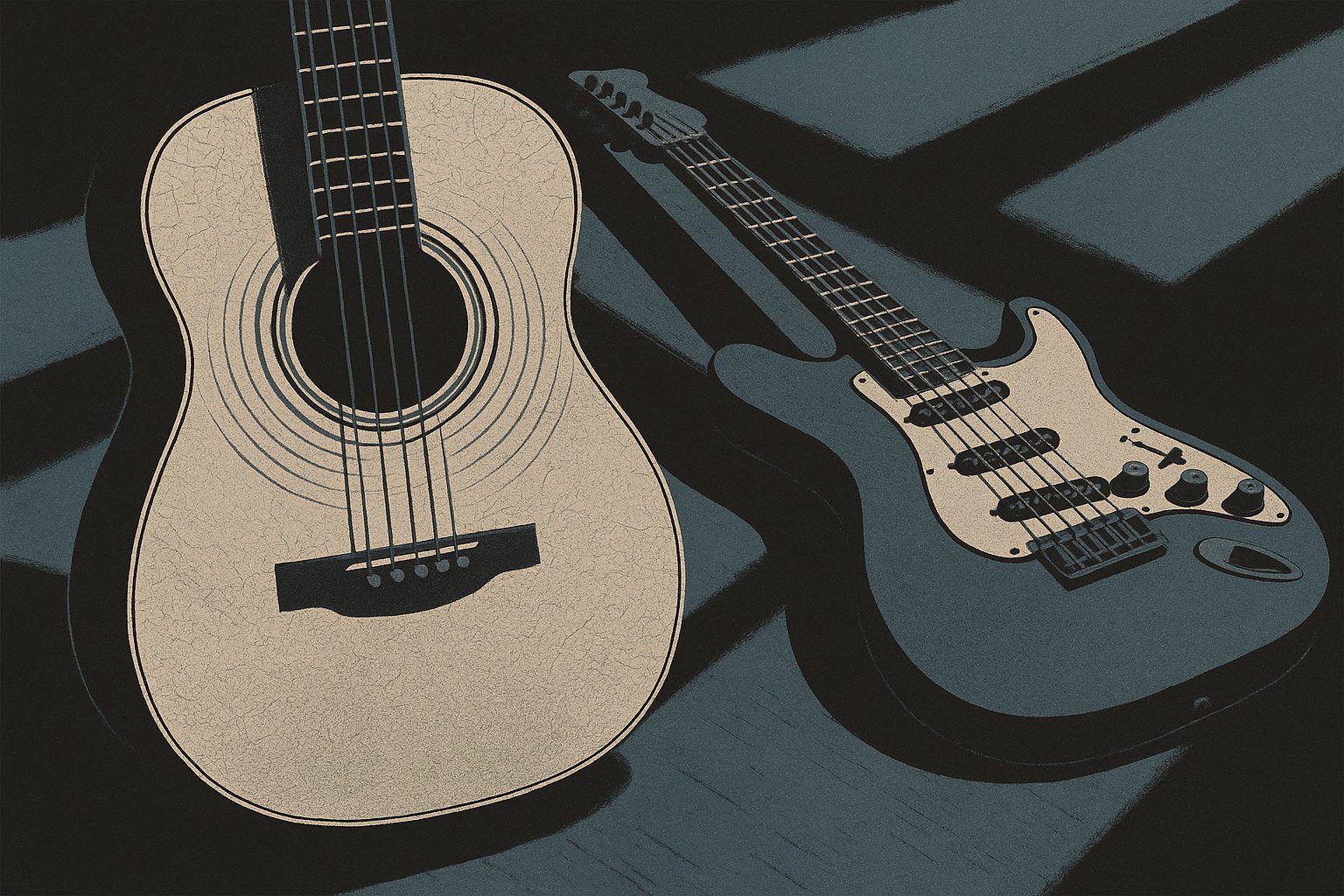
Murphy would understandably push back on the word forger, and he’d have physics behind him. In his telling there are two different jobs hiding under the one price tag. Distressing is the costume half: the dings, the rash, the worn patch on the neck, cosmetic by his own account, there for vibe and feel. Aging is the checked lacquer itself, and he means something mechanical by it. A fresh coat of nitro is a hard shell that grips the wood. His brittle formula checks into those thousands of hairline cracks, the shell lets go, and the wood underneath is free to move. “With that checked finish, the acoustic guitar — which is a box that vibrates — really rings,” he said when Gibson started aging its acoustics. On an acoustic he’s right, and it isn’t close. The top of an acoustic is a soundboard, finish audibly matters there, luthiers have known it for a century, and Gibson now goes further and bakes the tops before they ship, running decades of wood chemistry forward in an oven. On that side of the shop the factory has quietly started selling actual years.
The guitar I opened with is a Les Paul, though. A solid plank with magnets on it, and the plank is where the defense thins out. Plugged in, the pickups read the strings; whatever the freed wood contributes reaches the amplifier as a rounding error. I can’t hear it myself, and for once I don’t have to: the people who measure these things keep finding next to nothing. The same crackle that opens up a J-45 is mostly a look on a solid-body. So the heavy-relic’d electric turns out to be the purest object in the whole building, because almost every dollar of the premium is buying biography.
 Function on the box, story on the plank.
I can’t find a clean way to really take issue with any of it, which is exactly why it nags at me. Murphy’s work is honest about being a finish. Nobody at the counter believes the buckle rash is a true story. Maybe that’s the whole line, and it’s fine as long as everyone knows. The trouble with the machine is that soon enough no one will.
We were already wearing the cowboy hat
We were cheating long before the machine showed up, anyway.
Country music is at least partially guys who moved to Nashville from a cul-de-sac in Connecticut, bought a cowboy hat, taught themselves a twang, and started writing about a dirt road they first laid eyes on at twenty-six. It sells enormously. That’s the seller’s version of the cheat, a life invented for the audience, the wear painted on where the customers can see it.
The guitar world keeps a slur for the buyer’s version: blues lawyer. The comfortable hobbyist buying his way to the front of a culture whose real cover charge is decades and calluses. The tone he buys is real enough, pickups and amps doing what his fingers haven’t learned yet, and it usually arrives wrapped in the exact kind of relic’d finish I started this with, the sound and the story sold separately. He’s a different animal from the hat act, and the difference matters. Nobody at the counter is fooled; everyone knows what he does for a living. The costume is for himself, bought the way you’d buy any other comfort. And I’m sympathetic. Genuinely. Not everyone has the years to give, and I’m closer to the blues lawyer than the bluesman myself, and I know it.
The posing is real on both sides of the sale, it predates the algorithm, and it ruins every smug thing I’d like to say. The machine didn’t invent the costume. It automated it, and pulled the last human out of the act. We’ve been buying the hat for generations. AI is the cowboy hat, made to order, in your size, instantly, for everyone at once.
The ear is part of the fee
So does the costume fool anybody?
This is where I’d rather be hopeful and have to be honest instead. Mostly, I don’t think it needs to. The comforting story is that the poser always gets found out, that the hollow love song rings hollow and the room empties. I don’t believe it. A small number of people can hear the difference, and they care enormously, and there are not very many of them. Most listeners want a song that does the job, that sounds like heartbreak on the drive home, and have never once asked whether anyone behind it was actually heartbroken. The early returns are already in, and they’re stranger than the scare headline. Late last year an AI act called Breaking Rust ran a track to the top of a Billboard country sales chart. Around the same stretch an AI singer named Xania Monet signed a reported three-million-dollar record deal. No face at the microphone in either case, no hat to buy, no dirt road.
But look at who’s actually behind them, and the machine turns out to have kept the one thing I keep insisting it can’t fake. Breaking Rust’s songs are written by a real producer. Monet’s words are the work of a Mississippi poet who says most of them are her own true stories, and who defends the whole project by calling the singer an extension of herself. The voice is synthetic. The heartbreak isn’t. What got automated was the throat and the craft, and a human still sat in the chair where the loss goes in. Even here, at the leading edge of the thing everybody’s frightened of, nobody dared pull the last person off the well. They faked the singer and kept the sorrow. And the numbers didn’t so much as flinch at the part that was fake.
Here’s the least cynical way I’ve found to put it. The people who can hear what’s missing tend to be the people who paid the same fee. The ear is part of the price. The discernment that lets you feel the seam between an earned ache and a manufactured one is itself something you only get by aching, and making, and failing at it for years. Which means the poser usually can’t tell he’s posing. Hearing it was the part he skipped. The blues lawyer honestly cannot separate his bought tone from an earned one, and he isn’t a fool for it. The ability to tell sat downstream of dues he never paid.
Most of the world will be fine with the relic’d life, and they aren’t shallow for it. Hearing what it’s missing is one more thing you have to live your way into, and most people, reasonably, have better uses for their one life than learning to hear the ghost in a guitar. Two objects, identical to the eye, one wear earned and one printed at the factory. I’ve chased this same gap before with diamonds, where the lab stone and the mined one are the same rock with two different stories, and almost nobody outside the trade can tell, or wants to.
What I keep circling about that relic’d guitar is whether I’d catch the lie if it were ever in my hands, or whether the wear has gotten good enough to beat me. Set one beside a guitar that actually did live through everything its finish claims, some beat-to-death thing a real player hauled through real decades, and I want to believe my hands would know the difference, that the years leave something in the wood the factory can’t reach.
I want to believe that. I’m not certain it’s true, and the trend runs the other way. The factory already prints the look, the checking and the buckle rash and the worn patch where a hand would go. On the acoustic side it bakes the years into the wood itself. One by one the things I could point to are getting crossed off, and what’s left at the bottom of the page is a single line no factory can print. Something happened, to someone, and this thing was there for it. That uncertainty is starting to feel like the actual stake in the whole machine question, the one that has nothing to do with whether the song hits. Whether, a few years from here, we’ll still feel the floor drop when something was real, or whether we’ll have worn that ear smooth the way you wear the finish off a neck, from handling too many beautiful copies.