You're a Bass Player Now
The new mark on this site is traced from a wooden bass bridge Les Paul carved in his home workshop. It reached me through two gifts and one refusal. Nobody charged anybody for any of it.
I tried to give it back.
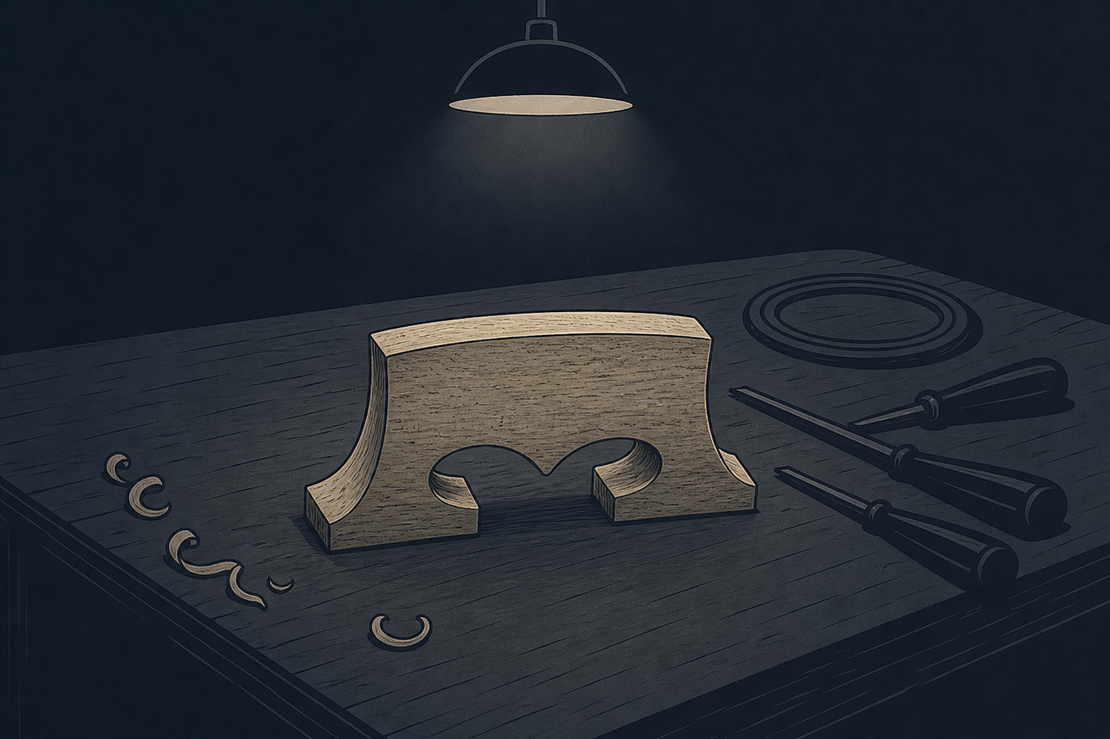
The thing in question is a bass guitar bridge, carved from a pale blond hardwood, small enough to close one hand around. An arc with two feet, a swept crown where the strings would ride, a curl of negative space through the middle. The tool marks are still in it, as are the penciled lines where the sawed curves don’t quite match side to side, because it’s a shop part, and in a working shop you don’t polish a part, you fit it. This one never got fitted. It sat in a box instead, and the box is why I’m writing this.
Les Paul carved it. THE Les Paul.
If you aren’t a guitar person: Les Paul is the guitarist and inventor who gave the world multitrack recording and the solid-body Gibson that’s carried his name since 1952. Jimmy Page, Eric Clapton, Slash, Billy Gibbons, Randy Rhoads…all Les Paul players. A real object from Les Paul’s own hands is a big deal.
The chain
Walk up the chain with me, because the chain is most of the object. Les Paul spent the last decades of his life in Mahwah, New Jersey. During a snowstorm in the early 1980s he called the local police station to ask for help plowing his driveway, and the young cop who volunteered was Jim Wysocki. The plow job turned into a twenty-nine-year friendship, one of the stranger and sweeter stories in guitar lore; Premier Guitar tells it properly. Les received gifts from strangers constantly and gave things away nearly as fast. He once handed Wysocki a Danelectro guitar with the instruction to “put it under your bed for a rainy day.” And before Les died in 2009, he effectively made Wysocki the caretaker of his collection of guitars and parts, getting a promise back: people would be able to see it, touch it, and play it. Wysocki has kept the deal ever since, running the collection the way Les ran his living room, with the stuff in reach.
One of the things Wysocki has passed along in that spirit is a box of parts from Les’s home workshop. He gave it to my friend Jim DeCola, a master luthier at Gibson.
And Jim gave a piece of it to me.
The membership card
I need you to understand how uncomfortable this made me. I understood what I was holding, and I handed it back. I told him I couldn’t take it. That I had no business having it. This was a meaningful piece of music history being casually handed to an abject music beginner.
He put it back in my hand. “It’s yours. You’re a bass player now.”
Here’s what you need to know about that sentence: Jim knows exactly how bad I am. I had only just picked the thing up, and I may be a Music City native but that’s the precise extent of my musical ability. Bottom rung. The lowest occupied position on any ladder of musical skill, the guy the word “aspiring” was invented to flatter. He also knows that I care a lot about the instrument, I’m constantly asking questions of my more musical friends, including him, and I badly want to improve. Apparently that was the entire qualification. He was issuing a membership card, and he was issuing it the way skateboarding issues them.
I neglected to add that he handed me the bridge after a skateboard session, us standing there sweaty in the parking lot talking about music. Jim skates, which I’ve decided is not incidental — you’re a skater the first day you step on a board. Nobody audits you at the gate. The belonging comes first and the skill is your own long meandering path to navigate later, and that ordering is one of the most quietly radical things the culture ever built. Jim and I look up to each other across exactly this line, and I can date the moment I learned the respect ran in both directions.
The concrete bowl
Years ago we were at a contest at a concrete bowl, one of those hectic snake sessions where it’s hard to get in and you keep a run alive once you do. I was on the deck. Jim came up into a 50-50 in front of me with his weight a hair too far out of the bowl, and I could see the bail coming maybe even before he could: I’d watched him deck out of that exact grind a hundred times at local sessions. Nothing dangerous, just a premature end to a run he’d fought to get. There’s a hard rule up there that’s such a given it’s not even a rule. You do not touch a skater mid-trick. Why would you? The consequences of getting it wrong are real, and nobody with sense takes that risk. I reached over anyway and gave his back a gentle shove, just enough weight back into the bowl to save his 50-50. He made the grind and kept the run. He still can’t quite believe I did it, and he still calls it perfectly executed help, and we’ve been laughing about it ever since.
The bridge was the same move in the other direction. I was bailing out of a gift, and he put a hand on my back. Neither of us has ever called any of it a trade, which tells you what kind of economy we’re standing in.
The cash register
I argued in The Diamond Was Always a Story that once a lab can grow the identical stone, the only thing holding the price up is the sentence attached to the rock. So I have to ask the obvious question about my own shelf. As wood, this bridge is worth nothing. A few ounces of shop stock, a functional part for an instrument that was never built. Everything it “is” rides on provenance, which is precisely the thing I spent that essay calling a con.
The difference is the cash register. A premium is a story with a price tag attached, and De Beers spent most of a century renting the billion years of diamond formation out at retail. Nobody in this chain charged anyone anything. Les gave constantly. Wysocki keeps the collection moving through hands instead of sitting behind glass. And Jim, who buys and sells serious guitars and parts as a matter of course, gave a piece of Les Paul’s workbench to a beginner because the beginner loved the instrument. I have never once heard him put a number anywhere near that box, I know in fact he wouldn’t. When provenance travels by gift, there’s nothing to overcharge for and nobody to fool. The story just is the object. Strip the story off a diamond and you still have a diamond. Strip it off this bridge and you’re holding kindling.
The authentication, you’ll notice, is also the chain. No lab report, no laser inscription on the girdle, no origin registry on a blockchain. Three pairs of hands since Les’s, and I can name every one of them. That’s the entire certificate, and it’s the oldest kind there is: the only one that gets more convincing as it gets less formal.
Straight on
Then there’s the part that turned all of this into a design decision. Stand the bridge up and look at it straight on. It’s a letter M. The outer silhouette makes a capital, feet and all, and the cutout through the middle makes a lowercase m in negative space. My initials, twice, in one object, carved decades ago by a man who had no idea he was doing lettering, much less for the lowest ranking member of his trade.
So it’s becoming the mark for this site. I’m tracing it exactly as it is, wobble included. The temptation with a trace is to true it up — even out the curves, match the feet — and what you’d get is a clean little picture of a generic bridge, indistinguishable from clip art, with a backstory the pixels can’t show. The asymmetry is the part Les touched. I wrote a whole essay about wear you can’t buy; the least I can do is decline to sand off the wear I was given. From now on, the small mark in the corner of this site links back to this page, which makes this essay the certificate of authenticity: a story, told free, passed along the same way it arrived.
I still don’t entirely believe I should have it. Jim’s sentence left that objection standing and made it beside the point anyway. The gift was a bet placed in advance, unrepayable by design, and I’ve slowly come to understand that’s the only kind worth making.
Some year down the road, the bridge goes to somebody else. Somebody who loves the instrument out of all proportion to their ability to play it, and who will try to hand it back, because that’s the reflex a thing like this produces in anyone paying attention.
I already know what I’ll say.