The abbot had it printed
Responding to You Probably Won't Read This Article—And That's OK www.oreilly.comRufus Rock has a piece on O’Reilly Radar about what happens when producing credible-looking work gets cheap. He calls it credibility cost collapse. Scarcity used to stand in for quality, badly but well enough, and it has stopped: Daniel Stenberg is buried in curl bug reports that look entirely plausible and aren’t, and Rock cites a 42 percent surge in journal submissions with the quality running the other way.
What he wants is a new gate. His problem is that both available kinds are bad. Human institutional gates entrench whoever is already inside, which kills the thing that made the open version worth having. AI reviewers get built out of the same models producing the flood, so the gate inherits the blind spots of what it’s gating. Turtles, as he says, most of the way down.
His history beat walks right past a man I’d nominate as its mascot.
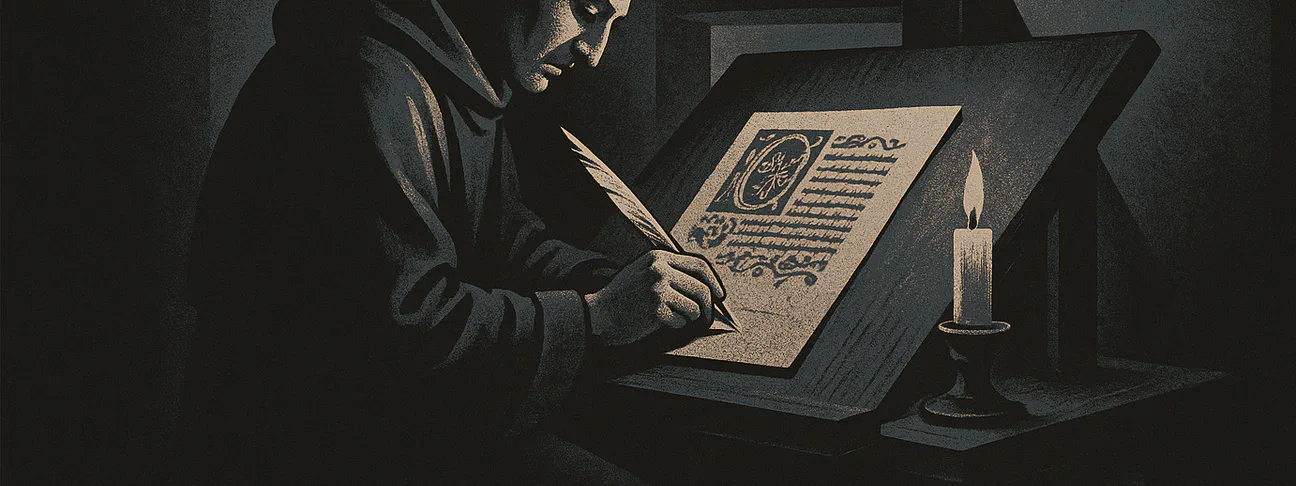
In 1492 Johannes Trithemius, abbot of Sponheim, wrote a passionate defense of the monks who copied books out by hand. Copying was holy work. A stamped page could not hold the devotion of an inked one. Something sacred would die if we let the contraption take over. He called it In Praise of Scribes.
He had it printed.
The joke is good on its own and better with the gate in view. Trithemius wasn’t defending quality in the abstract. Scribal production was slow, expensive, and restricted to people with credentials, and that was the filter: no great screen on accuracy, an enormous one on volume. He reached for the cheap new channel to argue for keeping the costly old one. Every incumbent gate does some version of that when the cost floor drops out from under it, and it’s the first thing I’d watch for in whatever gets built this round. A booth selling hammers, framed with a nail gun.
Rock ends without a solution and says so, which is the honest place to stop. I went at the same collapse from a different angle a few weeks ago, following the money rather than the filter:
 Read the essay
Nobody Told the Scribes
Article 17 of 30 so far in Machined by Hand
The monastic scribes had a good four hundred years, and nobody sent word it was ending. The paid-creator era is a window of the same kind, and the consolation on offer isn't comfort.
Read the essay →
Read the essay
Nobody Told the Scribes
Article 17 of 30 so far in Machined by Hand
The monastic scribes had a good four hundred years, and nobody sent word it was ending. The paid-creator era is a window of the same kind, and the consolation on offer isn't comfort.
Read the essay →Becoming Gnarly, by email