Written just for me
Responding to How AI is Changing the Way We Think agoeldi.medium.comAndreas Goeldi has a piece on Medium that starts from McLuhan’s The Gutenberg Galaxy and climbs the media ladder rung by rung: oral culture, print, broadcast, the feed, and now the chatbot, each one changing what a unit of thought looks like. Most of the walk is familiar but one rung stopped me. For five centuries, print guaranteed that two strangers arguing about a book were arguing about the same book. The page was fixed, quotable, identical in Boston and in Basel, and he credits that one unglamorous property with an enormous share of what followed: science, scholarship, the whole habit of settling a dispute by pointing at a paragraph both parties can see. Print established a shared reality that has recently been undermined by information bubbles, and with AI the undermining may take a wildly more personal turn.
Then his number. Goeldi estimates that 20 to 30 percent of the text he reads on a given day was generated specifically for him. Nobody else will ever read it. Ask the model his question and you’ll get a different answer, tuned to you, shaped by your history with the machine. He calls where this leads private intellectual universes, which feels spot-on with my own experience using AI for thinking help.
The information bubble is the obvious precedent, and it undersells what’s coming. Eli Pariser’s filter bubble worked by selection: the feed chose which pages reached you, but the pages themselves existed, identical for everyone, and a determined reader could always click past the algorithm to the source. AI skips the filter and composes the page itself, fresh for each reader, with no original sitting behind it to click through to. That’s where the quiet risk lives. A system tuned by everything it knows about you doesn’t need to censor a thing to bend your thinking; agreeable is already the house style, and a bubble you can argue with feels like the opposite of a bubble while it confirms everything you walked in believing. Pariser’s bubble you could burst by reading better. I’m not sure this one has an outside.
Goeldi frames the shift as a return to oral culture, thinking as conversation again. That loop is McLuhan’s own: he never drew media history as a ladder so much as a circle, with electronic media re-tribalizing us back into the global village. The rhyme holds right up until it doesn’t. The bard performed to the whole village at once. Everybody heard the same telling, and could correct it, mock it, embellish it, carry it to the next town. This is oral culture with an audience of one — perfectly conversational, perfectly unshared, a cell in the grid that has never existed before. Every institution we use to catch error presumes a common page to point at: peer review, the classroom, the newspaper correction, two friends closing an argument with a Wikipedia link. I don’t know what correction looks like when every page is bespoke. Neither does he, to his credit, and he wrote the piece anyway.
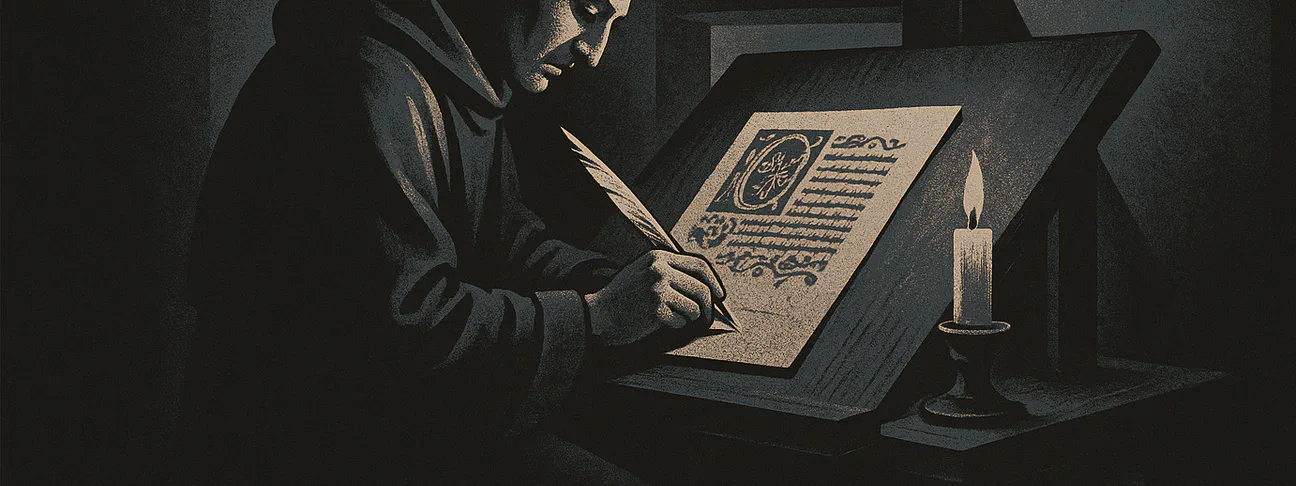
He’s standing at the printing press watching what it did to readers, and what its successor is starting to undo. A few weeks ago I stood at the same press, watching what it did to the people holding the pens:
 Read the essay
Nobody Told the Scribes
Article 17 of 30 so far in Machined by Hand
The monastic scribes had a good four hundred years, and nobody sent word it was ending. The paid-creator era is a window of the same kind, and the consolation on offer isn't comfort.
Read the essay →
Read the essay
Nobody Told the Scribes
Article 17 of 30 so far in Machined by Hand
The monastic scribes had a good four hundred years, and nobody sent word it was ending. The paid-creator era is a window of the same kind, and the consolation on offer isn't comfort.
Read the essay →Becoming Gnarly, by email