Vault · archived work, not current thinking
Checkbook
1989
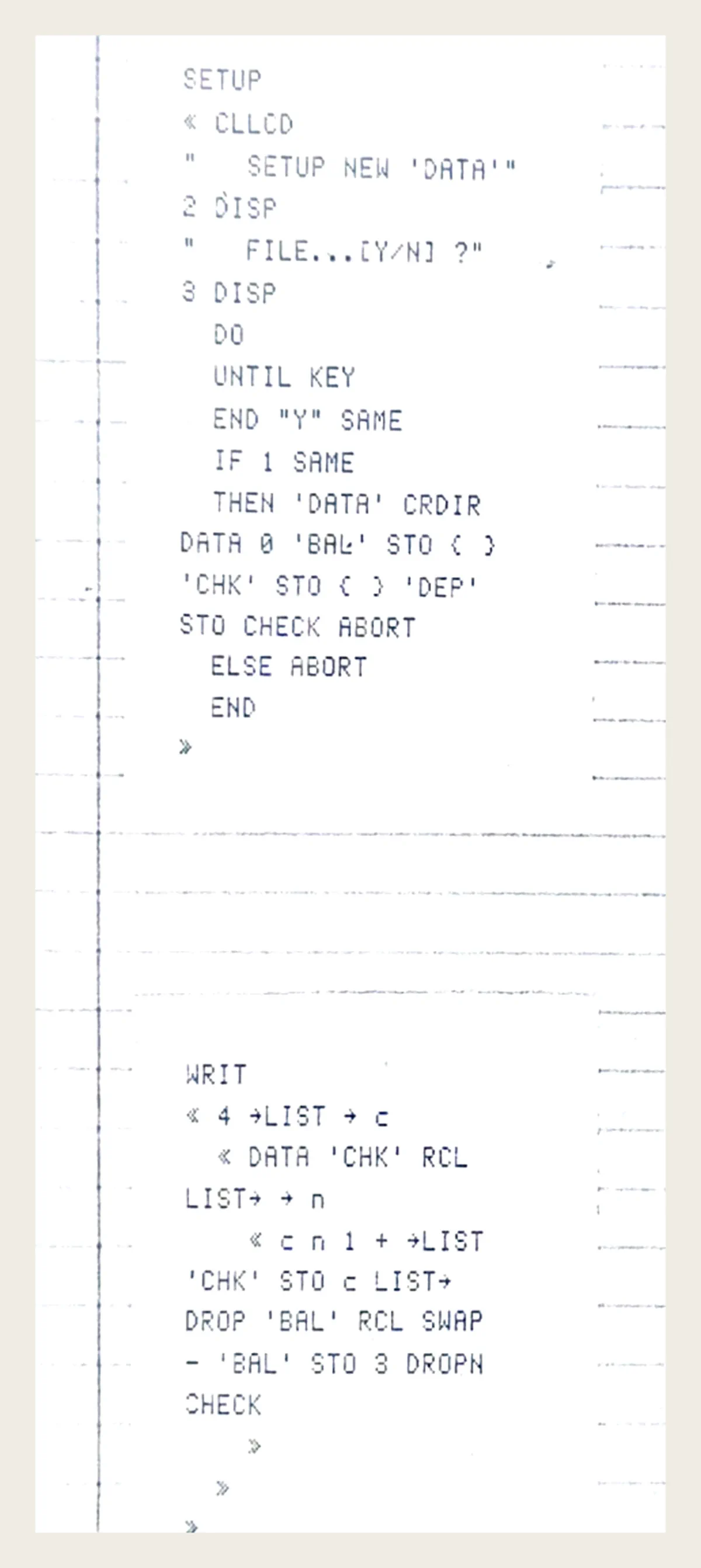
Eight programs that make an HP-28S into a cheque register: SETUP, WRIT, DEPOS, VCHK, VDEP, BALAN, FXBAL, PRINT. No manual page for this one survives — the listings are all there is.
The HP-28S was a pocket calculator. In 1989 it went wherever I went, which is a mundane fact about a calculator and a load-bearing one about a chequebook.
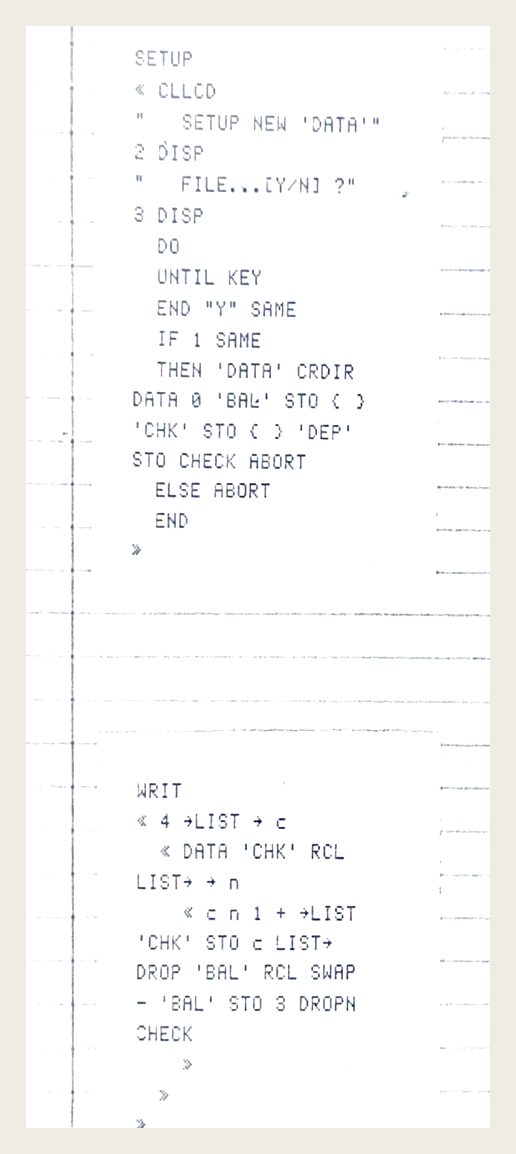 SETUP builds a directory, not a pile of loose variables.
It’s the most carefully built thing in the notebook. SETUP doesn’t scatter globals around; it makes a real subdirectory —
THEN 'DATA' CRDIR DATA 0 'BAL' STO { } 'CHK' STO { } 'DEP' STO CHECK ABORT
— holding a running balance and two lists, one of cheques and one of deposits. Writing a cheque appends it and subtracts from the balance in the same breath, so the balance is maintained rather than recomputed. VCHK and VDEP page through the registers; any key but ENTER stops. PRINT produces a full statement on the infrared printer: balance, then every cheque, then every deposit.
FXBAL
FXBAL
« DATA 'BAL' STO CHECK
»
Two words and a call. Its entire job is to overwrite the balance with whatever number you hand it.
You only write that program if the calculator and the bank statement have disagreed with each other, and you need a way to say the bank is right. It’s a reconcile function. A game and a drawing tool are what you write to find out what a machine will do; a cheque register with a reconcile function is what you write because you’re carrying the thing and running your actual money on it.
On a calculator with no storage of any kind, where a memory clear meant re-entering every transaction by hand.
Thirty-seven years later
The HP 48SX arrived in March 1990 and fixed the thing that stranded this program: it had a serial port. Two megahertz, expansion slots, infrared and a wire. Anything on that machine could be copied off, which is why HP-48 programs sit on floppy disks in my closet and this one survives because somebody photocopied a notebook.
That is the arc in two calculators. A pocket machine you program on itself, then a pocket machine that can talk to the rest of the world, then a pocket machine that is the rest of the world. The same problem is still open, and I’m still building for it. That one is called Croft, and it runs on a phone.
The pages
- manuscript Two pages of listing, as scanned
- edition The same two pages set in type — listings only, since there is no prose to edit
- source All eight programs, in a file
Two pages of listing and nothing else — no manual, no worked example, no page explaining what FXBAL is for. The telephone directory got all three. So the notebook documents the program a stranger might borrow and leaves the one handling real money undescribed, which reads either as a note about audience or as a note about how fast it got written.
Same machine, same year, same notebook as Space Chase, Doodle and the Telephone Directory.