Vault · archived work, not current thinking
Telephone Directory
1989
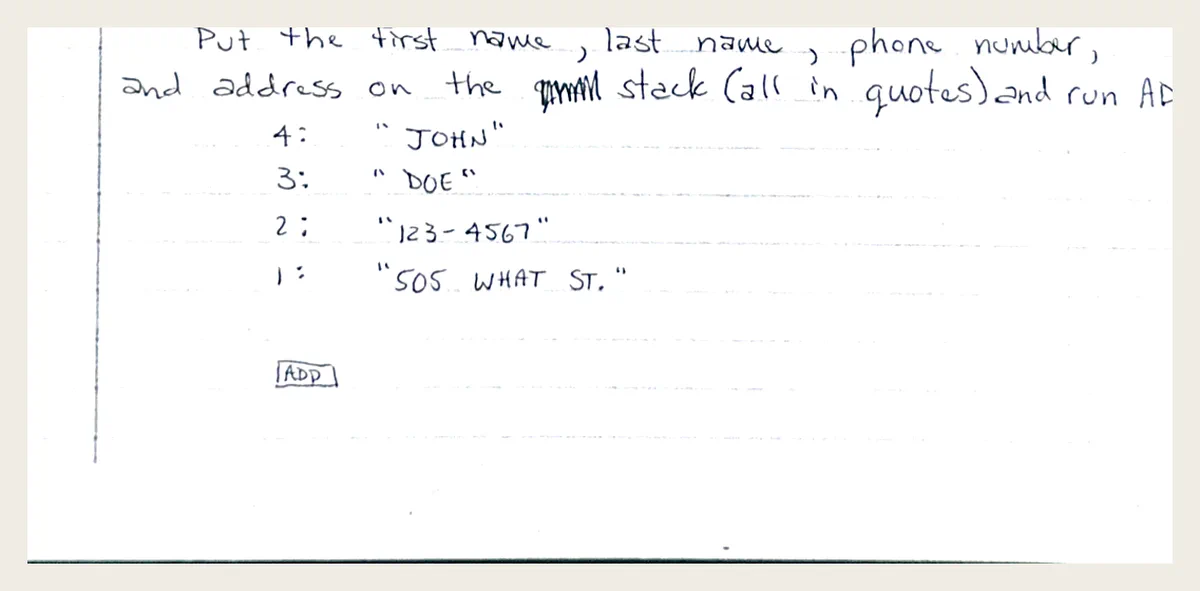
Six programs — SETUP, VIEW, FIND, ADD, DEL, PRINT — that turn an HP-28S into an address book. Four fields per person: first name, last name, phone number, address. You put them on the stack in that order, in quotes, and run ADD.
In 1989 an HP-28S was what a student had instead of a computer in a bag. Mine went to class, to the lab, and to wherever I was going to need a phone number.
The clamshell opens onto two full keypads. On the right, a scientific calculator. On the left, an alphabetic keyboard — laid out in alphabetical order rather than QWERTY, because Hewlett-Packard was not pretending this was a typewriter. That left half is the entire reason an address book is possible here. Without letters you have a machine that can hold a phone number and nothing to call it by.
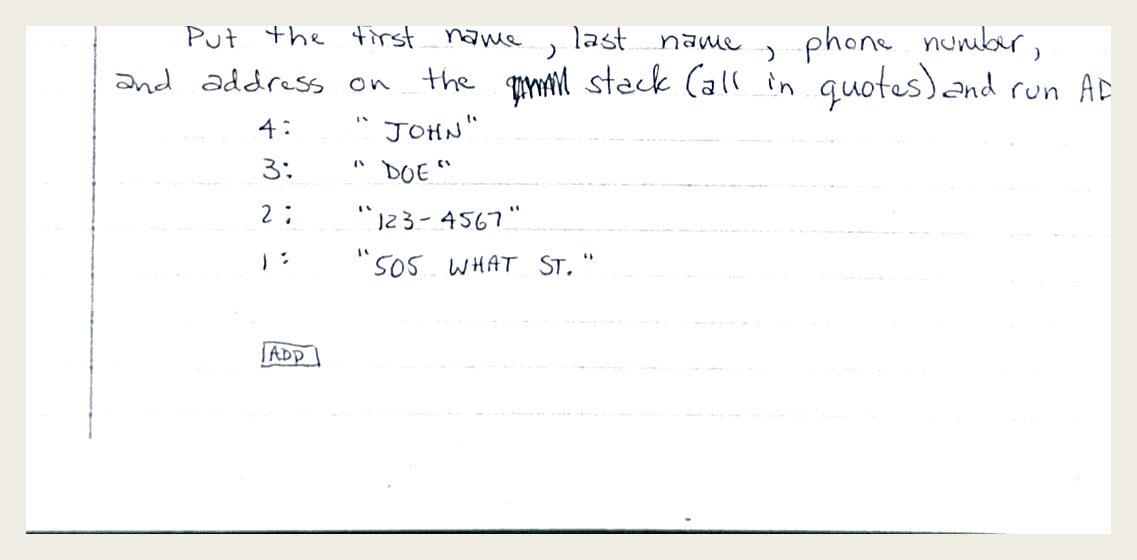 Four strings on the stack, then ADD. The manual's own example.
The neat part is VIEW. Give it a field number and it pulls that field out of every entry, then calls MENU:
ELSE 1 d
  START s GET d ROLLD
  NEXT d →LIST MENU s
END
MENU loads the 28S’s own softkey menu — the six boxes across the bottom of the screen, right under the display. So the last names appear as physical buttons, and NEXT pages through them. He didn’t write a picker; he handed the list to the calculator’s menu system and let the hardware be the picker. Then you press USER to get back to the program menu and run FIND.
PRINT sends the lot to an HP infrared printer, which was the machine’s only output of any kind.
What it cost to keep
The 28S had no wire port and no storage. Nothing could be saved anywhere, ever. The address book lived in RAM and nowhere else, which means a memory clear — a dropped calculator, dead batteries, one bad SYSEVAL while writing something else — took the whole thing with it, and the only recovery was typing every name, number and address back in by hand on a calculator keyboard.
Knowing that, someone still built it, still added a delete function, still wrote a printer routine. That is not a demo. That’s a thing you carry.
The pages
- manuscript Five pages as scanned: the manual, two worked examples, and the listings for all six programs
- edition The same document set in type, stack diagrams and all
- source All six programs, in a file
The edition keeps the voice and fixes the slips — “scroll thru”, a plural “Doe’s” — then lists every change at the end, so the two can be held against each other.
One correction is visible on the last manual page: “All of the persons with the last name DOE” is struck out and “The first” written in above it. Whoever wrote it had just discovered what FIND actually does.
This is the best-documented thing in the notebook, and the manual is not decoration. Paper was the distribution channel. The only way to hand somebody this program was to hand them the listing and let them key it in, which is what Selden’s paper did with the others — so a manual page written for a reader who has to type all six programs before anything works is a completely practical document.
Written on the same machine as Space Chase and Doodle, in the same year, in the same handwriting.